Quick answer: Electricians get more calls from Google and AI search by building their Google Business Profile around the jobs they want, setting an honest service area, showing their license and insurance, giving each high-value job its own page, earning fresh reviews within Google’s rules, listing true emergency hours, adding Electrician schema and deciding where Local Services Ads fit.
Key takeaways
- Google ranks local results on relevance, distance and prominence, so a complete, accurate Business Profile is the starting point for every electrician.
- Proof of licensing and insurance matters more than ever: Google’s Local Services Ads now screen electricians for state licenses, insurance and background checks in the US.
- Local Services Ads are moving into the main Google Ads platform through 2027, with business name, address and hours synced from your Business Profile.
- Reviews need to be recent: 74% of US consumers look for reviews from the last three months, according to BrightLocal’s 2026 survey.
- Google says there are no special optimizations needed for AI Overviews or AI Mode. The same local SEO basics feed AI answers too.
What is local SEO for electricians?
Local SEO for electricians is the work that helps an electrical contractor appear when people nearby search for an electrician on Google Search, Google Maps and AI tools. It covers your Google Business Profile, your website’s service and area pages, reviews, business listings and structured data, all aimed at turning local searches into phone calls.
For most electricians, the goal is simple: show up in the map pack and in AI answers when someone searches for a job you do, in a town you cover, and make it easy for them to call. That applies whether you run one van or a team of twenty, and whether you work in the US, UK, Canada, Australia or New Zealand.
How did we choose these 8 moves?
We chose these eight moves because each one is backed by Google’s own guidance, can be done by an electrical contractor or their marketing partner without special tools, and affects calls rather than vanity metrics. We left out tactics that break Google’s rules, such as keyword-stuffed business names or paid reviews, even where they still appear to work for some competitors.
Three questions shaped the list:
- Does Google document it? Every move links back to Google Business Profile Help, Local Services Help or Google Search Central.
- Is it specific to electrical work? We focused on what customers need from an electrician: licensing, safety, urgent call-outs and high-value jobs such as panel upgrades and EV charger installs.
- Can you measure it? Each move should show up in profile calls, website calls, form leads or review counts within a few weeks.
How do the 8 moves compare at a glance?
The eight moves split into profile work, website work and trust signals. Profile changes usually take an hour or two and show up within days. Website pages and schema take longer but keep paying off. The table below shows where each move happens, what it fixes and roughly how much effort it takes.
| Move | Where it happens | What it fixes | Effort |
|---|---|---|---|
| 1. Categories and services | Google Business Profile | Showing up for the right jobs | Low |
| 2. Honest service area | Google Business Profile | Calls from towns you don’t cover | Low |
| 3. License and insurance on show | Website and profile | Trust for customers and AI tools | Low |
| 4. One page per high-value job | Website | Ranking for panel, EV and rewiring searches | Medium |
| 5. Fresh reviews, all answered | Google Business Profile | Prominence and click-through | Ongoing |
| 6. True emergency hours | Profile and website | Missed urgent calls and bad reviews | Low |
| 7. Electrician schema and matching NAP | Website and listings | Mixed signals about who you are | Medium |
| 8. A plan for Local Services Ads | Google Ads | Paying for leads that SEO could win | Medium |
What are the 8 local SEO moves that get electricians more calls?
The eight moves below run roughly in the order we suggest making them. Start with your Google Business Profile, because it feeds the map pack and Local Services Ads. Then build the website pages and trust signals that help Google and AI tools understand which jobs you do, where you do them and why customers can trust you.
1. Build your Business Profile around the jobs you want
Your categories and services tell Google which searches you’re relevant for. Pick “Electrician” as your main category if that’s what your business is, then add only the few extra categories that describe your core work. Next, fill the services list with the jobs you actually want more of, each with a short description.
Google’s guidelines say to “choose the fewest number of categories it takes to describe your overall core business,” and to pick categories that finish the sentence “This business IS a,” not “This business HAS a.” Extra categories that stretch the truth can make your profile less clear, not more visible.
The services list is where you can be specific. Google lets you pick suggested services or add custom ones, and you can add a description and a price to each. Good services to list, if you offer them:
- Panel and fuse box upgrades
- EV charger installation
- Whole-house or partial rewiring
- Generator hookups and transfer switches
- Lighting installation, indoor and outdoor
- Electrical safety inspections and fault finding
Write each description in plain language, with the details a customer would ask about on the phone: what the job involves, whether you handle permits and inspection, and which areas you cover.
2. Set a service area that matches where your vans actually go
Most electricians visit customers rather than having customers visit them, so Google treats you as a service-area business. You should hide your home or yard address and list the cities or postal codes you serve, up to 20 areas, keeping the whole area within about two hours’ drive of your base.
Google’s guidelines say plainly that “if you’re a service-area business, you should hide your business address from customers,” and that a service-area business should have one profile for its whole area. Service areas can’t be drawn as a radius any more. You set them by city, postal code or another area type, and approved edits can take up to 48 hours to appear.
Keep the list honest. Your service area doesn’t decide where you rank, because distance from the searcher still counts, but it does shape the calls you get. Listing towns you rarely visit leads to calls you turn down and customers who feel misled.
3. Show your license and insurance everywhere a customer checks
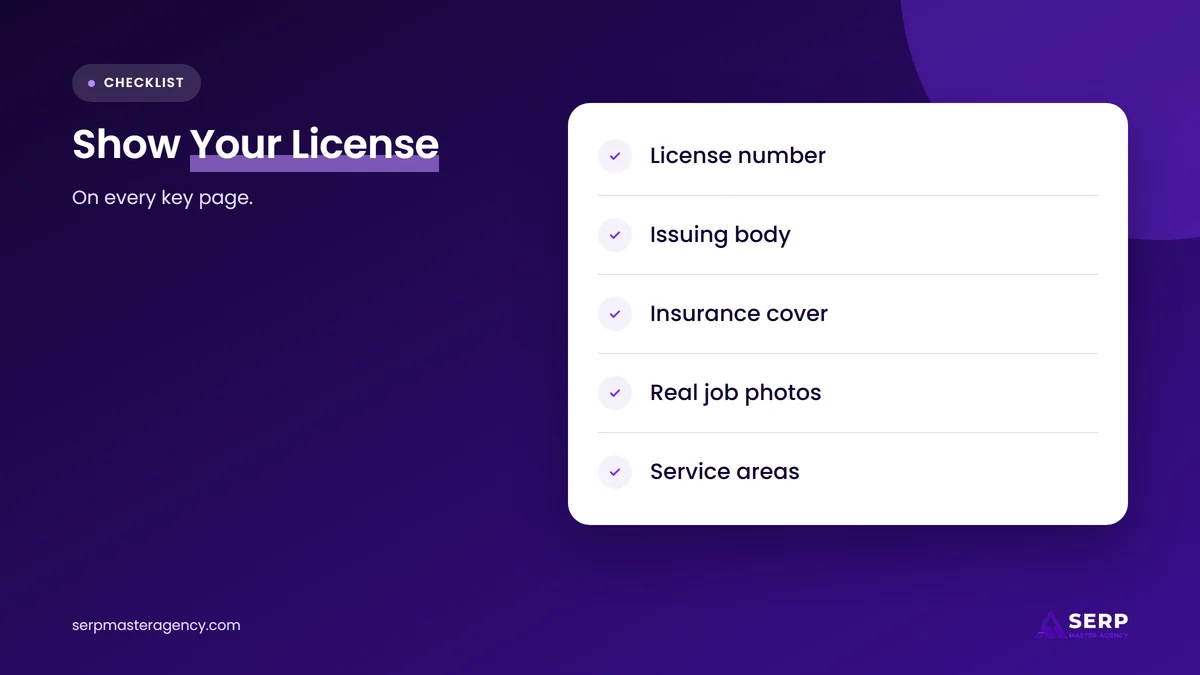
Electrical work is licensed in most places, and customers know it. Put your license number, the issuing body and your insurance details on your website footer, About page and each service page. Make them easy to find on your quote forms and invoices too, so they match everything Google and customers see elsewhere.
Google takes licensing seriously in this trade. Its Local Services Help pages list electricians as an urgent category, where customers have “time-sensitive, urgent needs,” and the US screening for electricians can include a state-level business license, a state-level owner license, general liability insurance and background checks on the business, the owner and the service professionals, where these apply. Not every check applies to every business, but the direction is clear.
The same details help with AI search. When someone asks ChatGPT or Google AI Mode for “a licensed electrician near me,” a page that states your license clearly gives the tool something specific to check against. A vague “fully qualified” line gives it nothing.
4. Give each high-value job its own page
One “Services” page that lists everything rarely ranks for anything. Give each job that brings in good revenue its own page, such as panel upgrades, EV charger installation, rewiring and generator hookups, and answer the questions customers ask before they call: what affects the price, whether a permit is needed, how long it takes and what happens on the day.
These pages do two jobs. They help Google match your site to specific searches, and they give AI Overviews, AI Mode and ChatGPT clear answers to quote. Google says there are “no additional requirements to appear in AI Overviews or AI Mode,” but a page “must be indexed and eligible to be shown in Google Search with a snippet” to be used as a supporting link.
A strong job page for an electrician usually includes:
- A short answer at the top saying what the job is and who it suits.
- The factors that change the price, without promising a figure you can’t stand behind.
- Permit and inspection steps for your area, and who handles them.
- Photos from your own jobs, not stock images.
- The towns where you do this work most often.
- A phone number that is tappable on mobile, plus a short quote form.
Only build pages for work you do regularly. A thin page for a service you offer once a year adds little and can water down the site.
5. Ask every customer for a review, and answer every review
Reviews are part of how Google judges prominence, and they shape whether a searcher calls you or the next electrician. Ask every customer after the job, using your Google review link or a QR code on the invoice, then reply to every review with a short, personal answer. Never pay for reviews or only ask happy customers.
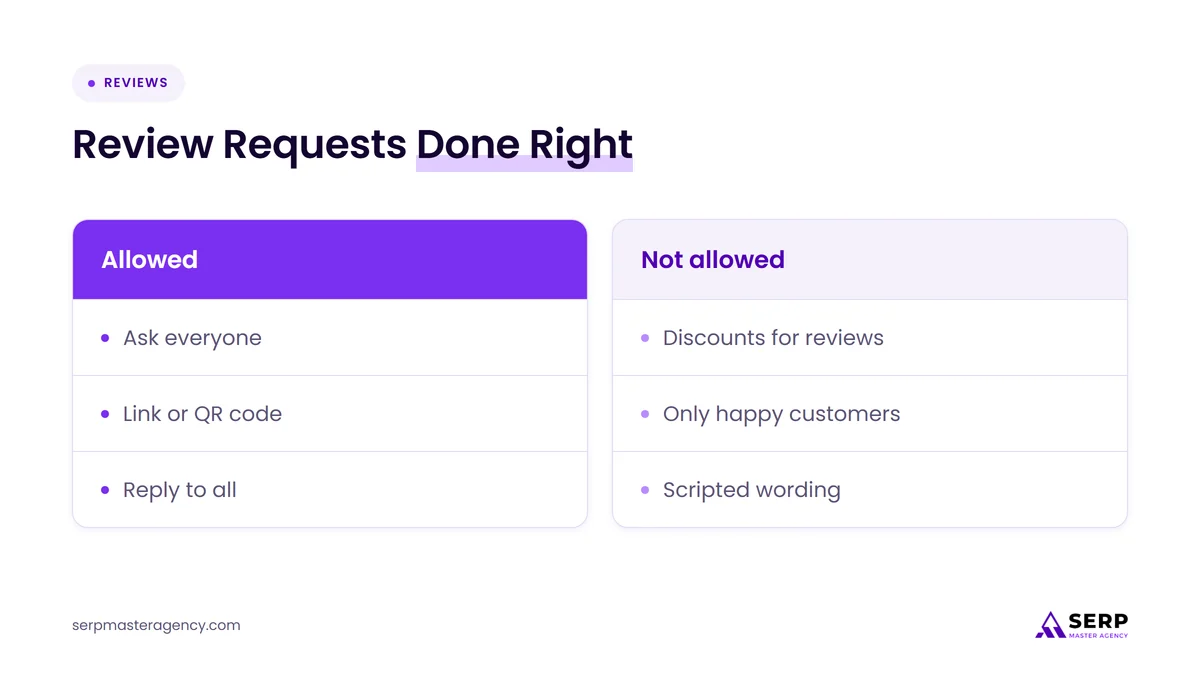
Google’s review policy is stricter than many trades realize. Businesses may not “selectively solicit positive reviews from customers,” may not offer discounts or free work for a review, and “should not require or pressure users” or “request that specific content be included.” So don’t ask customers to mention “EV charger” or your town. Let them write in their own words.
You can still add helpful context in your reply. Thanking someone for “choosing us for your panel upgrade” is natural, honest and useful to the next reader. BrightLocal’s 2026 survey of 1,002 US consumers found that 89% expect owners to respond to reviews, 74% look for reviews from the last three months and 47% won’t use a business with fewer than 20 reviews. A steady stream of new reviews beats a burst once a year.
6. List the emergency hours you can really answer
Electrical faults don’t wait for office hours, and urgent searches are a big source of calls for electricians. If you offer after-hours or weekend call-outs, show them in your profile hours and on your website. Only list “Open 24 hours” if someone really answers the phone around the clock, and set special hours for holidays.
Google asks businesses to “provide your regular customer-facing hours of operation” and to use special hours for holidays and events. Showing 24-hour cover you can’t deliver causes missed calls, angry reviews and a profile that Google and customers stop trusting.
A practical set-up for many electricians:
- Normal hours in the profile, matching when the phone is answered.
- An “Emergency electrician” page on the website that explains which faults you treat as urgent and how call-out works.
- Special hours set before every public holiday.
- A missed-call text-back or answering service, so after-hours callers aren’t left with voicemail.
7. Add Electrician schema and keep your details the same everywhere
Structured data helps search engines read your business details without guessing. Add LocalBusiness markup to your website using the Electrician type, which schema.org lists under HomeAndConstructionBusiness, and include your name, phone number, website, hours and the areas you serve. Then make sure your name, address and phone number match on every listing.
Google’s structured data guide says to “use the most specific LocalBusiness sub-type possible,” and for an electrical contractor that sub-type is Electrician. Name and address are the required properties. If you hide your address on your profile, check how your web developer handles the address field so the markup doesn’t publish a home address you’ve kept private.
Name, address and phone consistency still matters, especially for AI tools that pull facts from many sources. Check your website, Google Business Profile, Bing Places, Apple Business Connect, Yelp, Facebook and trade directories. If you’ve moved or changed numbers, update the old listings first, because an outdated copy can keep showing up in search results and AI answers.
8. Decide where Local Services Ads fit, now they’re moving into Google Ads
Local Services Ads sit above the map pack and charge per lead, and electricians are an eligible category. In 2026 Google began moving them into the main Google Ads platform as a Performance Max campaign type, with the move running through 2027. Your business name, address and hours sync from your Business Profile, so your organic profile now directly affects your paid leads.
Several changes are worth knowing about:
- One badge: Google replaced Google Guaranteed, Google Screened and License Verified by Google with a single Google Verified badge.
- Renamed rules: from July 6, 2026, Google’s “Local Services platform policies” became “Local Services Ads requirements,” with screening that can include business, license, insurance and background checks.
- Profile sync: Search Engine Roundtable reports that changing your name or address can trigger a verification review that pauses the campaign for 24 to 48 hours.
- Lost history: performance reports from the old Local Services dashboard won’t carry over to Google Ads, so export what you need now.
- Pre-badge ads: from August 2026, some businesses can get leads after passing preliminary checks, before onboarding is complete.
Local Services Ads and SEO aren’t a choice of one or the other. Ads can fill the diary while your organic rankings build, and strong organic rankings reduce how much you depend on paid leads. The mistake is running ads without tracking which leads turn into paid jobs. Availability and screening rules also vary by country, so check Local Services Help for your market before planning around them.
How do these moves help electricians show up in AI search?
AI tools such as Google AI Overviews, AI Mode and ChatGPT build answers from the same sources that drive local SEO: your Business Profile, your website, your reviews and what other sites say about you. Google states there are no extra requirements for its AI features, so clear, consistent, well-reviewed information is what gets an electrician named.
Customers are using these tools more for local decisions. BrightLocal’s 2026 survey found that the share of US consumers using ChatGPT or other AI tools for local recommendations rose from 6% to 45% in a year, and 82% read AI-generated review summaries. When an AI summary describes your business, it draws on what your reviews and pages actually say.
That’s why moves 3, 4 and 5 matter so much for AI search. A page that states your license, explains how an EV charger install works in your area and sits alongside recent reviews gives an AI tool solid facts to repeat. For the wider picture, read our guide on getting your business recommended by ChatGPT, and see how AI Mode now sends home service searches to booking and quote links.
In what order should an electrician make these moves?
Start with the profile fixes, because they’re quick and affect both the map pack and Local Services Ads. Then add trust details to the website, build job pages one at a time, and keep reviews and hours running as monthly habits. Most electricians can finish the first three moves in a week.
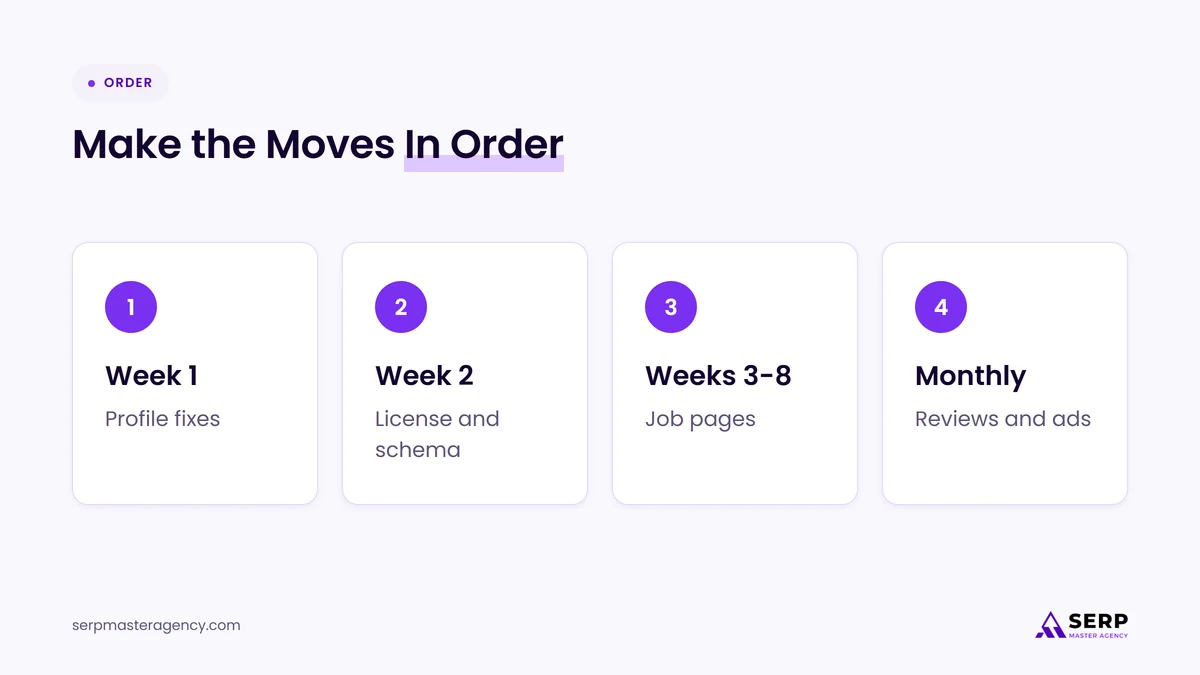
- Week 1: categories, services, service area and hours in your Business Profile (moves 1, 2 and 6).
- Week 2: license and insurance details on the website, plus Electrician schema and a listings check (moves 3 and 7).
- Weeks 3 to 8: one job page every week or two, starting with the job that earns you the most (move 4).
- Every month: ask every customer for a review, reply to all reviews, update special hours and review Local Services Ads leads against booked jobs (moves 5 and 8).
Track profile calls from your Business Profile performance report and website phone clicks in your analytics before you start, so you can compare the numbers after six to eight weeks.
What mistakes cost electricians calls?
The most common mistakes are adding a city or “24/7” to the business name, listing service areas you don’t really cover, using stock photos, asking only happy customers for reviews and burying the license number. Each one either breaks a Google guideline or gives customers and AI tools less reason to trust you.
- Keywords in the business name: Google’s guidelines say “including unnecessary information in your business name isn’t permitted.” It risks suspension.
- A storefront address that isn’t a storefront: showing a home address as a shopfront goes against the service-area rules.
- Copied area pages: twenty town pages with the same text and a swapped place name help no one. Write about real work in each area, or don’t publish the page.
- Review shortcuts: discounts for reviews, staff reviews and filtering out unhappy customers all break Google’s policy.
- No call tracking: without knowing which calls came from search, you can’t tell which moves worked.
If you also work in heating, cooling or plumbing, many of the same rules apply. Our list of local SEO fixes for HVAC companies covers the trade-specific details for those jobs.
How does SERP Master Agency help electricians with local SEO?
We help electrical contractors in the US, UK, Canada, Australia and New Zealand turn local searches into booked jobs. That covers Business Profile clean-ups, job and area pages, review processes, schema, listings and call tracking, sold as fixed-price tasks or ongoing monthly work, depending on how competitive your market is.
We start by checking how your profile and site compare with the electricians already winning your area’s map pack, then fix the gaps in the order that brings calls soonest. You can see what’s included on our SEO for electricians page.
Frequently asked questions
What is the best Google Business Profile category for an electrician?
For most electrical contractors, “Electrician” is the right primary category because it describes the core business. Add only a few extra categories that also describe what the business is, and use the services list to show specific jobs such as panel upgrades, rewiring and EV charger installation.
Should an electrician show their home address on Google?
No. If customers don’t visit your premises, Google treats you as a service-area business and says you should hide your address. Remove it from your profile, then list up to 20 cities or postal codes you serve, within about two hours’ drive of your base.
Can I ask customers to mention the job in their Google review?
No. Google’s policy says businesses should not request that specific content be included in reviews. Ask every customer for an honest review in their own words. You can mention the job type in your own reply, which adds useful context for the next reader.
Do electricians need Local Services Ads as well as SEO?
Not always. Local Services Ads can bring leads quickly while organic rankings build, but they cost money for every lead. Many electricians use both and judge each by booked jobs, not lead counts. Check that Local Services Ads are available for electricians in your country first.
How long does local SEO take to bring an electrician more calls?
Profile fixes such as categories, services, hours and service areas can show up within days, and service area edits can take up to 48 hours to appear. New job pages and review growth usually take a few months to build ranking strength, depending on how competitive your area is.
What should an electrician do first?
Open your Google Business Profile today and check the basics: the right category, a full services list, an honest service area and hours you can really answer. Then put your license and insurance on your website and start asking every customer for a review. Those first moves cost little and lead straight into the job pages and schema that build calls over the following months. If you’d rather hand the work over, SERP Master Agency offers these tasks as part of our SEO services.
Want more calls from local searches?
SERP Master Agency helps electrical contractors fix their Google Business Profile, build job pages that rank and track the calls that come in. Tell us your trade, your service area and the jobs you want more of, and we’ll show you where the quickest wins are.
Sources
- Google Business Profile Help, “Tips to improve your local ranking on Google”, accessed November 15, 2026. https://support.google.com/business/answer/7091
- Google Business Profile Help, “Guidelines for representing your business on Google”, accessed November 15, 2026. https://support.google.com/business/answer/3038177
- Google Business Profile Help, “Manage your service areas for service-area & hybrid businesses”, accessed November 15, 2026. https://support.google.com/business/answer/9157481
- Google Business Profile Help, “Manage your services on your Business Profile”, accessed November 15, 2026. https://support.google.com/business/answer/9455399
- Google Business Profile Help, “Tips to get more reviews”, accessed November 15, 2026. https://support.google.com/business/answer/3474122
- Maps User Generated Content Policy Help, “Prohibited & restricted content”, accessed November 15, 2026. https://support.google.com/contributionpolicy/answer/7400114
- Local Services Help, “Getting started with Local Services Ads”, accessed November 15, 2026. https://support.google.com/localservices/answer/6224841
- Local Services Help, “Business screening and verification requirements”, accessed November 15, 2026. https://support.google.com/localservices/answer/12174778
- Local Services Help, “Understand the screening and verification process”, accessed November 15, 2026. https://support.google.com/localservices/answer/6226575
- Google Search Central, “AI Features and Your Website”, accessed November 15, 2026. https://developers.google.com/search/docs/appearance/ai-features
- Google Search Central, “Local business (LocalBusiness) structured data”, accessed November 15, 2026. https://developers.google.com/search/docs/appearance/structured-data/local-business
- Schema.org, “Electrician”, accessed November 15, 2026. https://schema.org/Electrician
- Search Engine Roundtable, “Google Local Services Ads Transitioning To Google Ads Platform”, July 21, 2026. https://seroundtable.com/google-local-services-ads-transition-google-ads-41717.html
- Search Engine Roundtable, “Google Local Service Ads Pre-Badge Ads & Expansion Of Verticals”, August 21, 2026. https://seroundtable.com/google-lsa-prebadge-new-verticals-41920.html
- TechWyse, “Google Local Services Ads Rules Shift Toward Verification First”, June 9, 2026. https://www.techwyse.com/news/platform-updates/google-local-services-ads-requirements-july-2026
- BrightLocal, “Local Consumer Review Survey 2026: Star Ratings Keep Rising, Old Reviews Don’t Cut It”, February 11, 2026. https://www.brightlocal.com/research/local-consumer-review-survey/

Suraj Rana is a highly regarded SEO expert specializing in the dental industry. His expertise lies in crafting strategic SEO marketing plans to help new or expanding businesses increase their online visibility and attract more customers. Suraj Rana’s skills extend to improving website rankings and boosting organic search visibility, thereby enhancing web traffic and return on investment for businesses.