Quick answer: ChatGPT recommends a business when it can find clear, consistent and trusted information about it on the web. That means your site must be open to OpenAI’s search crawler, your pages must answer buyer questions directly, your listings must match everywhere, and other sites and reviewers must talk about you. You can influence all four.
Key takeaways
- ChatGPT is now a real search channel: OpenAI’s consumer product lead said in November 2026 that its volume of search-like queries is roughly one-fifth of Google’s.
- If your site blocks OAI-SearchBot, OpenAI says it won’t show your pages in ChatGPT search answers. Check this first.
- Pages that get cited tend to answer the question straight away, use tables and show recent dates, according to a 193,507-answer study reported in October 2026.
- Big brands lead AI answers for broad and price-led questions, but specific, experience-based questions leave room for smaller businesses.
- There is no form to submit and no way to pay for an organic recommendation. You earn it with the same work that builds trust in search generally.
What does it mean to be recommended by ChatGPT?
Being recommended by ChatGPT means your business is named, linked or listed in ChatGPT’s answer when someone asks for a product, service or provider like yours. It differs from ranking on Google because there is usually no list of ten links. The answer names a few options and explains why, so being left out means being invisible for that question.
There are two ways a business can show up. The first is an organic mention, where ChatGPT names you because of what it found on the web. The second is paid placement through ChatGPT ads, which OpenAI labels and keeps separate from the answer. This guide covers the organic side. If you’re weighing the paid side, our post on whether your business should advertise in ChatGPT covers it.
Why does ChatGPT matter for business owners now?
ChatGPT matters because people now use it like a search engine, at a scale that is hard to ignore. OpenAI says ChatGPT’s search-like query volume is about a fifth of Google’s, and that weekly users grew from one billion to 1.2 billion in two months. Buyers who ask it for a recommendation may never see your Google listing.
Adam Fry, ChatGPT’s consumer product lead, gave those figures in an interview with Big Technology published on November 3, 2026. He described a search simply: every time a user asks a question and ChatGPT goes to the web for the answer. Search Engine Roundtable noted that Google has not shared comparable figures and that the 20% number is OpenAI’s own claim, so treat it as a direction of travel rather than an audited market share.
The practical point is that questions such as “who’s a good accountant for a small online store” or “which roofing company near me does slate repairs” are now being typed into ChatGPT as well as Google. If ChatGPT can’t find good evidence about your business, it will name someone else.
How does ChatGPT decide which business to name?
For questions about current products, services and local providers, ChatGPT runs a web search, reads the pages it finds and writes an answer from them. It names the businesses that its sources describe most clearly and consistently as a good match for the question. OpenAI doesn’t publish a ranking formula, so the work is to be the best-documented answer.
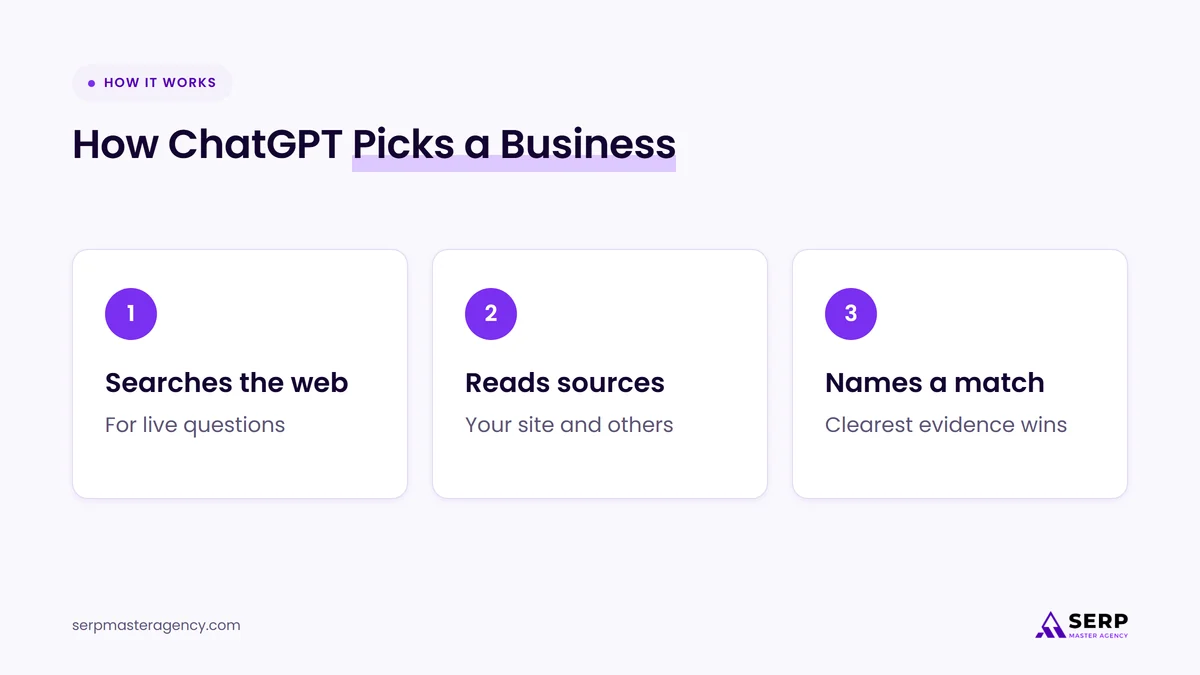
Here is what is known from OpenAI’s own documentation and recent research:
- It searches the web for live questions. When OpenAI launched ChatGPT search in October 2024, it said the feature draws on third-party search providers and on content provided by its partners. That means how findable you are in conventional search still feeds into what ChatGPT sees.
- It can only use pages its search crawler is allowed to read. OpenAI uses a crawler called OAI-SearchBot to surface websites in ChatGPT’s search features. Sites that block it won’t appear in ChatGPT search answers, though they can still show up as plain navigational links.
- It prefers pages that answer the question. A study of AI answers reported by Search Engine Journal found that cited pages were more likely to open with a direct answer and to answer the question fully than pages the AI passed over.
- It leans on what others say about you. For “best” and “which should I choose” questions, an AI answer has to rely on reviews, comparison articles, directories and discussion, not only your own claims. A business that is described the same way across many independent sources is easier to recommend.
What do pages that ChatGPT cites have in common?
Pages that AI tools cite more often get to the point quickly, cover the question completely and look current. In a study of 193,507 AI answers from ChatGPT, Google AI Mode and AI Overviews, cited pages were more likely to open with a direct answer and to include tables, recent dates, prices and first-hand experience.
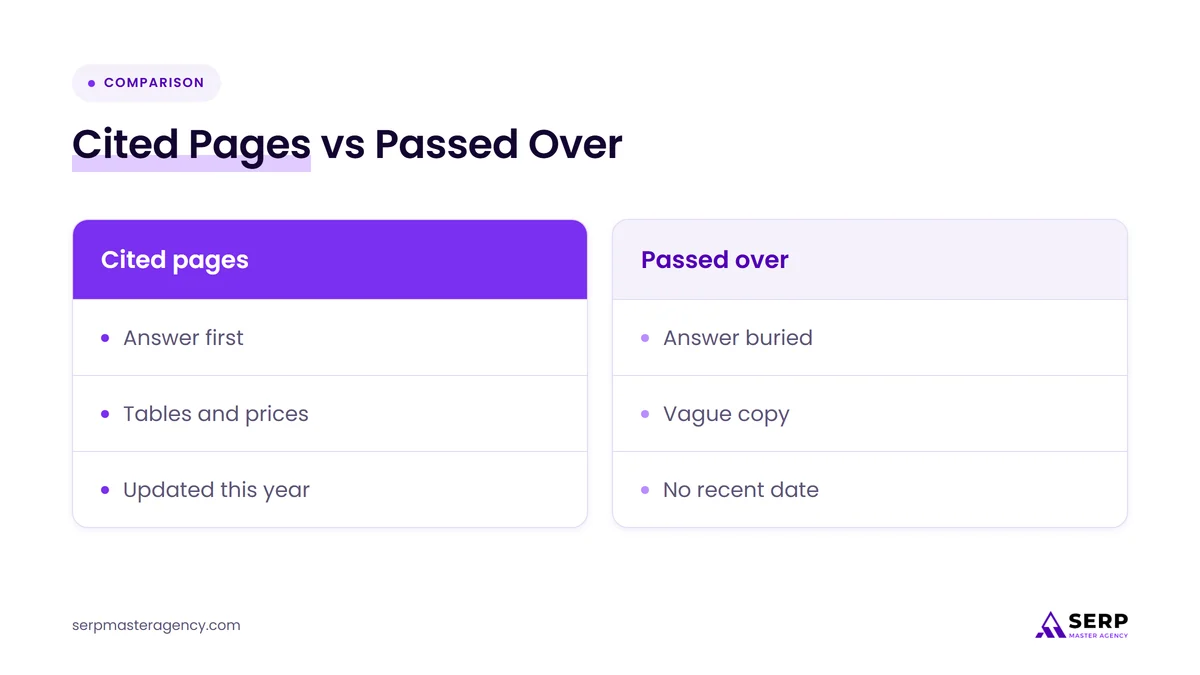
The study was run by TJ Robertson of TJ Digital, which sells SEO and generative engine optimization services, and it was reported by Search Engine Journal on October 28, 2026. It covered 4,167 questions across 78 companies in nine business models, captured weekly from August 27 to October 21, 2026. The main findings:
| Page trait | What the study found | What to do on your site |
|---|---|---|
| Direct answer at the top | 20% of cited pages opened with a direct answer, against 5% of top-10 Google pages the AI never pulled up | Start every service page with two or three sentences that answer the buyer’s question |
| Complete answer | Half of passed-over pages had no answer in the part raters read; cited pages scored 2.3 out of 5 for completeness, against 1.7 | Cover cost, process, timing and who the service suits on one page |
| Recent date | A publish or update date in the past 12 months came with 88% higher odds of being cited | Review key pages at least once a year and show the updated date |
| Tables | 69% higher odds of being cited | Use tables for packages, comparisons and specifications |
| First-hand experience | 45% higher odds of being cited | Explain how you actually do the work, with real details from your business |
| Prices | 28% higher odds of being cited | Publish prices or realistic price ranges where you can |
| Promotional tone | Nearly identical for cited and passed-over pages (3.8 against 3.7) | Sales copy neither helps nor hurts much; substance does the work |
Two cautions apply. The author describes these as associations, not proof that any trait causes citations, and the study didn’t test adding direct answers to existing pages. Still, every trait on the list is something a buyer would also value, so improving them is low-risk.
Can a smaller business compete with big brands in ChatGPT?
Yes, but not on every question. Big brands lead AI answers for broad, price-led and comparison questions, where well-known names have the most coverage. Smaller businesses have a better chance on specific questions about a niche, a location or a situation, where first-hand experience and detailed answers matter more than brand size.
Search Engine Journal reported on October 31, 2026 on BrightEdge research into travel brands in AI search. Large brands led their categories on both Google AI Overviews and ChatGPT. Marriott, for example, led hotels on ChatGPT with a 29.4% share of voice, and American Airlines led airlines at 25.3%. Booking platforms dominated questions about cheap and budget options.
Inspiration-style questions were different. Sources such as YouTube, Reddit and AAA showed up more often there, and the article’s author argued that sites offering real experience and expertise have room to compete. The research is about travel, but the pattern is a useful guide for any business:
- Don’t chase the broadest question. “Best accounting firm” favors the biggest names. “Accountant for Etsy sellers in Leeds” is winnable.
- Write about the situations you know best. Pages built around specific customer problems give ChatGPT a clear reason to name you for those problems.
- Show expertise the big players can’t. Local knowledge, specialist services and clear explanations of your process are hard for a national brand to copy.
How do you get your business recommended by ChatGPT?
Start by making sure ChatGPT can read your site, then fix your listings, rewrite key pages to answer buyer questions directly, and build independent mentions and reviews. Finally, test the questions your customers ask and track the visits ChatGPT sends. Most of this is solid SEO aimed at being understood, not just ranked.
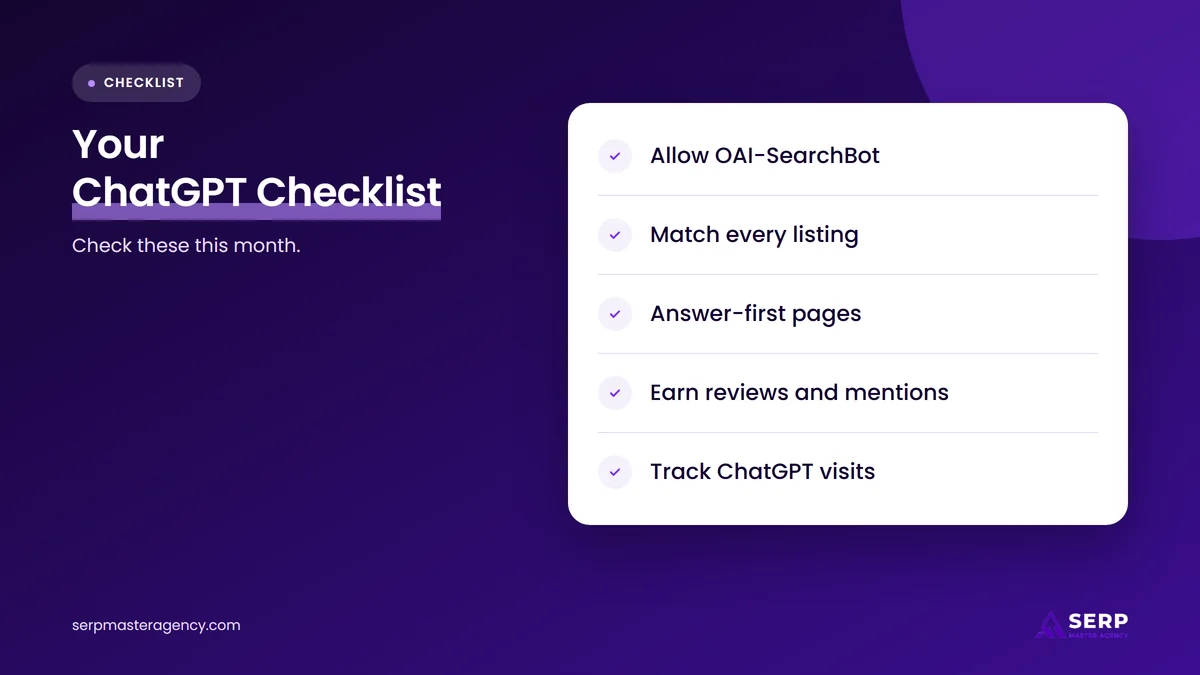
1. Allow OAI-SearchBot to crawl your site
Check that your robots.txt file doesn’t block OAI-SearchBot. OpenAI recommends allowing it in robots.txt and also allowing requests from its published IP ranges, which matters if a firewall or security plugin blocks unfamiliar bots. OpenAI says robots.txt changes take about 24 hours to take effect in search.
OAI-SearchBot is separate from GPTBot, the crawler OpenAI uses to collect content for training its models. You can block GPTBot and still allow OAI-SearchBot, so opting out of training doesn’t have to cost you visibility. Our guide to the shared AI training opt-out explains the trade-off in more detail.
2. Make your business details identical everywhere
ChatGPT builds its picture of your business from many sources, so your name, address, phone number, hours and services should match on your website, Google Business Profile, Bing Places, Apple Business Connect, Yelp and the directories in your industry. Conflicting details give an AI reason to doubt which version is right.
Bing Places is often overlooked because most owners focus on Google. It is free to claim, and because ChatGPT search draws on third-party search providers, a complete and accurate Bing listing is a sensible, low-cost step. Treat it with the same care as your Google profile.
3. Rewrite key pages to answer buyer questions
Each main service or product page should open with a short, plain answer to the question a buyer would ask, then cover what’s included, who it suits, how long it takes and what it costs. Use headings that match real questions, add a table where a comparison helps, and show when the page was last updated.
A good test: read only the first paragraph of the page. If a stranger couldn’t tell what you do, where, for whom and roughly at what price, ChatGPT will struggle too.
4. Earn reviews and independent mentions
For “best” and “who should I use” questions, ChatGPT needs evidence from sources other than you. Steady, recent customer reviews, mentions in local or trade press, listings in respected industry directories and inclusion in comparison articles all give it that evidence. Ask happy customers for reviews regularly, and say yes to genuine interview and guest-article requests.
Avoid shortcuts such as paying for fake reviews or buying placement on low-quality “best of” lists. They break platform rules, and they create the kind of inconsistent, low-trust footprint you are trying to fix.
5. Test the questions your customers ask
Write down 10 to 20 questions a real customer might type, such as “best commercial cleaner for offices in Austin” or “how much does a small business website cost in Toronto”. Ask them in ChatGPT every month, note which businesses are named and which sources are linked, and look for patterns in the sites it relies on.
Answers vary from one run to the next, so look at trends across several checks rather than reacting to one result.
6. Track the traffic ChatGPT sends
OpenAI adds utm_source=chatgpt.com to the links ChatGPT sends to websites, so these visits show up under that source in Google Analytics and similar tools. Set up a simple report for it and track enquiries and sales from those visits, not just the number of clicks.
How is ChatGPT visibility different from Google SEO?
ChatGPT visibility builds on Google SEO but rewards some things more. Both need a crawlable site, helpful pages and a trusted reputation. ChatGPT puts more weight on clear, quotable answers and on what independent sources say, because it writes one answer instead of showing a page of links.
| Factor | Google search | ChatGPT answers |
|---|---|---|
| What the buyer sees | A list of links, ads, maps and AI Overviews | A written answer naming a few options, with source links |
| Crawler to allow | Googlebot | OAI-SearchBot |
| What wins the spot | Relevance, quality and links to the page | Being the clearest, best-supported answer among the pages it reads |
| Role of your own content | Central | Important, but weighed against reviews, press and directories |
| How to measure | Search Console and analytics | Analytics (utm_source=chatgpt.com) and regular prompt checks |
What mistakes stop ChatGPT from recommending a business?
The most common mistakes are blocking OpenAI’s search crawler by accident, hiding key information in images or PDFs, writing vague pages that never answer a question, letting business details drift across listings, and having little independent coverage. Each one gives ChatGPT less to work with, so it names a competitor whose information is easier to trust.
- Blocking all AI bots in one rule. A blanket block written to stop training also stops OAI-SearchBot. Block GPTBot on its own if that’s your aim.
- Prices and services only in images or PDFs. Put the key facts in the page text.
- Old pages with no dates. Pages updated in the last year were more likely to be cited in the study above.
- Different names and numbers across listings. Pick one version and fix the rest.
- Relying only on your own website. Without reviews and outside mentions, ChatGPT has no independent reason to pick you.
Frequently asked questions
Can I pay to be recommended by ChatGPT?
Not in the organic answer. ChatGPT now shows ads in some markets, but OpenAI labels them and keeps them separate from the answer itself. To be named inside the answer, your business needs a crawlable site, clear pages, consistent listings and independent reviews and mentions that ChatGPT can find.
How do I check whether ChatGPT recommends my business?
Ask ChatGPT the questions your customers would ask, in their words and with their location, and note which businesses it names and which sources it links. Repeat the same set of questions each month, because answers vary between runs. Also check your analytics for visits tagged with utm_source=chatgpt.com.
Does blocking GPTBot stop ChatGPT from recommending me?
No. GPTBot collects content for training OpenAI’s models, while OAI-SearchBot is the crawler used for ChatGPT search results. OpenAI treats them separately, so you can block GPTBot and still allow OAI-SearchBot. Blocking OAI-SearchBot is what keeps your pages out of ChatGPT search answers.
How long does it take to start appearing in ChatGPT?
Technical fixes such as unblocking OAI-SearchBot can take effect within about a day, according to OpenAI. Content, listing and review improvements take longer, often weeks to months, because ChatGPT relies on search results and outside sources that also need time to update and to reflect your changes.
Do I need a separate strategy for ChatGPT and Google?
Mostly no. The same foundations, a crawlable site, helpful pages, consistent listings and a good reputation, serve both. The extra work for ChatGPT is allowing OAI-SearchBot, writing answer-first pages, earning independent mentions and tracking ChatGPT traffic and prompts as their own channel.
What should you do first?
Start with the checks that take minutes: make sure OAI-SearchBot isn’t blocked and that your listings match. Then rewrite your most important service pages so they answer buyer questions in the first paragraph, and build a steady flow of reviews and outside mentions. Our guides to fixing inconsistent business listings and the role of reviews in local SEO cover two of those steps in detail. If you want help with the whole job, see our SEO services and local SEO services at SERP Master Agency.
Want to know why ChatGPT names your competitors?
SERP Master Agency checks how ChatGPT and other AI tools describe your business, finds the gaps in your site, listings and reputation, and fixes them in order of impact. Tell us about your business and the questions your customers ask.
Sources
- Big Technology, “OpenAI: ChatGPT Search Is About 20% of Google’s, 250 Million People Speak With ChatGPT, and Chat Is Merging With Work”, November 3, 2026. https://www.bigtechnology.com/p/openai-chatgpt-search-is-about-20
- Search Engine Roundtable, “OpenAI Says ChatGPT Is At 20% Of Google Search Volume”, November 4, 2026. https://www.seroundtable.com/chatgpt-20-percent-google-42451.html
- Search Engine Journal, “Pages AI Cited Got Straight To The Answer More Often”, October 28, 2026. https://www.searchenginejournal.com/ai-cited-pages-more-often-got-straight-to-the-answer/594781/
- Search Engine Journal, “Big Brands Dominate AI Search But Leave Openings For Smaller Sites”, October 31, 2026. https://www.searchenginejournal.com/big-brands-dominate-ai-search-but-leave-openings-for-smaller-sites/595397/
- OpenAI, “Overview of OpenAI Crawlers”, accessed November 5, 2026. https://developers.openai.com/api/docs/bots
- OpenAI Help Center, “Publishers and Developers FAQ”, accessed November 5, 2026. https://help.openai.com/en/articles/12627856-publishers-and-developers-faq
- OpenAI Help Center, “Ads in ChatGPT: The Basics”, accessed November 5, 2026. https://help.openai.com/en/articles/20001207-ads-in-chatgpt-the-basics
- OpenAI, “Introducing ChatGPT search”, October 31, 2024. https://openai.com/index/introducing-chatgpt-search/

Suraj Rana is a highly regarded SEO expert specializing in the dental industry. His expertise lies in crafting strategic SEO marketing plans to help new or expanding businesses increase their online visibility and attract more customers. Suraj Rana’s skills extend to improving website rankings and boosting organic search visibility, thereby enhancing web traffic and return on investment for businesses.