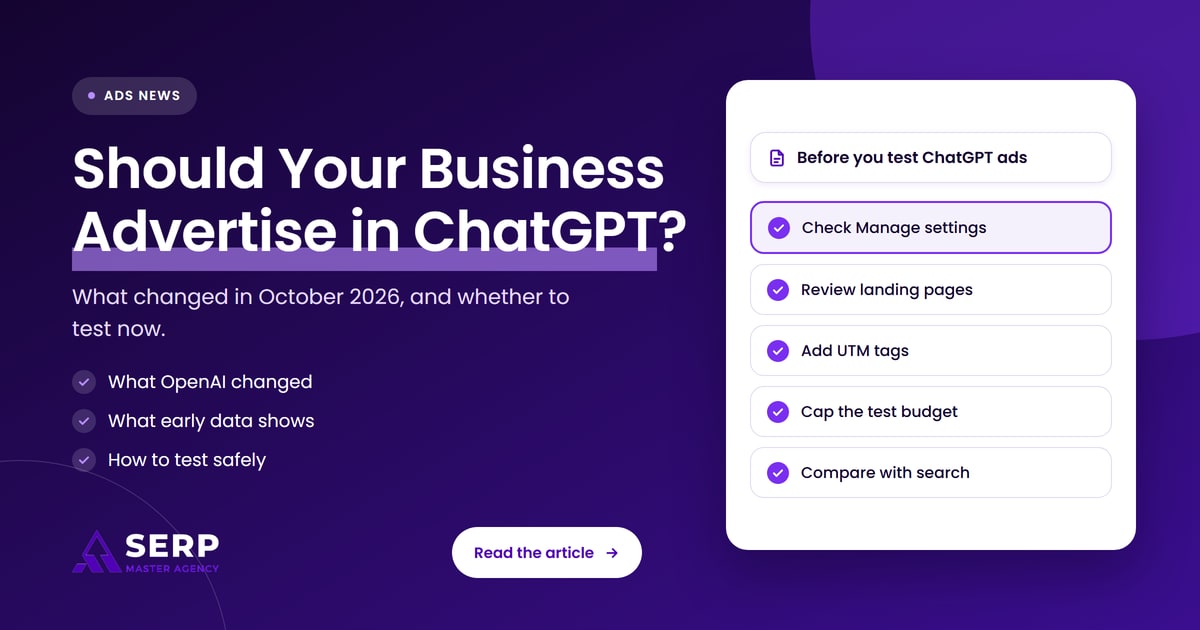
Quick answer: ChatGPT ads now run in 89 countries, use a wider format and, since October 30, 2026, rewrite ads by default through “creative enhancements”. For most businesses, ChatGPT ads are worth a small, tightly tracked test, not a budget shift away from Google. Check your Ads Manager settings first, because the system can now change your landing page.
Key takeaways
- OpenAI expanded ChatGPT Ads to 26 more countries on October 21, 2026, bringing it to 89 countries and over 100,000 advertisers.
- From October 30, 2026, creative enhancements are on by default for new and existing campaigns, unless you opted out earlier.
- Enhancements can rewrite headlines and descriptions, translate ads, resize images and change the destination URL, with no preview of every version.
- Early independent data is weak: in a working paper covered by Search Engine Journal, a US ChatGPT ad visit earned $0.89 against $2.45 for a Google search ad visit.
- The sensible move now is a small, capped test with UTM tracking, a clear decision on creative enhancements and a revenue-per-visit comparison against search.
What changed with ChatGPT ads at the end of October 2026?
Three things changed in late October 2026. OpenAI took ChatGPT Ads to 89 countries, rolled out a wider standard ad format and multi-image ads, and switched on creative enhancements by default from October 30. That last change means ChatGPT can now adjust your ad copy, images and landing page without asking first.
Here is the timeline, taken from OpenAI’s own pages and the trade press:
- October 21, 2026: OpenAI announced ChatGPT Ads in 26 additional countries, reaching 89 in total, and said more than 100,000 advertisers have run campaigns since ads launched just over eight months earlier.
- October 26, 2026: multi-image ads entered open beta for standard campaigns, using four to six square images that all link to the same page, according to Search Engine Journal.
- October 30, 2026: OpenAI’s help center states that creative enhancements are enabled automatically for new and existing campaigns from this date. The same day, OpenAI’s weekly advertiser email, reported by Search Engine Roundtable, announced a wider ad card that uses more of the conversation width on desktop, multi-image ads open to all advertisers and its Shopify integration available internationally.
The wider format needs no action, because it uses your existing campaigns and creative. Creative enhancements are the change that deserves your attention.
What are ChatGPT ads and creative enhancements?
ChatGPT ads are sponsored cards that appear below ChatGPT’s responses, showing an advertiser name, logo, headline, description, image and landing page. Creative enhancements are an OpenAI setting that adapts those ads to each conversation, using your existing ad and your landing page content to write new versions automatically.
According to OpenAI’s “Ads in ChatGPT: The Basics” page, ads are matched to the context of the conversation, your landing page and copy, and optional context hints you add at ad group level. Those hints are not exact-match keywords. You can buy on impressions (Views), clicks or conversions, and OpenAI recommends starting click campaigns with a maximum bid of $3 to $5 per click. Ads are not shown to users on Plus, Pro or Business plans, or to accounts identified as belonging to people under 18.
OpenAI’s creative enhancements help page lists exactly what the setting can change:
| Ad element | What creative enhancements can do | Why it matters to you |
|---|---|---|
| Headlines and descriptions | Write new or updated text that connects your offer to the conversation | Claims, tone and offers may read differently from what you approved |
| Language | Translate your ad text into another language | Your ad may appear in a language your team cannot check or serve |
| Images | Resize images to fit the ad format | Crops can hide logos, text or product details |
| Destination URL | Send people to a different, relevant page on your website | Visitors may land on a page you never built or tested for paid traffic |
OpenAI says variations can be prepared in advance or created in real time, and that they can run without you reviewing or approving each version. The help page also states that the experience “does not provide a preview of every variation.” Search Engine Journal adds that there is a single enhancements setting, with no separate controls for text, translation, images or URLs, and no report showing each enhanced version on its own.
Who is affected by the ChatGPT ads expansion?
Every business already advertising in ChatGPT is affected, because creative enhancements apply to existing campaigns unless you opted out. Businesses in the US, UK, Canada, Australia and New Zealand can already buy ChatGPT ads, and the expansion mainly adds Latin America, Africa, the Middle East and parts of Asia and Europe.
ChatGPT ads launched in the United States on February 9, 2026, and reached Australia, Canada, New Zealand and the United Kingdom by early August, according to Search Engine Journal. The October expansion added countries such as Argentina, Chile, Colombia, Peru, Nigeria, South Africa and Ukraine.
The change matters most to three groups:
- Current advertisers. Your ads may already be running in rewritten form. If you never visited Manage settings, the default applies to you.
- Businesses selling abroad. Automatic translation can put your ad in front of people in a language you don’t support, which matters if your checkout, phone team or delivery only work in one language.
- Regulated or claim-sensitive businesses. If your ad wording needs compliance sign-off, such as finance, health or legal services, automatically rewritten copy is a real risk to weigh before you leave the setting on.
What does the early performance data say about ChatGPT ads?
The first independent data is not encouraging. A working paper by Maximilian Kaiser and Christian Schulze, covered by Search Engine Journal on November 2, 2026, found a US ChatGPT ad visit earned $0.89 in revenue against $2.45 for a paid Google search visit, and converted at 0.37% against 1.17%.
The details from that coverage are worth knowing before you set a budget:
- Most advertisers earned less. Of 87 advertisers who bought both ChatGPT ads and paid search for US traffic, 84 earned less per ChatGPT ad visit.
- Sales were concentrated. 73 of those advertisers had zero sales from 18,726 ChatGPT ad visits between them, and one advertiser accounted for 66% of all paid ChatGPT purchases across the 102 tracked sites.
- The “parity price” is low. Matched against paid search’s rate of return, the authors value a US ChatGPT ad click at about $0.26, well below OpenAI’s recommended starting bid of $3 to $5.
Treat these figures with care. The paper is under review, its data ends on August 22, 2026, it covers e-commerce sites tracked through Google Analytics, and advertisers chose to buy ChatGPT ads, so it shows their results rather than proving cause. Search Engine Journal also notes more favorable results reported elsewhere using different measures, and it quotes OpenAI’s ads FAQ as saying the platform does not yet have performance benchmarks across advertisers.
The study is a reason to test carefully, not a reason to ignore the channel. Its own authors give you a simple formula you can run on your own account, covered in the steps below.
Should your business advertise in ChatGPT now?
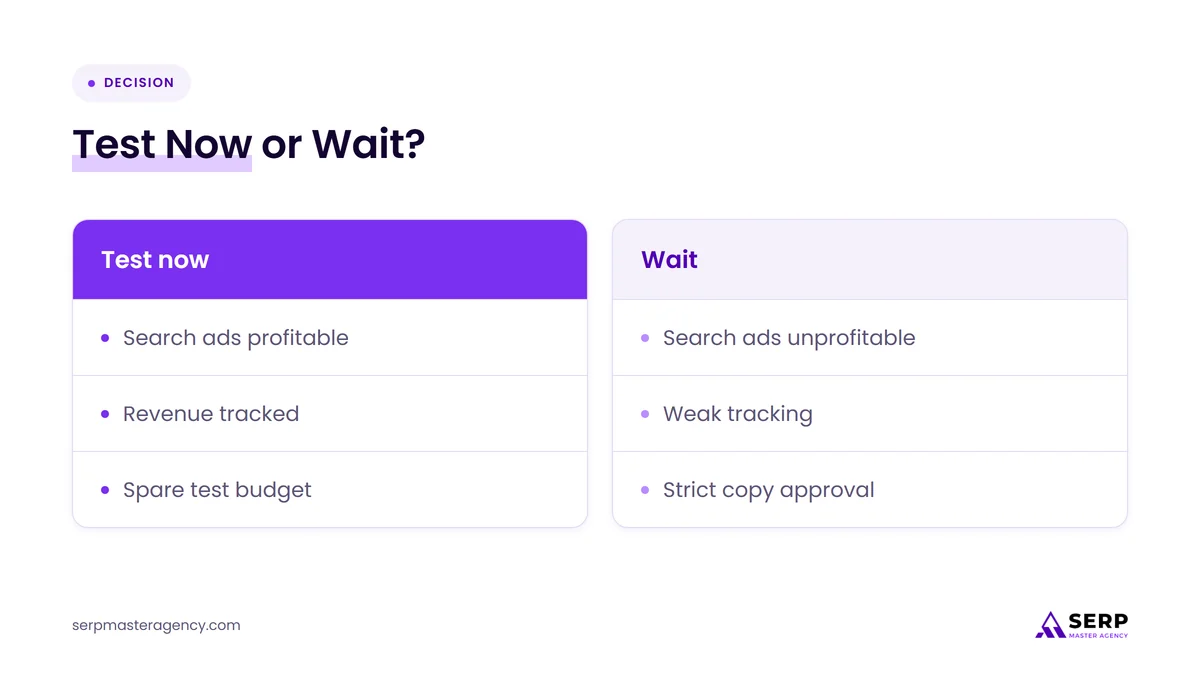
Test ChatGPT ads now if your customers research and compare before they buy, you can track revenue or leads by visit, and you can spare a test budget you can afford to lose. Wait if Google search ads are not yet profitable for you, your tracking is weak, or you cannot accept automatically rewritten ad copy.
| Situation | Test ChatGPT ads now | Wait for now |
|---|---|---|
| Google search ads | Already profitable, with spare budget | Still losing money or not yet set up |
| Tracking | Revenue or leads tracked per visit, with UTM tags | No conversion tracking or call tracking |
| How customers buy | They research, compare and ask questions first | Urgent, local “near me” needs answered by Google Maps |
| Ad copy rules | You can accept AI-written versions, or opt out | Every claim needs legal or compliance approval |
| Landing pages | Every key page is current and converts well | Prices, offers or service pages are out of date |
For most small and mid-sized service businesses, Google search ads and organic search still deserve first call on the budget. ChatGPT ads are a reasonable side test once those are working, and a poor first channel when they are not.
What should you do now if you already run ChatGPT ads?
Open Ads Manager, go to Manage settings and make a deliberate decision on creative enhancements at account level, then override it for campaigns that need tighter control. After that, check your landing pages, confirm your UTM tags, filter out ad-review crawler visits and compare revenue per visit against paid search.
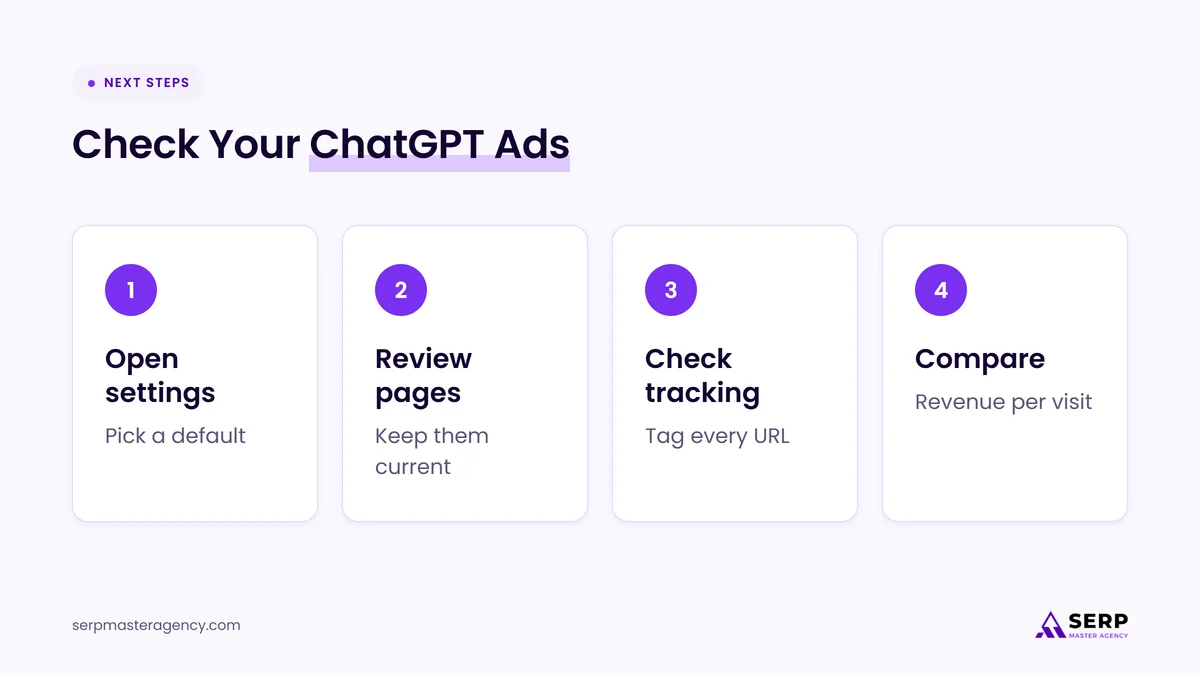
- Decide on creative enhancements. In Ads Manager, select Manage settings. Account settings are the default, and campaign settings take priority, so you can keep enhancements on for a broad campaign and off for one that promotes a regulated offer.
- Review every page the system could send people to. OpenAI says the destination URL may be changed to a relevant page on your site. Make sure your service, pricing and product pages are current and have a clear call to action, because any of them could now receive paid clicks.
- Keep source content accurate. OpenAI’s own advice is to keep ads and landing pages current, including prices, promotions, product details and availability, and to write clear, specific copy. Enhancements build on what you give them.
- Check your tracking. OpenAI says static tracking parameters such as UTM tags persist on ad clicks. Search Engine Journal points out that the help page does not explain how tracking parameters carry over when the destination changes, so check your analytics for ChatGPT ad sessions on pages you didn’t choose.
- Remove crawler visits. OpenAI notes that ad-review crawlers may visit landing pages with tracking parameters, and third-party analytics may count them as paid visits. Exclude them before you judge results.
- Calculate your parity price. Divide revenue per visit from ChatGPT ads by revenue per visit from paid search, then multiply by your search cost per click. If you pay more than that figure per ChatGPT click, the channel is earning less per dollar than search.
- Watch results every week. If you leave enhancements on, compare conversion rate by campaign week by week, and remember OpenAI’s own caution that changes over time do not, by themselves, prove what the enhancements did.
The destination URL change is the one most advertisers will want to think about. One X user whose profile lists past roles at Google and Pinterest put the risk plainly:
“A landing page you didn’t pick is a landing page you never tested.”
Jordan (@jordanfry) on X, November 2, 2026 (source)
If a single page on your site would be a poor first impression for a paid visitor, fix that page or keep enhancements off for the campaigns that could reach it.
How do you run a fair first test of ChatGPT ads?
A fair first test of ChatGPT ads uses one clear offer, one well-tested landing page, a capped budget, UTM tags on every URL and a fixed review date. Judge the test on revenue or qualified leads per visit compared with paid search, not on clicks or impressions alone, and decide before launch what result would make you stop.
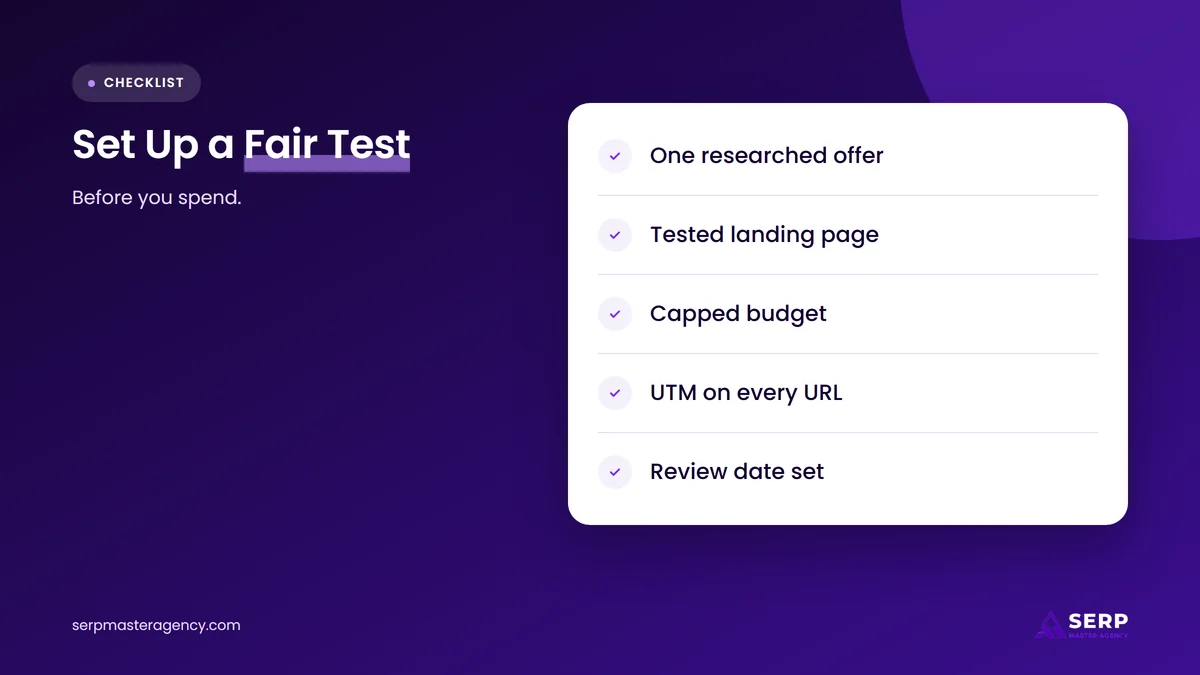
- Pick an offer people research. ChatGPT conversations are often about comparing options, so test a product or service that buyers think about before they choose.
- Write context hints from real questions. Use the questions customers ask your sales team or support staff as your ad group context hints.
- Cap spend and set a review date. Agree a fixed test budget and a date to review it, and stop at that limit whatever the click numbers look like.
- Tag every URL. Add UTM parameters so ChatGPT ad traffic shows up as its own source in your analytics.
- Compare against search. Use the same revenue or lead measure you use for Google Ads, so the comparison is like for like.
If you already run Google Ads, our PPC advertising services page explains how we manage paid search, and the same discipline applies to any new ad channel.
How do ChatGPT ads compare with ads in Google AI Mode?
ChatGPT ads and ads in Google AI Mode both place paid results inside AI conversations, but they run on different systems. ChatGPT ads are bought in OpenAI’s Ads Manager and shown below ChatGPT responses. AI Mode ads come from your existing Google Ads campaigns, so most businesses can reach AI Mode without opening a new account.
We covered Google’s side in detail in Google Ads now appear inside AI Mode conversations. The short version for budget planning: if you run Google search ads, start by checking how they perform in AI Mode, then treat ChatGPT as a separate test with its own tracking and its own budget line.
Do ChatGPT ads affect your organic visibility in ChatGPT?
Buying ChatGPT ads does not change how ChatGPT answers. OpenAI states that ads do not influence ChatGPT’s answers and are clearly labeled and kept separate. Being recommended in the answer itself still depends on your website, your reputation and how often trusted sources mention your business.
The same working paper also looked at unpaid referrals from ChatGPT answers to 1,898 sites and estimated a moderate drop of about 6% to 8% in the first 13 weeks after ads arrived, relative to organic search referrals. That is an estimate with a wide range, but it suggests organic visibility in ChatGPT is worth protecting alongside any paid test. Our guide on getting cited by AI search tools covers the organic side.
What is likely to happen next with ChatGPT ads?
OpenAI says its next phase will add more ad formats, objectives, buying options and measurement tools. In our view, measurement is the gap that matters most to business owners, and until per-variation reporting exists, advertisers will need to judge creative enhancements through their own analytics.
This section is our opinion. We expect more automation rather than less, because creative enhancements cut the work of building many ad versions and OpenAI has said it is exploring “more native ways” for businesses to interact with people in ChatGPT. We also expect early performance to vary widely by industry, which is why a small, tracked test tells you more than any average figure.
Frequently asked questions
Are ChatGPT ads available in the UK, Canada and Australia?
Yes. ChatGPT ads launched in the United States in February 2026 and reached the UK, Canada, Australia and New Zealand by early August 2026. After the October 2026 expansion, OpenAI says ChatGPT Ads is available in 89 countries, through self-service Ads Manager or technology partners.
How do I turn off creative enhancements in ChatGPT ads?
Open ChatGPT Ads Manager and select Manage settings. You can turn creative enhancements off at account level, which becomes your default, or for individual campaigns, which take priority over the account setting. Opt-outs you set before October 30, 2026 were kept, so check both levels to confirm what applies.
Can ChatGPT change my ad’s landing page?
Yes, if creative enhancements are on. OpenAI says the destination URL may be changed to direct people to a relevant page on your website. If some pages are not ready for paid visitors, either improve them or turn enhancements off for the campaigns concerned.
How much do ChatGPT ads cost?
ChatGPT ads use an auction, so there is no fixed price. You can pay by impression or by valid click, and OpenAI recommends starting click campaigns with a maximum bid of $3 to $5 per click. Compare that with what a click is worth to you before setting your budget.
Do ChatGPT ads work better than Google Ads?
Early independent data says not yet for most advertisers. A working paper covered by Search Engine Journal found a US ChatGPT ad visit earned $0.89 against $2.45 for a Google search ad visit. Results vary by business, so measure revenue per visit in your own accounts before shifting budget.
Is it worth testing ChatGPT ads now?
ChatGPT ads are now big enough to take seriously and new enough to test with care. If your search ads already pay off and your tracking is solid, run a small, capped test and make a deliberate choice on creative enhancements. If not, fix your search foundations first. At SERP Master Agency, we help businesses build that foundation through our SEO services, so new ad channels are tested from a position of strength.
Not sure whether ChatGPT ads belong in your plan?
Tell us how you win customers today, from Google search to paid ads. We’ll give you a straight answer on whether a ChatGPT ads test makes sense now, and what to fix first if it doesn’t.
Sources
- OpenAI Help Center, “Creative enhancements for ChatGPT Ads”, accessed November 3, 2026. https://help.openai.com/en/articles/20001614-creative-enhancements-for-chatgpt-ads
- OpenAI, “ChatGPT Ads expands to 26 new countries as over 100,000 advertisers have used the platform”, October 21, 2026. https://openai.com/index/chatgpt-ads-expands-26-new-countries/
- OpenAI Help Center, “Ads in ChatGPT: The Basics”, accessed November 3, 2026. https://help.openai.com/en/articles/20001207-ads-in-chatgpt-the-basics
- Search Engine Roundtable, “ChatGPT Gets Wider Ads, Multi-Image Ads Expands, Expansion & More”, October 30, 2026. https://www.seroundtable.com/chatgpt-ads-update-42427.html
- Search Engine Journal, “ChatGPT Ads Turns On Automatic Ad Changes By Default”, October 30, 2026. https://www.searchenginejournal.com/chatgpt-ads-turns-on-automatic-ad-changes-by-default/595117/
- Search Engine Journal, “Google Search Ad Visits Out-Earned ChatGPT Ads In U.S.”, November 2, 2026. https://www.searchenginejournal.com/google-search-chatgpt-ad-revenue-per-visit/595596/
- Jordan (@jordanfry) on X, post on ChatGPT ads creative enhancements, November 2, 2026. https://x.com/jordanfry/status/2117285742263087334

Suraj Rana is a highly regarded SEO expert specializing in the dental industry. His expertise lies in crafting strategic SEO marketing plans to help new or expanding businesses increase their online visibility and attract more customers. Suraj Rana’s skills extend to improving website rankings and boosting organic search visibility, thereby enhancing web traffic and return on investment for businesses.