Quick answer: A plumbing business gets found for urgent and local searches by building a complete, accurate Google Business Profile, earning fresh reviews and replying to them, publishing one clear page per service and area, and keeping its name, phone and hours consistent everywhere. The same signals help it appear in AI Overviews, AI Mode and the map pack.
Key takeaways
- Google ranks local results on three factors: relevance, distance and prominence. You control relevance and prominence, not distance.
- Your Google Business Profile is the base of plumbing SEO. Pick an accurate primary category, set real service areas, hide your home address and keep hours correct.
- Google says there are no special optimizations needed to appear in AI Overviews or AI Mode. Normal SEO basics apply.
- Fresh reviews matter: BrightLocal’s 2026 survey found 74% of US consumers look for reviews written in the last three months.
- Local Services Ads are moving into Google Ads in 2026 and still charge per lead. They work alongside organic SEO, not instead of it.
What is SEO for plumbers?
SEO for plumbers is the work of making a plumbing business show up when nearby customers search Google, Google Maps or AI tools for plumbing help. It covers the Google Business Profile, service and area pages on the website, reviews, business listings and technical health, all aimed at turning searches into phone calls and booked jobs.
Plumbing search splits into two very different kinds of demand, and good plumbing SEO plans for both:
- Urgent searches: “emergency plumber near me”, “burst pipe”, “blocked drain tonight”. The customer wants a phone number in the next few minutes and usually calls one of the first businesses they see.
- Planned searches: “water heater replacement”, “repipe a house”, “bathroom plumbing remodel”. The customer compares options, reads reviews and often asks an AI tool for advice before calling anyone.
Urgent searches are won mostly in the map pack and the Google Business Profile. Planned searches are won by detailed service pages that answer real questions, which is also the content AI Overviews and AI Mode link to.
Why does local search matter so much for plumbing businesses?
Local search matters for plumbers because almost every job starts with someone nearby searching for help, often in a hurry. The businesses that show up in the map pack, AI answers and ads at that moment get the call. A plumber who is hard to find loses the job to whoever is easiest to reach.
How customers search is also widening. In BrightLocal’s 2026 survey of 1,002 US consumers, use of ChatGPT and other AI tools for local business recommendations rose from 6% to 45% in one year, making AI the third most popular source. The same survey found that 97% of consumers read reviews for local businesses (BrightLocal, 2026).
For a plumbing business, that means a single listing is no longer enough. Customers may meet you in Google Maps, an AI Overview, AI Mode, a Local Services Ad or a ChatGPT answer, and each of these draws on the same public information about your business.
How does Google decide which plumbers show up for local searches?
Google decides which plumbers appear in local results using three main factors: relevance, distance and prominence. Relevance is how well a profile matches the search, distance is how far the business is from the searcher, and prominence is how well known the business is, based on reviews, links and other information Google finds online.
Google Business Profile Help explains each factor and what you can do about it:
| Factor | What it means | What a plumber can do |
|---|---|---|
| Relevance | How well your Business Profile matches what someone searched for | Choose the right primary category, list every service you offer and write a clear description |
| Distance | How far your business is from the person searching | Set accurate service areas and build a page for each main town you cover. You can’t change where the searcher is. |
| Prominence | How well known your business is | Earn steady reviews, reply to them, get listed in trusted local directories and earn mentions from local sites |
Google’s own tips for improving local ranking are simple: verify your business, keep your name, address, hours, category and attributes accurate and complete, reply to reviews, and add photos and videos that show your work (Google Business Profile Help).
How should a plumber set up a Google Business Profile?
A plumber should set up a Google Business Profile with the real business name, the most accurate primary category, a list of services, real hours and defined service areas. Most plumbers work at customers’ homes, so Google’s guidelines say a plumber working from home should hide the address and show a service area instead.
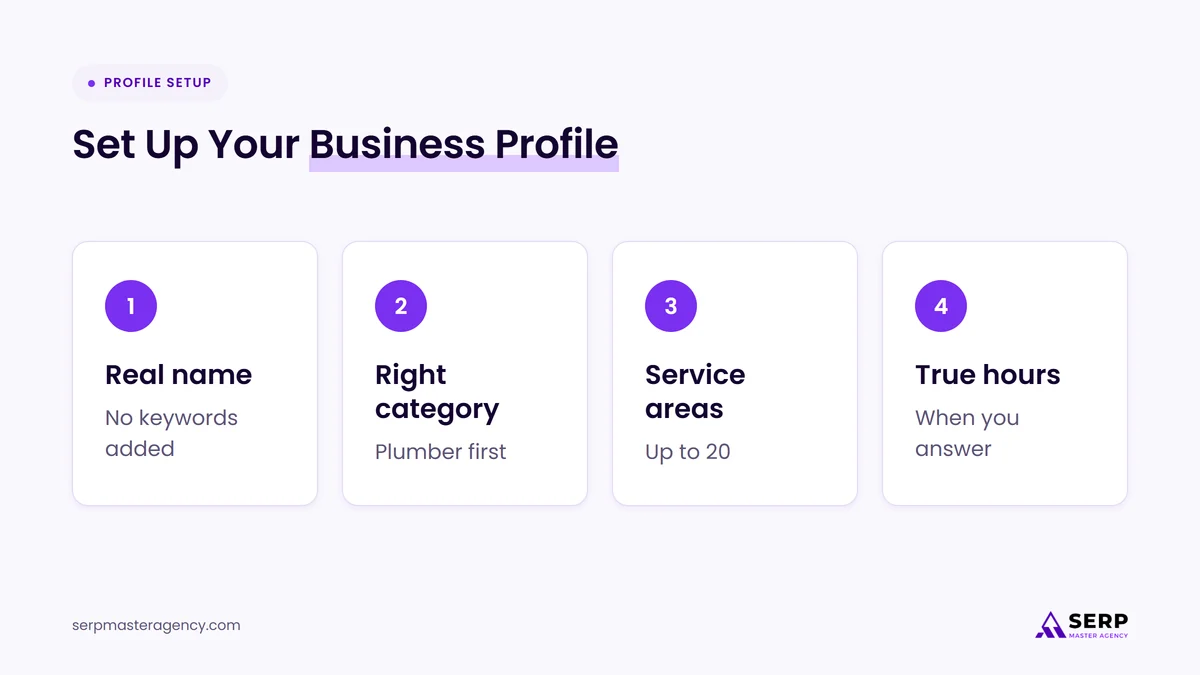
- Use your real business name. Google’s guidelines say your name should reflect your real-world name. Adding keywords such as “24 hour emergency plumber” or your city to the name breaks the rules and risks suspension. Hours go in the hours field, not the name.
- Choose the right category. Pick the category that completes “This business IS a” plumber, and add only a few secondary categories that describe your core work. Google says not to use categories as keywords.
- Set your service areas properly. Google lets you set up to 20 service areas by city, postal code or similar area, but not as a radius. The whole area shouldn’t extend beyond about two hours of driving time from your base.
- Hide your address if customers don’t visit you. If you work from home or a yard customers never visit, remove the address from your profile. A virtual office can’t be listed unless it is staffed during business hours.
- Set accurate hours. If you genuinely answer the phone 24 hours a day, set your hours to show that. If you don’t, list the hours someone actually picks up. A missed call at 2 a.m. costs you both the job and possibly a bad review.
- List your services and add real photos. Add each service you offer, such as drain cleaning, water heater repair and leak detection, and upload photos of your team, vans and finished work.
Our guide on how Google Business Profile affects local SEO covers the profile in more depth.
How do plumbers show up in AI Overviews and AI Mode?
Plumbers show up in AI Overviews and AI Mode the same way they show up in regular Google results. Google states there are no additional requirements or special optimizations needed. AI features pull from pages that are crawlable, clear and useful, so complete service pages, an accurate Business Profile and strong reviews do the work.
Google Search Central explains that AI Overviews and AI Mode may use “query fan-out”, running several related searches across subtopics to build one answer. For a question like “why does my water heater make a popping noise”, AI Mode might also search for causes, repair costs and when to call a plumber. A page that answers those follow-up questions clearly has more chances to be linked.
Google also says you don’t need new machine-readable files, AI-specific text files or special markup to appear in these features (Google Search Central, 2025). In practice, that means a plumber should focus on:
- Answering real customer questions in plain text on service pages: what causes the problem, what the fix involves, how long it takes and when it’s an emergency.
- Letting Google crawl the site. Don’t block important pages in robots.txt, and keep key information in text rather than only in images.
- Keeping business facts consistent across your website, Business Profile and directories, so AI tools find one version of your name, phone number and service area.
- Adding LocalBusiness structured data that matches what’s visible on the page. Google’s documentation shows how to mark up a business’s hours, departments and other details, and even uses “Plumber” in one of its examples (Google Search Central, 2026).
Should plumbers use Local Services Ads or organic SEO?
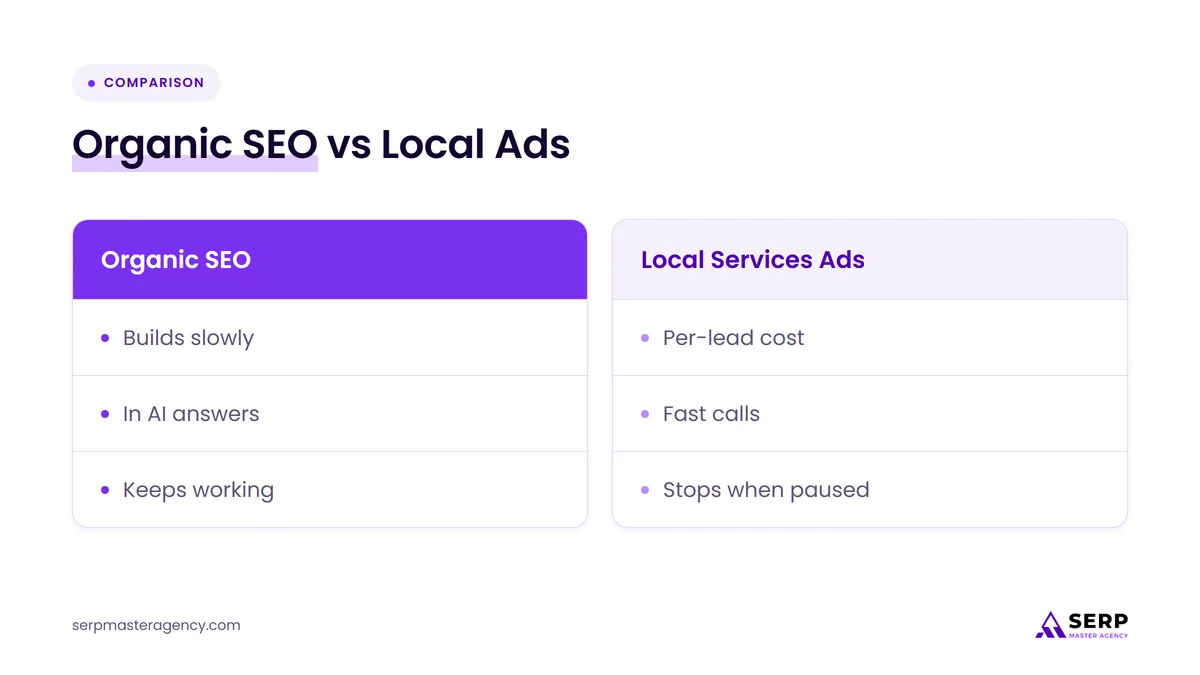
Most plumbers do best using both. Local Services Ads put a business at the top of urgent searches and charge per lead, so they deliver calls quickly. Organic SEO and the map pack build visibility that doesn’t stop when the budget does, and they also feed the information AI tools use to recommend businesses.
Local Services Ads are changing in 2026. Google is moving them out of their separate dashboard and into Google Ads as a Performance Max campaign type with pay-per-lead goals. The first phase started in August 2026 for select US home and storefront service advertisers. Service-area businesses without storefronts, which describes most plumbers, are in the broader group scheduled for late 2026, with non-US accounts following in 2027 (Google Ads Help; Search Engine Roundtable, 2026).
Some things stay the same. Ads still show only on Google Search and Google Maps, you still pay only for valid leads such as calls and messages, and an existing Google Verified badge transfers automatically. Google advises downloading your past performance reports before your account moves, because they won’t carry over.
| Factor | Organic SEO and map pack | Local Services Ads |
|---|---|---|
| How you pay | Time or agency fees, no cost per click | Per valid lead, such as a call or message |
| Speed | Builds over months | Can bring calls soon after approval |
| When it stops | Visibility fades slowly if you stop the work | Calls stop when the budget stops |
| Where it shows | Map pack, organic results, AI Overviews, AI Mode | Google Search and Google Maps ad positions |
| Best for | Planned jobs, long-term lead flow, AI visibility | Urgent jobs and filling the schedule quickly |
Reviews help both channels. Google lists review replies among its tips for local ranking, and strong reviews make an ad or a map listing more likely to get the call.
What pages should a plumbing website have?
A plumbing website should have one page for each main service, one page for each main town or area you serve, an emergency page if you offer emergency work, and clear contact details on every page. Each page should answer the questions a customer asks before calling, in plain words and with a visible phone number.
A practical page plan looks like this:
- Homepage: who you are, the area you cover, your main services and a click-to-call phone number at the top.
- Emergency plumbing page: what counts as an emergency, your real response hours, what to do while waiting (such as turning off the main water valve) and a phone number above the fold.
- Service pages: one each for drain cleaning, water heaters, leak detection, sewer lines, repiping and any other service that brings in real work. Explain the problem, the fix and the signs it needs a professional.
- Area pages: one for each main town you serve, with genuinely local details such as the areas covered, typical housing stock and the jobs you do most there. Thin pages that only swap the town name help no one.
- About and reviews pages: your license and insurance details where they apply, your team and links to your review profiles.
Our tips on optimizing local landing pages go further on making area pages useful rather than repetitive.
How do reviews help a plumbing business get more calls?
Reviews help plumbers get more calls because customers read them before choosing who to phone, and Google uses them as part of prominence. Recent reviews count most with customers, so a steady flow of new reviews, each with a personal reply, works better than a burst of reviews from one campaign that then goes quiet.
BrightLocal’s 2026 survey shows how much recency and replies matter to customers:
- 74% of consumers look for reviews written in the last three months.
- 89% expect business owners to respond to reviews.
- 80% are likely to use a business that responds to all of its reviews.
- 50% are put off by templated or generic responses.
For a plumber, the easiest system is to ask at the end of every job, while the customer is relieved the problem is fixed. Send a short text with your review link the same day, and reply to every review personally, mentioning the job where it’s appropriate. Read more on how reviews and ratings affect local SEO.
What should plumbers check every month?
Plumbers should check their Google Business Profile details, new reviews and replies, calls from Google, and whether service pages still answer current customer questions. Google changes its search features often, and competitors keep adding reviews and pages, so a short monthly check keeps a plumbing business visible.
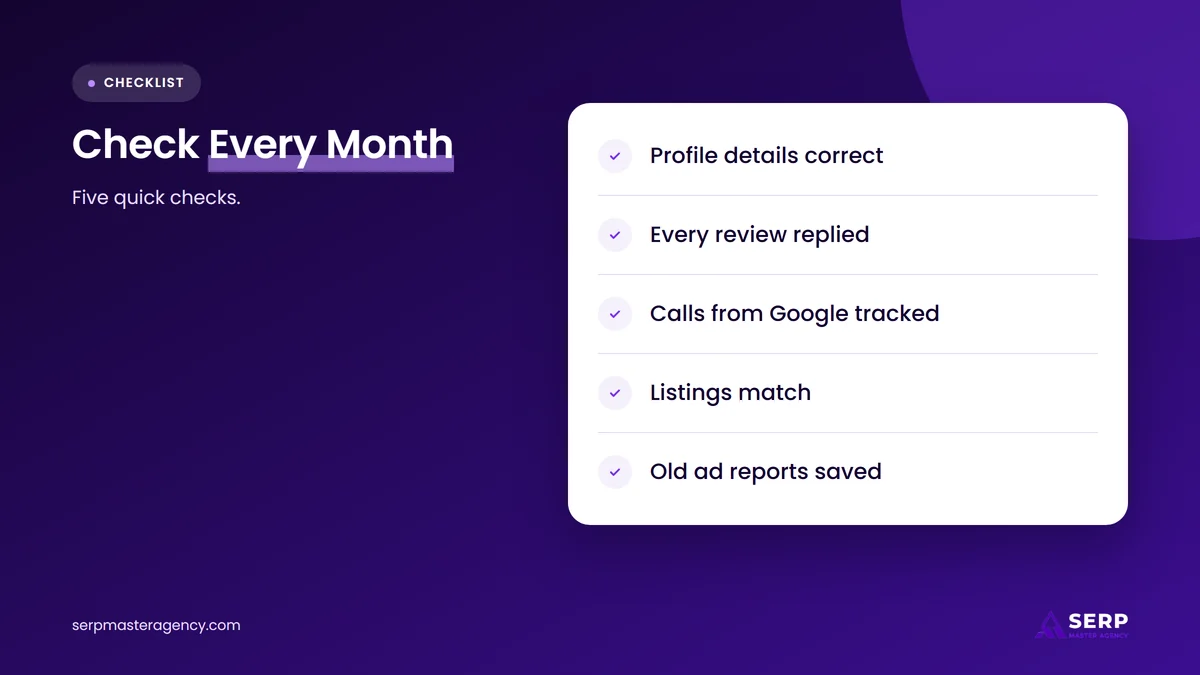
- Profile accuracy: hours, holiday hours, phone number, services and service areas are still correct.
- Reviews: new reviews came in this month and every one has a personal reply.
- Calls and leads: track calls from your Business Profile and your website, not only rankings.
- Listings: your name, phone and address match across directories. Our guide on fixing inconsistent NAP across listings explains the cleanup.
- Ads: if you run Local Services Ads, watch for your migration to Google Ads and download old reports first.
What mistakes stop plumbers from ranking?
The most common mistakes are stuffing keywords or city names into the business name, showing a home address customers can’t visit, listing hours nobody answers, using vague category choices, and building a website with one page that tries to cover every service and town. Each one makes it harder for Google and customers to trust the business.
- Keyword-stuffed business names. Google’s guidelines don’t allow location information or extra details in the name. It may work briefly and then cost you the profile.
- Wrong address setup. Showing a home address as a storefront, or using a virtual office that isn’t staffed, goes against Google’s guidelines for service-area businesses.
- “24/7” with no one answering. Promising round-the-clock service you can’t deliver leads to missed calls and poor reviews.
- One page for everything. A single “Services” page rarely ranks for “water heater repair” and “drain cleaning” at the same time. Separate pages answer each search properly.
- Copy-paste area pages. Dozens of pages that only swap the town name add little and can look spammy.
- Judging SEO only by rankings. The number that matters is calls and booked jobs from search.
How does SERP Master Agency approach SEO for plumbers?
SERP Master Agency approaches plumbing SEO by fixing the Google Business Profile and listings first, then building service and area pages that answer real customer questions, then setting up a steady review routine. We measure success by calls and booked jobs from search, not rankings alone, and report against those numbers.
We start with an audit of the profile, the website and the local competitors, because the right next step depends on what’s missing. If your profile and listings are strong but your site has thin service pages, content comes first. If the profile is incomplete or breaks Google’s guidelines, that comes first. See what’s included on our plumbing SEO services page.
Frequently asked questions
How long does SEO take for a plumbing business?
Fixes to a Google Business Profile, such as correcting categories, hours and service areas, can show up quickly once Google accepts the edits. New service and area pages usually take a few months to gain ground, and the timeline depends on how competitive your area is and what your competitors are already doing.
Can a plumber rank in the map pack without a storefront?
Yes. Google supports service-area businesses that visit customers rather than serve them at an address. A plumber without a storefront should hide the address, set service areas by city or postal code, and build relevance and prominence through an accurate profile, service pages and steady reviews.
Should a plumber put the city name in the Google Business Profile name?
No, unless the city is genuinely part of the real-world business name used on signage and paperwork. Google’s guidelines say the name should reflect the real-world name and that location information and other unnecessary details are not permitted in the business name.
Do plumbers need special markup to appear in AI Overviews?
No. Google states that there are no additional requirements or special optimizations needed to appear in AI Overviews or AI Mode. LocalBusiness structured data can still help Google understand your business details, as long as it matches what is visible on the page.
Are Local Services Ads still worth it for plumbers in 2026?
Local Services Ads can still be worth testing for urgent jobs, because you pay per valid lead and the ads show on Google Search and Maps. They are moving into Google Ads as a Performance Max campaign type, so download your old reports before migration and keep investing in organic visibility too.
How many service areas can a plumber set on Google?
Google lets service-area businesses set up to 20 service areas, defined by city, postal code or another area type rather than a radius. Google also says the overall area shouldn’t extend beyond about two hours of driving time from where the business is based.
What should a plumbing business do next?
Start with the parts that decide urgent calls: an accurate Google Business Profile, correct service areas and hours, and a steady flow of fresh reviews with personal replies. Then build one clear page per service and main area, so Google, AI Overviews and AI Mode have useful answers to link to. Track calls, not just rankings. If you’d like help, our plumbing SEO work sits within the wider SEO services offered by SERP Master Agency.
Want more calls from Google and AI search?
SERP Master Agency helps plumbing businesses fix their Google Business Profile, build service pages that answer real questions and track the calls that come from search. Tell us about your business and the areas you cover, and we’ll show you where the quickest gains are.
Sources
- BrightLocal, “Local Consumer Review Survey 2026: Star Ratings Keep Rising, Old Reviews Don’t Cut It”, February 11, 2026. https://www.brightlocal.com/research/local-consumer-review-survey/
- Google Business Profile Help, “Tips to improve your local ranking on Google”, accessed November 2, 2026. https://support.google.com/business/answer/7091
- Google Business Profile Help, “Guidelines for representing your business on Google”, accessed November 2, 2026. https://support.google.com/business/answer/3038177
- Google Business Profile Help, “Manage your service areas for service-area & hybrid businesses”, accessed November 2, 2026. https://support.google.com/business/answer/9157481
- Google Search Central, “AI features and your website”, updated December 10, 2025. https://developers.google.com/search/docs/appearance/ai-features
- Google Search Central, “Local Business (LocalBusiness) structured data”, updated September 8, 2026. https://developers.google.com/search/docs/appearance/structured-data/local-business
- Google Ads Help, “Local Services Ads transition to Performance Max campaigns with pay-per-lead goals”, accessed November 2, 2026. https://support.google.com/google-ads/answer/17213585
- Search Engine Roundtable (Barry Schwartz), “Google Local Services Ads Transitioning To Google Ads Platform”, July 21, 2026. https://www.seroundtable.com/google-local-services-ads-transition-google-ads-41717.html

Suraj Rana is a highly regarded SEO expert specializing in the dental industry. His expertise lies in crafting strategic SEO marketing plans to help new or expanding businesses increase their online visibility and attract more customers. Suraj Rana’s skills extend to improving website rankings and boosting organic search visibility, thereby enhancing web traffic and return on investment for businesses.