Quick answer: A fixed-price SEO task is enough when you have one clear, bounded problem, such as a technical audit, a Google Business Profile setup or a listings cleanup, and your market is not very competitive. A monthly retainer is the better buy when search is a main source of leads, competitors keep investing, and you need content, reviews and fixes every month.
Key takeaways
- Fixed-price tasks buy a defined result, such as an audit, a fix or a setup. Retainers buy ongoing time and attention.
- Most SEO providers sell retainers: 78.2% of the 439 providers in an Ahrefs survey charge monthly, and 48.9% also offer per-project pricing.
- A one-off task works best for fixing a known problem in a market where rivals do little SEO.
- Ongoing work matters more in 2026: Google has listed seven ranking updates so far this year, and 74% of US consumers look for reviews written in the last three months.
- Many businesses do best with a hybrid: fix the foundations with fixed-price tasks, then decide on a retainer based on results.
What is the difference between a fixed-price SEO task and a monthly retainer?
A fixed-price SEO task is a single piece of work with a set scope, a set price and a finish line, such as a technical audit or a Google Business Profile setup. A monthly retainer is an ongoing arrangement where you pay a set fee each month for continuous SEO work, reporting and adjustments, usually with no fixed end date.
What counts as a fixed-price SEO task?
A fixed-price SEO task, also called a one-off or project-based SEO service, is any piece of SEO work with an agreed scope, an agreed price and a written deliverable you can check when it’s done. If you can’t describe the finished result in one sentence, it probably isn’t a good fit for a fixed price.
Common examples include:
- A technical SEO audit with a prioritized fix list
- Setting up or rebuilding a Google Business Profile
- Cleaning up inconsistent business listings and citations
- Keyword research and a page plan for a new website
- Rewriting or optimizing a set number of service pages
- An SEO check before and after a website redesign or migration
What does a monthly SEO retainer usually include?
A retainer covers work that never really finishes. That typically means publishing and updating content, earning links and mentions, managing reviews and your Google Business Profile, fixing new technical issues as they appear, tracking rankings and leads, and adjusting the plan after Google updates or competitor moves. You should always get a written list of what each month includes.
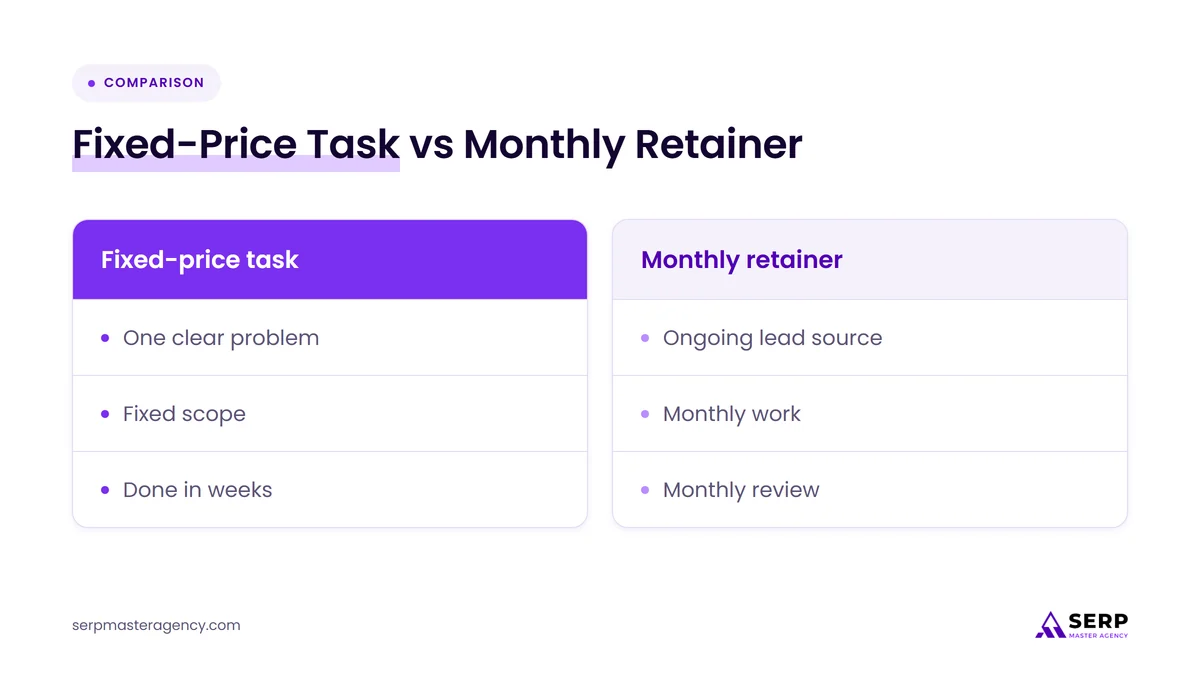
How do fixed-price SEO tasks and monthly retainers compare?
Fixed-price tasks give you cost certainty and a clear deliverable but stop when the job is done. Retainers cost more over a year but keep improving your visibility and respond to change. The right choice depends on how competitive your market is, how much of your revenue comes from search and whether anyone in-house can keep the work going.
| Factor | Fixed-price SEO task | Monthly SEO retainer |
|---|---|---|
| What you buy | A defined deliverable (audit, setup, fix, set of pages) | Ongoing work, monitoring and reporting |
| Cost pattern | One payment, known up front | Recurring monthly fee |
| Commitment | None after delivery | Usually a minimum term, then month to month |
| Best for | Known problems, new sites, low-competition markets, tight budgets | Competitive markets, businesses that rely on search for leads |
| Speed of visible change | Fast for fixes such as listings or broken pages | Gradual, builds over months |
| Handles Google updates and competitors | No, unless you buy another task | Yes, adjustments are part of the work |
| Main risk | Gains fade if nobody maintains them | Paying for vague activity with no clear output |
| How to judge success | Was the deliverable completed as scoped? | Are leads, calls and revenue from search growing? |
How much do SEO tasks and retainers cost?
SEO prices vary widely by provider type and country. In Ahrefs’ survey of 439 SEO providers, the average reported cost was $2,917 per month, local SEO averaged $1,557 per month, the most common retainer band was $501 to $1,000 per month, and the most common per-project fee was $2,501 to $5,000.
A few details from that survey are useful when you compare quotes:
- Pricing models: 78.2% of providers charge a monthly retainer, 48.9% charge per project and 34.8% charge hourly. Many offer more than one model.
- Retainers: $501 to $1,000 per month was the most popular band, chosen by 20.4% of respondents.
- Projects: $2,501 to $5,000 was the most popular per-project fee, chosen by 21.2% of respondents.
- Local SEO: the average was $1,557 per month, lower than the overall average.
Treat these as a guide, not a price list. The figures are self-reported by providers, so they show what SEOs charge rather than what results cost, and prices depend heavily on the size of the site, the competition and the country you target (Ahrefs, 2024).
The useful comparison is not the monthly fee against the task price. It’s the total you would spend over 12 months under each option against the leads you expect search to bring in. A one-off audit is cheaper this month. Whether it stays cheaper depends on what happens after it’s delivered.
When is a one-off SEO task enough?
A one-off SEO task is enough when the problem is specific, the fix is clear and nothing in your market will undo it quickly. Good examples are a new local business that needs its Google Business Profile and listings set up correctly, or an established site with a technical issue that a single audit and fix will solve.
A fixed-price task is usually the right buy in these situations:
- You have a known, bounded problem. For example, pages dropped out of Google after a redesign, or your business shows the wrong phone number on directories. Inconsistent listings are a classic one-off job, and our guide on fixing inconsistent NAP across listings explains what that cleanup involves.
- Your local market is not crowded. If you’re one of three electricians in a small town and none of your competitors invest in SEO, a solid setup may hold its position for a long time.
- You’re launching or rebuilding a website. Keyword research, a page plan and on-page setup before launch is a natural fixed-scope project.
- You have someone in-house to carry on. If an office manager or marketer can post updates, ask for reviews and publish content, a one-off audit with a clear plan may be all the outside help you need.
- You want to test a provider first. A small fixed-price task shows you how an agency communicates and delivers before you commit to a monthly plan.
- Your budget is limited. One well-chosen task that fixes your biggest problem beats a cheap retainer spread too thin to do anything properly.
When does a business need ongoing SEO?
A business needs ongoing SEO when search brings in a meaningful share of its customers and competitors keep working on theirs. Rankings, reviews and content all age, Google changes its systems several times a year, and a position won through one project can be lost to a rival who keeps publishing and earning reviews every month.
Four things explain why SEO results rarely stay fixed:
- Google keeps changing. Google’s Search Status Dashboard lists seven ranking updates in 2026 so far, including the March and May core updates and four spam updates. Each one can shift who ranks for what.
- Customers want fresh reviews. BrightLocal’s 2026 survey of 1,002 US consumers found that 74% seek reviews written in the last three months. A burst of reviews from one campaign goes stale quickly.
- Strong rankings take years to build. Ahrefs found that only 1.74% of newly published pages reached Google’s top 10 within a year, that 72.9% of top 10 pages are more than three years old and that the average #1 page is five years old (Ahrefs, 2025).
- Customers now search in more places. In the same BrightLocal survey, use of ChatGPT and other AI tools for local recommendations rose from 6% to 45% in one year. Staying visible across Google and AI tools is ongoing work.
A retainer is usually the better choice when one or more of these is true:
- Most new customers find you through Google or Google Maps.
- You compete in a busy category such as law, home services, accounting or medical aesthetics in a large city.
- Your competitors publish content and collect reviews every month.
- You serve several locations or several services, each needing its own pages.
- Nobody in your business has time to keep SEO going after a project ends.
Our local SEO services page explains what ongoing local work covers for businesses that rely on map results and nearby customers.
Is there a middle ground between one-off tasks and a full retainer?
Yes. Many businesses start with fixed-price tasks to fix their foundations, then move to a smaller monthly plan focused on the activities that keep producing leads. Others buy specific tasks each quarter. A hybrid approach keeps costs predictable while making sure the important work does not stop after the first project.
Three hybrid patterns work well for service and local businesses:
- Audit first, then decide. Pay for a technical and local audit, fix what it finds, and use the results to decide whether ongoing work is worth it.
- Foundation project, then a light plan. Do the heavy setup as a fixed-price project, then keep a smaller monthly plan for reviews, Google Business Profile updates and a few pieces of content.
- Scheduled tasks. Buy specific tasks on a calendar, such as a quarterly listings check and a twice-yearly content refresh, with no monthly contract.
How do you decide which option your business should buy?
Decide by working out how much revenue search brings you, how competitive your market is and who will maintain the work. If search is a small channel and you have one clear problem, buy a task. If search drives a large share of your leads and rivals are active, budget for ongoing work.
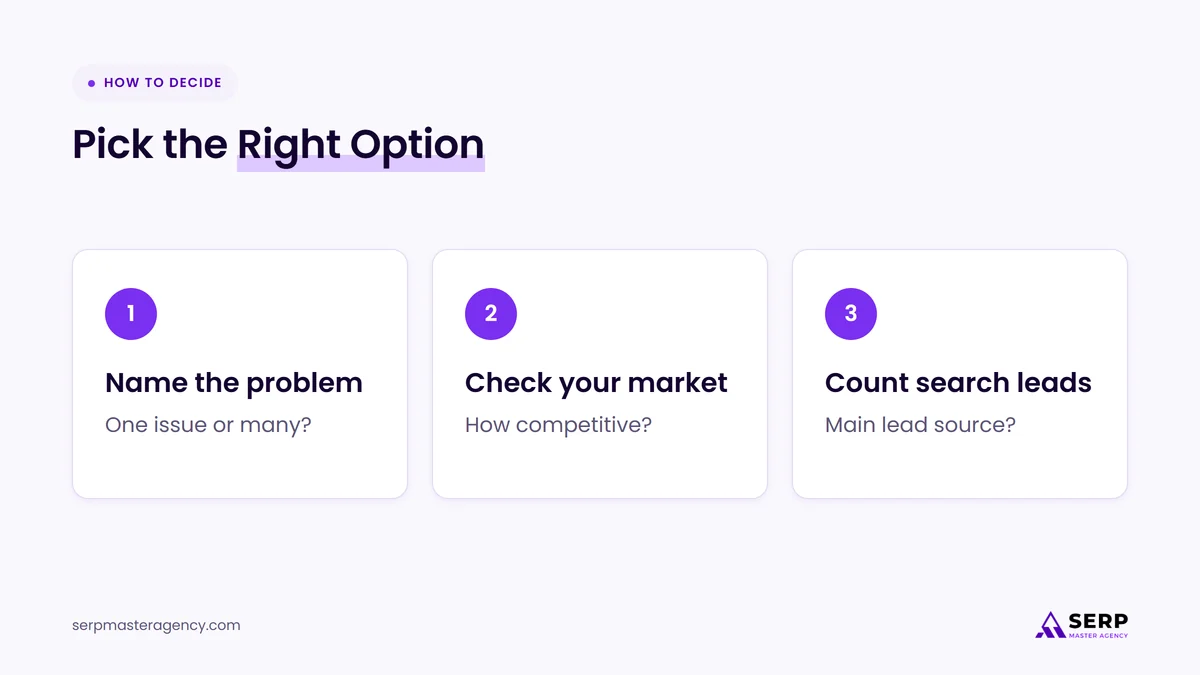
- Check where customers come from. Ask new customers how they found you and look at calls and form fills from Google. If search is a big source, protecting it is worth a monthly cost.
- Look at your competitors. Search for your main service and city. If the businesses above you have fresh reviews, detailed service pages and recent posts, they’re investing every month.
- List your known problems. If you can name a specific issue, such as wrong listings, missing pages or a slow site, price it as a fixed task first.
- Be honest about in-house time. If nobody will post updates, ask for reviews or write content after the project ends, a retainer replaces that missing time.
- Compare 12-month cost against lead value. Estimate what one new customer is worth and how many extra customers search would need to bring in to cover each option.
- Agree how success is measured. For tasks, the measure is the deliverable. For retainers, track leads, calls and revenue, not only rankings. Our guide to measuring SEO by leads and revenue shows how to set this up.
What should you ask before you pay for either option?
Before paying for any SEO work, ask exactly what will be delivered, how success will be measured, how long results usually take and what happens if you stop. Google’s own hiring advice says no one can guarantee a #1 ranking, so treat any provider that promises one as a warning sign.
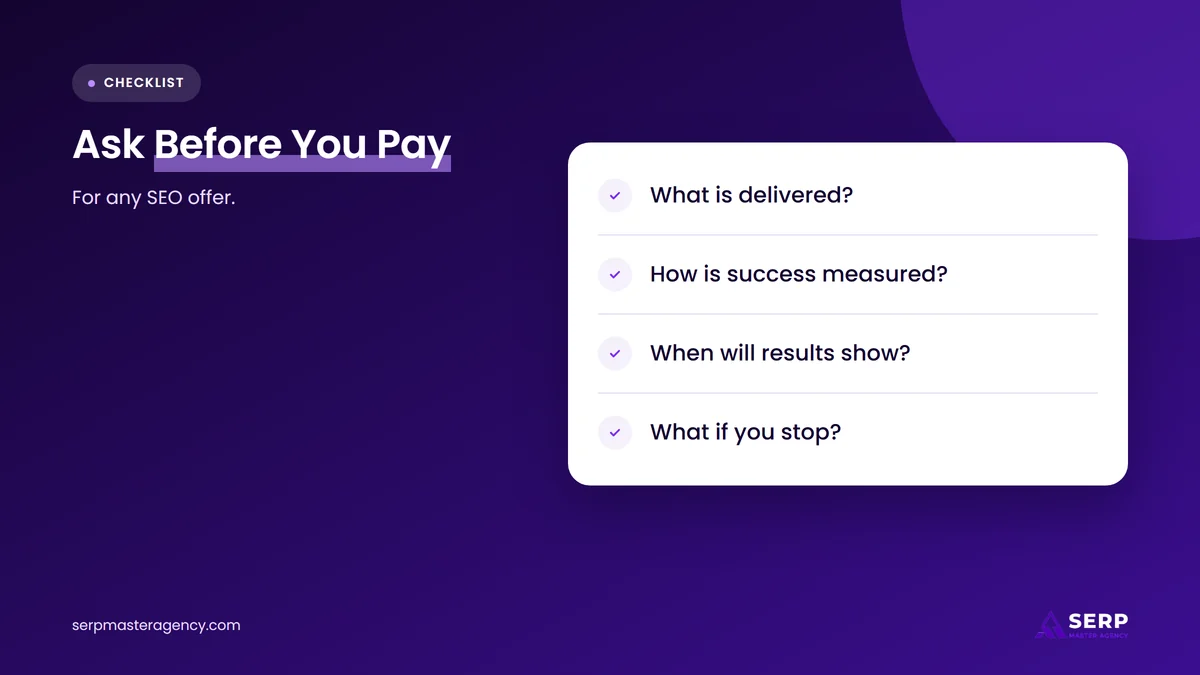
Google’s Search Central guide to hiring an SEO suggests asking providers for examples of previous work, whether they follow Google Search Essentials, what results they expect and in what timeframe, and how they will communicate the changes they make. It also states that “No one can guarantee a #1 ranking on Google.”
For a fixed-price task, also ask:
- What exactly is in scope, and what is not?
- Who implements the fixes, you or the provider?
- What do you receive at the end: a report, completed changes or both?
For a monthly retainer, also ask:
- What specific work happens each month, and how will you see it?
- How long is the minimum term, and how much notice do you need to give to leave?
- Which business numbers, such as calls, form fills or booked jobs, will the reports track?
Contract length deserves its own question. Some providers now skip long lock-ins altogether. One SEO consultant who runs every retainer month to month said this about 12-month contracts on X:
“It just delays the conversation about whether it’s working.”
Connor Cedro (@connorcedroseo) on X, September 16, 2026 (source)
Whatever term you sign, agree up front when and how you will review results together.
How does SERP Master Agency approach tasks and retainers?
SERP Master Agency sells SEO both ways: as fixed-price tasks for specific jobs and as monthly plans for ongoing work. We recommend a fixed-price task when a business has one clear problem and a retainer when search is a main lead source in a competitive market, and we say so when a smaller option will do.
In practice, that means we often suggest starting with a single task, such as an audit or a Google Business Profile and listings cleanup, before discussing anything monthly. If the audit shows that competitors are far ahead or that the business depends on search for most of its leads, a monthly plan usually makes more sense than buying task after task. You can see the full range of work on our SEO services page.
Frequently asked questions
Is one-time SEO worth it?
One-time SEO is worth it when it fixes a specific problem that is holding your site back, such as technical errors, wrong business listings or a poorly set up Google Business Profile. It is less useful as a substitute for ongoing work in a competitive market, because the gains fade if nobody maintains them.
How long should an SEO retainer last before I judge it?
Give a retainer at least a few months before judging rankings, because new and updated pages take time to gain ground. You can judge the work itself from the first month: you should see a clear plan, completed tasks and reports that track calls and leads, not only rankings.
Can I switch from a retainer to fixed-price tasks later?
Yes. Once your foundations are strong and your rankings are stable, some businesses move to occasional fixed-price tasks such as quarterly listing checks or content refreshes. Check your contract’s minimum term and notice period first, and make sure you keep access to your accounts, reports and content.
Do small local businesses need a monthly SEO retainer?
Not always. A small local business in a quiet market can often do well with a one-off Google Business Profile setup, a listings cleanup and a simple plan for collecting reviews. A retainer makes more sense in busy categories and larger cities, where competitors invest every month and most customers search on Google Maps.
What should a fixed-price SEO task include?
A fixed-price SEO task should include a written scope, a clear deliverable, a delivery date and a statement of who implements the changes. For audits, ask for a prioritized list of fixes rather than a long export from a tool, so you know exactly what to do first.
Which should your business buy?
If you have one clear problem and a quiet market, buy a fixed-price task, fix it properly and review the results. If search is where most of your customers come from and your competitors are active, budget for ongoing work, because rankings, reviews and content need regular attention. If you’re unsure, start with an audit to learn which situation you’re in. You can see both options in our SEO services at SERP Master Agency.
Not sure whether you need a task or a monthly plan?
SERP Master Agency sells SEO as fixed-price tasks and monthly plans. Tell us about your business, your market and what you want from search. We’ll tell you honestly whether a fixed-price task will do the job or whether ongoing SEO makes more sense.
Sources
- Ahrefs, “SEO Pricing: How Much Does SEO Cost? 439 People Polled”, August 15, 2024. https://ahrefs.com/blog/seo-pricing/
- Ahrefs, “How Long Does It Take to Rank in Google? And How Old Are Top Ranking Pages?”, May 15, 2025. https://ahrefs.com/blog/how-long-does-it-take-to-rank-in-google-and-how-old-are-top-ranking-pages/
- BrightLocal, “Local Consumer Review Survey 2026: Star Ratings Keep Rising, Old Reviews Don’t Cut It”, February 11, 2026. https://www.brightlocal.com/research/local-consumer-review-survey/
- Google, “Google Search Status Dashboard: Ranking incident history”, accessed November 1, 2026. https://status.search.google.com/products/rGHU1u87FJnkP6W2GwMi/history
- Google Search Central, “Do You Need an SEO? Tips for Hiring an SEO”, updated June 5, 2026. https://developers.google.com/search/docs/fundamentals/do-i-need-seo
- Connor Cedro (@connorcedroseo) on X, post on month-to-month SEO retainers, September 16, 2026. https://x.com/connorcedroseo/status/2100277913341895013

Suraj Rana is a highly regarded SEO expert specializing in the dental industry. His expertise lies in crafting strategic SEO marketing plans to help new or expanding businesses increase their online visibility and attract more customers. Suraj Rana’s skills extend to improving website rankings and boosting organic search visibility, thereby enhancing web traffic and return on investment for businesses.