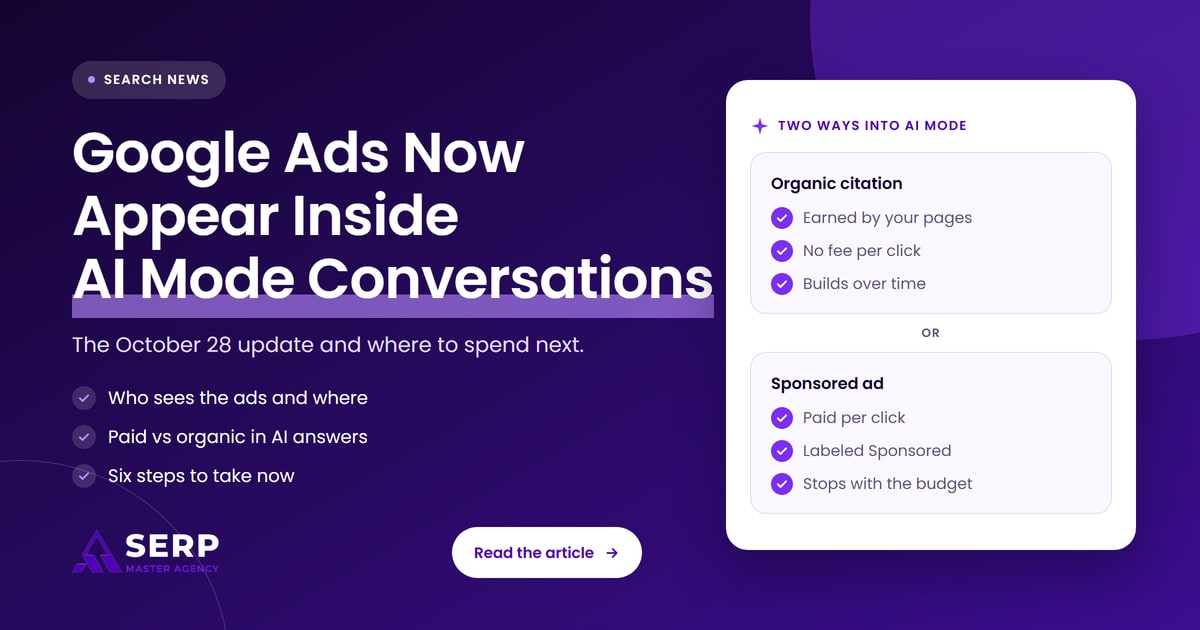
Quick answer: Google now shows ads inside AI Mode answers in the US and ten more countries, including Australia, Canada and New Zealand, with the UK planned for late 2026. In the US, ads can also appear on follow-up questions. Existing Search, Shopping and Performance Max campaigns are eligible automatically, so most businesses need sharper targeting and tracking rather than a bigger budget.
Key takeaways
- On October 28, 2026, Google said it is scaling ads in AI Mode to Australia, Canada, India, Kenya, Malaysia, New Zealand, Nigeria, Pakistan, the Philippines and Singapore.
- Google plans to add Brazil, Mexico and the United Kingdom in Q4 2026.
- New “multiturn” ads in the US can appear on follow-up questions inside an AI Mode conversation, labeled “Sponsored.”
- You can’t opt out of AI Mode ads separately from Search, and their results are blended into your normal campaign reports.
- Organic citations still matter: Google says pages only need to be indexed and eligible for a snippet to appear as links in AI Mode, with no special optimization.
- The sensible response is to tighten targeting and lead tracking, not to move budget away from SEO.
What changed with ads in Google AI Mode?
On October 28, 2026, Google announced that ads in AI Mode are expanding from the US to ten more countries, with Brazil, Mexico and the UK planned for Q4 2026. Google also launched multiturn ads in the US, which let sponsored results appear on follow-up questions, not only on the first question in an AI Mode conversation.
The announcement came from Shashi Thakur, Google’s VP and GM for Search Ads, on the Google Ads and Commerce blog. Search Engine Roundtable reported the news the same day and noted that Google first launched ads in AI Mode in May 2025, so this is an expansion of an existing product rather than a brand-new one.
Here is what the update covers, based on Google’s announcement and its Google Ads help page:
| Item | What Google says |
|---|---|
| Where ads show in AI Mode now | United States, plus Australia, Canada, India, Kenya, Malaysia, New Zealand, Nigeria, Pakistan, the Philippines and Singapore, in English |
| Planned next | Brazil, Mexico and the United Kingdom, in Q4 2026 |
| Follow-up questions | Multiturn ads launching in the US, so ads can appear on responses to follow-up queries |
| Label | Ads are labeled “Sponsored” |
| Ad formats | Text ads and Shopping ads, with local inventory and vehicle ads in testing |
| Eligible campaigns | Existing Search, Shopping and Performance Max campaigns, with no new campaign or separate budget needed |
| Opt-out | Not available separately from Search; negative keywords and brand exclusions still apply |
| Reporting | Included in aggregate in standard campaign reports and the search terms report |
What is Google AI Mode, and what are multiturn ads?
Google AI Mode is a conversational search experience inside Google Search where people ask a question, get an AI-written answer with supporting links and then ask follow-up questions. Multiturn ads are sponsored results that can appear on those follow-up answers, so an ad can show several steps into a conversation instead of only on the opening search.
Google’s Search Central documentation explains that AI Mode may run several related searches behind the scenes to build one answer, a process it calls query fan-out, and that it can show a wider and more varied set of links than a classic results page. That matters for advertisers and site owners alike: one question can trigger many searches, and the answer can draw on many pages.
Google also says AI Mode queries are, on average, three times longer than traditional searches, citing its own AI Mode Report for the US from May 2026. Longer questions usually carry more detail about what the person needs, such as a budget, a location or a deadline.
Who is affected by the AI Mode ads expansion?
Any business running Google Search, Shopping or Performance Max campaigns in a covered country is affected, because those campaigns are now eligible to show in AI Mode automatically. Businesses that rely only on organic search are affected too, because a sponsored result can now sit inside the same answer that cites or ignores their pages.
How the change reaches you depends on where your customers are:
- United States: ads can appear in AI Mode answers and, with multiturn ads, on follow-up questions.
- Australia, Canada and New Zealand: ads in AI Mode are now rolling out in English.
- United Kingdom: Google plans to add ads in AI Mode in Q4 2026, so UK advertisers have a short window to prepare.
- Businesses selling into several of these countries: the same campaign may now behave differently by market, which makes country-level reporting more important.
The help page also explains how matching works. Broad match keywords, AI Max for Search, Shopping and Performance Max can match both direct queries and the broader context of a conversation. Exact and phrase match keywords aren’t eligible for that contextual matching on broader exploratory questions, though they can still serve when a query shows direct commercial intent.
How do ads in AI Mode work for advertisers?
Ads in AI Mode run from your existing Google Ads campaigns. Google decides when a sponsored text or Shopping result fits the conversation, places it within or alongside the AI answer under a “Sponsored” label, and reports the results inside your normal campaign data. You can’t buy AI Mode placements on their own or switch them off separately.
Three details on the help page are worth knowing before you change anything:
- No separate targeting. You can’t target ads only to AI Overviews or AI Mode, and you can’t exclude them separately from Search. Your control comes from keywords, match types, negative keywords and brand exclusions.
- AI explainers you don’t control. Some ads may come with a short AI-written explainer. Advertisers can’t write, edit, approve or opt out of these explainers.
- Blended reporting. AI Overview and AI Mode results are included in aggregate in your standard reports and search terms report, covering impressions, clicks, conversions and cost. You won’t see a clean “AI Mode only” line.
Google also shared one early performance figure: in its internal US data from August 20 to September 3, 2026, click-through rates were similar between sponsored and organic product list items within AI Mode. That figure comes from Google, covers product listings only and doesn’t speak to leads or sales, so treat it as Google’s claim rather than a benchmark for your account.
Does this mean organic SEO matters less?
No. Ads in AI Mode add a paid way into AI answers, but the organic links inside those answers still come from indexed pages that Google trusts to answer the question. A business that is cited organically appears in the answer without paying per click, and that visibility doesn’t stop when an ad budget runs out.
Google’s guidance for site owners hasn’t changed with this announcement. Its Search Central page on AI features says there are no additional requirements and no special optimizations needed to appear in AI Overviews or AI Mode. A page needs to be indexed and eligible to show in Google Search with a snippet, and the usual SEO basics still apply. Google also says traffic from AI features is counted in the Search Console Performance report under the Web search type.
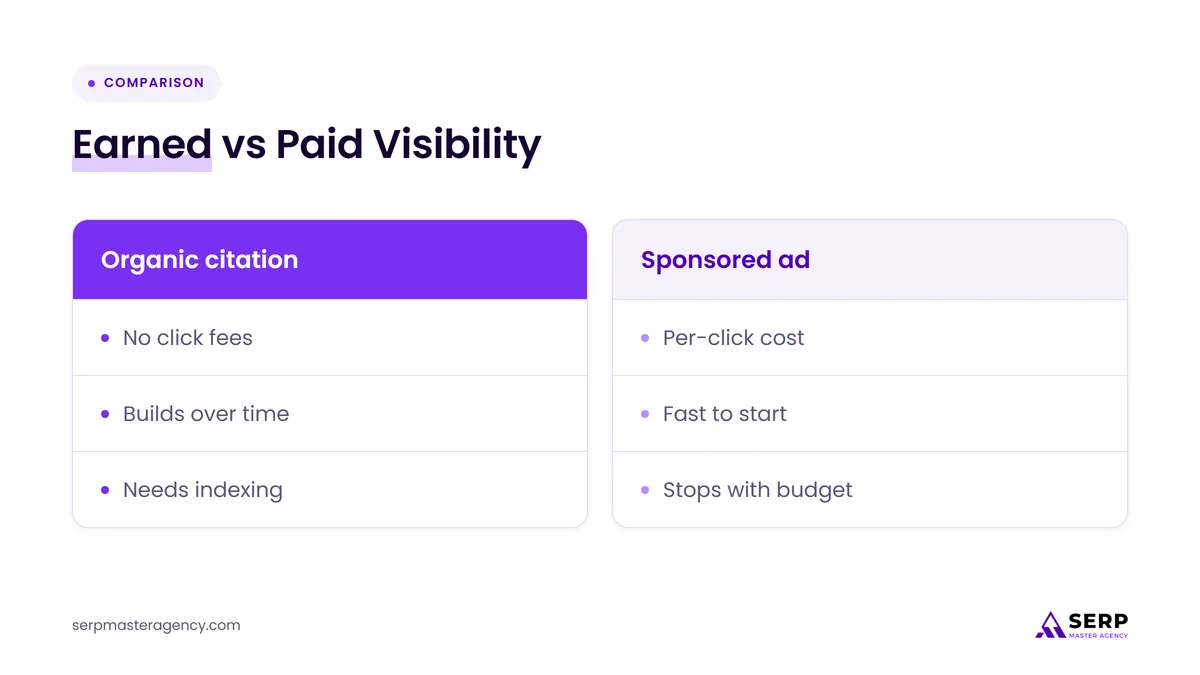
| Factor | Organic citation in AI Mode | Sponsored ad in AI Mode |
|---|---|---|
| How you get in | Indexed, snippet-eligible pages that answer the question well | An eligible Search, Shopping or Performance Max campaign |
| Cost | No fee per click; cost is the work on your site and content | You pay for clicks, as with other Google Ads |
| Speed | Builds over weeks and months | Can start as soon as campaigns are eligible |
| When it stops | Lasts while your pages stay relevant and indexed | Stops when the budget or campaign stops |
| Control | Your content, your facts, your structure | Keywords and exclusions; AI explainers can’t be edited |
| Where to measure | Search Console, Web search type, plus your lead tracking | Google Ads reports, blended with other Search results |
The two work best together. Paid placements can cover high-intent follow-up questions straight away, while organic citations build trust for the many questions you can’t afford to bid on. If you want the organic side in more depth, our guide on how to get cited by AI search tools walks through the content and entity work involved, and our piece on how AI Overviews change the way buyers find businesses covers the wider shift in search.
Should you change how you spend on search?
For most businesses, the right move is to adjust how existing budgets work rather than to shift money between SEO and ads. AI Mode ads use the campaigns you already run, so the main risks are poor-fit matches and unclear reporting. The main opportunity is showing up on detailed follow-up questions from people closer to buying.
A simple way to decide where each dollar goes:
- Keep funding organic work if search is a main source of leads, because organic citations in AI answers don’t depend on a daily budget.
- Review paid spend, don’t cut it on reflex, if Google Ads already brings in profitable leads. The ads are reaching new placements, not replacing the old ones.
- Hold off on large new paid budgets until you can see whether lead quality changes, since AI Mode results are blended into standard reports.
- Watch the UK date if you sell there. Google has only said Q4 2026, so prepare your account before it arrives.
If paid search is part of your mix, our PPC advertising services page explains how we manage Google Ads campaigns alongside SEO.
What should you do now?
Start by checking which of your campaigns can now show in AI Mode and on what kinds of questions. Then tighten negative keywords, make sure conversion tracking records real leads, and confirm your key pages are indexed and snippet-eligible so they can be cited organically in the same answers.
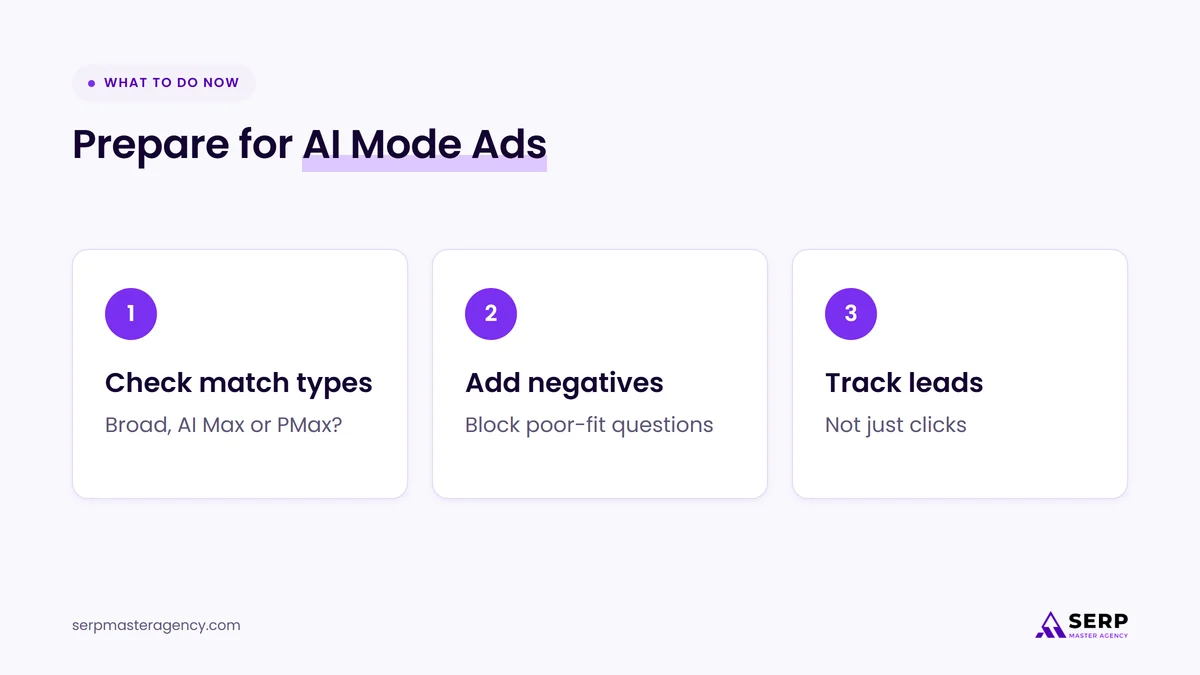
- Check your match types. Campaigns using broad match, AI Max for Search, Shopping or Performance Max can match broader conversational questions. If you only use exact and phrase match, you’ll mainly show when a query has direct commercial intent.
- Add negative keywords and brand exclusions. Longer, conversational questions can pull your ads into research-stage or poor-fit topics. Review your search terms report often and exclude what doesn’t convert.
- Track leads, not just clicks. Because AI Mode results are blended into your normal reports, the clearest signal is whether calls, forms and sales from paid search hold up. Make sure conversion tracking counts real enquiries.
- Check your Shopping feed if you sell products. Shopping ads are one of the supported formats, so accurate titles, prices and availability in Merchant Center matter more as ads appear in AI answers.
- Confirm your important pages can be cited. Make sure service and product pages are indexed and not blocked from showing snippets. Google says that is the requirement for appearing as a link in AI Mode.
- Watch organic traffic in Search Console. AI feature traffic is counted under the Web search type, so compare clicks and impressions for your main pages month over month.
How do you stay cited organically in AI Mode answers?
Stay cited by keeping your key pages indexed and snippet-eligible, answering real customer questions directly near the top of each page, and keeping your business facts consistent across your site, Google Business Profile and Merchant Center. Google says no special AI optimization is needed, so the basics done well are what count.
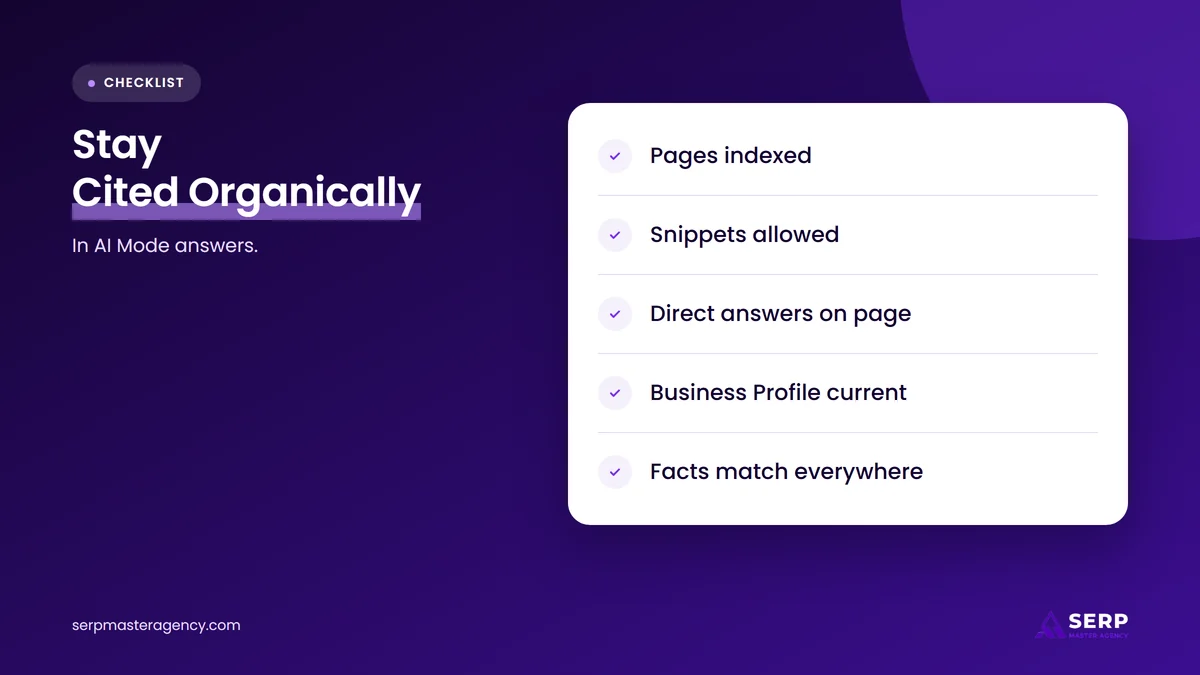
Google’s AI features guidance lists the practices that still apply:
- Allow Google to crawl your pages in robots.txt and make them easy to find through internal links.
- Provide a good page experience, so visitors who click through from an AI answer stay.
- Keep any structured data consistent with the text people can see on the page.
- Keep your Merchant Center and Business Profile information up to date.
Because AI Mode questions are longer, it also helps to write pages that answer the follow-up questions customers actually ask, such as cost ranges you are willing to publish, service areas, timelines and who the service suits. Google also says you don’t need new machine-readable files, AI text files or special markup to appear in these features. To check whether that work leads to enquiries, see our guide to measuring SEO by leads and revenue.
What is likely to happen next?
Google has said it will keep testing new ad formats in AI Mode and plans to reach Brazil, Mexico and the UK in Q4 2026. In our view, multiturn ads will spread beyond the US over time, and reporting will stay blended for a while, so businesses that track leads carefully will make better decisions than those watching clicks.
This section is our opinion, not Google’s. The facts are that Google is testing local inventory and vehicle ads in AI experiences and has not announced separate AI Mode reporting or opt-outs. We expect the businesses that do well to be the ones present on both sides of the answer: cited organically for the questions they know best and bidding selectively on the follow-ups closest to a sale.
Frequently asked questions
Are ads in Google AI Mode available in the UK?
Not yet. Google said on October 28, 2026 that it plans to expand ads in AI Mode to the United Kingdom, Brazil and Mexico in Q4 2026. UK advertisers can prepare now by reviewing match types, negative keywords and conversion tracking so their campaigns are ready when ads begin to show.
Do I need a new campaign to show ads in AI Mode?
No. Google’s help page says existing Search, Shopping and Performance Max campaigns are automatically eligible, with no new campaign or separate budget needed. Broad match, AI Max for Search, Shopping and Performance Max can also match broader conversational questions, while exact and phrase match mainly serve on direct commercial queries.
Can I stop my ads from showing in AI Mode?
Not on its own. Google says you can’t target ads only to AI Overviews or AI Mode, or opt out of them separately from Search. You can still shape where ads appear with negative keywords and brand exclusions, and by choosing which match types your campaigns use.
How are ads labeled in AI Mode?
Ads in AI Mode are labeled “Sponsored.” They can appear within or alongside the AI answer, and in the US they can also appear on answers to follow-up questions through multiturn ads. Some ads may include a short AI-written explainer that advertisers can’t edit or turn off.
Will ads in AI Mode reduce my organic traffic?
Google’s announcement doesn’t address organic traffic, so no one can say for certain how it will affect a given site. What Google does say is that organic links in AI Mode come from indexed, snippet-eligible pages, and that AI feature traffic is counted in Search Console. Track your own clicks and leads there month over month.
Should your business change how it spends on search?
Ads in AI Mode give paid search a new place to appear, but they don’t replace the organic citations that make your business part of the answer in the first place. Keep your SEO foundations strong, tighten your Google Ads targeting and judge both by leads. Our SEO services at SERP Master Agency focus on keeping your pages indexed, cited and bringing in enquiries as Google search changes.
Want to know how AI Mode ads affect your search plan?
Tell us where your customers are and how you use search today. SERP Master Agency will look at your organic visibility and paid campaigns together and tell you plainly what, if anything, to change.
Sources
- Google, “Ads in AI Mode expand to new markets” (Shashi Thakur, Google Ads and Commerce blog), October 28, 2026. https://blog.google/products/ads-commerce/ads-in-ai-mode-global/
- Search Engine Roundtable, “Google Expands Ads In AI Mode To More Countries & Multiturn Ads In U.S.” (Barry Schwartz), October 28, 2026. https://www.seroundtable.com/google-expands-ads-ai-mode-42412.html
- Google Ads Help, “About ads in AI-powered experiences in Google Search”, accessed November 2, 2026. https://support.google.com/google-ads/answer/18826097
- Google Search Central, “AI features and your website”, updated December 10, 2025. https://developers.google.com/search/docs/appearance/ai-features

Suraj Rana is a highly regarded SEO expert specializing in the dental industry. His expertise lies in crafting strategic SEO marketing plans to help new or expanding businesses increase their online visibility and attract more customers. Suraj Rana’s skills extend to improving website rankings and boosting organic search visibility, thereby enhancing web traffic and return on investment for businesses.