Quick answer: Law firms get recommended by Google and AI assistants by keeping an accurate Google Business Profile, earning steady, honest client reviews, publishing a clear page for every practice area and attorney, and making sure the firm’s details match everywhere online. AI Overviews, AI Mode and ChatGPT draw on that same public information, so solid SEO fundamentals come first.
Key takeaways
- Google says there are no special optimizations needed to appear in AI Overviews or AI Mode. Normal SEO fundamentals apply to law firms too.
- Legal topics fall under what Google calls “Your Money or Your Life”, where it gives extra weight to content showing strong experience, expertise and trust.
- Google Business Profile rules for lawyers are specific: firms, individual practitioners and solo attorneys each have their own naming and listing rules.
- Use of ChatGPT and other AI tools for local recommendations rose from 6% to 45% in one year, according to BrightLocal’s 2026 survey of US consumers.
- Every claim on your website, profile and reviews strategy must also pass your bar or regulator’s advertising rules, such as ABA Model Rules 7.1 and 7.2 in the US and the SRA Transparency Rules in England and Wales.
What is SEO for lawyers?
SEO for lawyers is the work of making a law firm show up when people search Google, Google Maps or AI assistants for legal help. It covers the Google Business Profile, practice area and attorney pages, reviews, directory listings and technical health, all aimed at turning searches into consultations while staying inside professional advertising rules.
Legal search splits into two kinds of demand, and good law firm SEO plans for both:
- Urgent searches: “DUI lawyer near me”, “arrested what do I do”, “car accident lawyer”. The person wants help quickly and usually contacts one of the first firms they see in the map pack or an AI answer.
- Researched searches: “how does divorce mediation work”, “do I need a lawyer for probate”, “best estate planning attorney in my city”. The person compares firms, reads reviews and often asks an AI assistant to explain the process before calling anyone.
What does it mean to be recommended by AI?
Being recommended by AI means your firm is named or linked when someone asks Google AI Overviews, AI Mode, ChatGPT or a similar assistant for a lawyer. These tools build their answers from information they find across the web, including your website, your Business Profile, reviews and directories, so they reward firms with clear, consistent public information.
Google explains that AI Overviews and AI Mode may run several related searches across subtopics to build one answer, a technique it calls query fan-out. For a question like “should I hire a lawyer after a car accident”, that can pull in pages about fault, insurance, timelines and local firms. A firm whose site answers each of those questions clearly has more chances to appear (Google Search Central).
How are clients using AI to find a lawyer now?
More people now ask AI tools for local recommendations alongside Google and Maps. BrightLocal’s 2026 survey found that use of ChatGPT and other AI tools for local business recommendations rose from 6% to 45% in one year. Google is also blending AI answers into local results, so a firm’s listing can now be summarized by AI.
Three recent changes are worth knowing about:
- Business listings shown as AI Overviews. In September 2026, Search Engine Roundtable reported Google showing local knowledge panels, the Business Profile listing, as an AI Overview with a “Show more” button that opens an AI Mode style chat. The reporter found most of the summary accurate but part of it out of date, which shows why your own site and profile need to stay current.
- Ads inside AI Mode in more countries. On October 28, 2026, Google said ads in AI Mode were expanding to Australia, Canada and New Zealand, among other markets, with the United Kingdom planned for the fourth quarter of 2026. Our guide on Google ads in AI Mode explains what this means for businesses.
- More spam and review enforcement. Search Engine Roundtable’s October 2026 roundup covered the September 2026 spam update and a warning to business owners about a spike in spam reviews. Shortcuts with reviews or listings carry more risk, not less.
Reviews still matter a great deal. The same BrightLocal survey of 1,002 US consumers found that 97% read reviews for local businesses and 74% look for reviews written in the last three months (BrightLocal, 2026).
How does Google decide which law firms show up in local results?
Google ranks local results on three main factors: relevance, distance and prominence. Relevance is how well a profile matches the search, distance is how far the firm is from the searcher, and prominence is how well known the firm is, based on reviews, links, articles and other information Google finds online.
| Factor | What it means | What a law firm can do |
|---|---|---|
| Relevance | How well your Business Profile matches what someone searched for | Choose the most accurate primary category, list your practice areas and write a plain description of who you help |
| Distance | How far your office is from the person searching | Keep your address accurate and build a page for each real office. You can’t change where the searcher is. |
| Prominence | How well known your firm is | Earn steady reviews, reply to them, keep listings consistent and earn mentions from local media, bar associations and legal publications |
Google’s own tips are simple: verify your business, keep your details accurate and complete, reply to reviews and add photos (Google Business Profile Help). Our guide on how Google Business Profile affects local SEO covers each part of the profile in more detail.
How should a law firm set up its Google Business Profile?
A law firm should set up its Google Business Profile with its real-world name, the most accurate primary category, real hours, its practice areas and a verified office address. Google has specific rules for lawyers as individual practitioners, so decide early whether you need a firm profile, attorney profiles or a single shared profile.
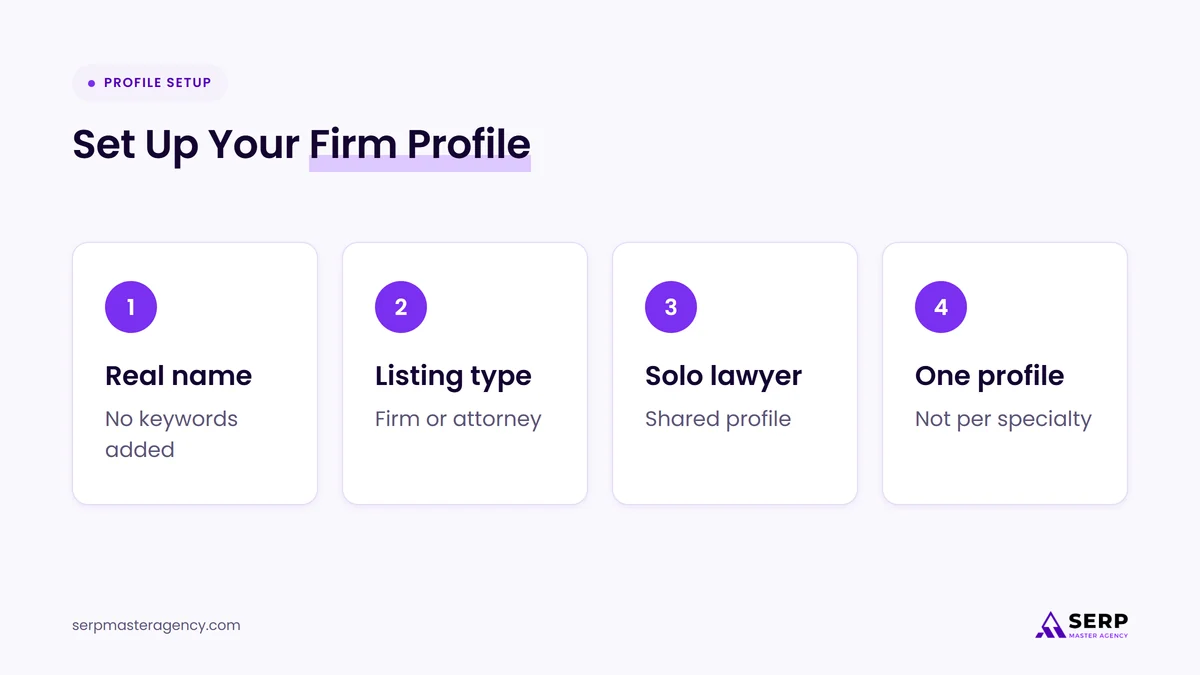
- Use your real firm name. Google’s guidelines say the name should match what you use on your signage, website and stationery. Adding practice areas or city names, such as “Best Car Accident Lawyer Chicago”, breaks the rules and risks suspension.
- Pick the right listing type. Google treats lawyers as individual practitioners. A firm with several attorneys at one office should have a profile for the office, and each attorney who meets clients directly may have their own profile with only their name, plus a title such as “Esq.” or “JD”.
- Handle solo practices correctly. If you are the only public-facing lawyer at a branded firm, Google suggests one shared profile named in the format “Firm name: Attorney name”.
- Don’t split by specialty. Google says a practitioner shouldn’t have several profiles to cover different specializations. List practice areas as services on one profile instead.
Keep hours honest. If you list evening or weekend availability, someone needs to answer the phone. Missed calls from an urgent search often go straight to the next firm in the results.
What website content gets a law firm cited by AI answers?
AI answers tend to cite pages that answer a specific question clearly, in plain text, from a source that looks trustworthy. For a law firm, that means one detailed page per practice area, a real bio for every attorney, and plain-English answers to the questions clients ask before they call, written or reviewed by a licensed lawyer.
Google’s guidance on helpful content says it gives “even more weight” to content showing strong experience, expertise, authoritativeness and trust on topics that can affect people’s finances, safety or well-being. Legal topics fit that description. Google also states that trust is the most important part of E-E-A-T (Google Search Central).
In practice, the pages that help most are:
- Practice area pages: one page for each service, such as wills, probate, DUI defense or employment claims, explaining who it is for, how the process works and what the first consultation covers.
- Attorney bio pages: bar admissions, years in practice, education, publications and the practice areas each lawyer handles. This answers Google’s “who created this” question directly.
- Question pages and FAQs: short, direct answers to questions like “how long does probate take in this state”. Keep answers general and note that every case differs.
- Office and location pages: one per real office, with the address, hours and the practice areas handled there.
Structured data can help Google read your details. Schema.org’s LegalService type describes a business that provides legal services, and Google’s LocalBusiness documentation explains how to mark up name, address, hours and phone. The markup must match what is visible on the page. Our beginner’s guide to schema markup for local SEO walks through the basics.
How do reviews affect whether a law firm gets recommended?
Reviews feed the prominence factor in Google’s local ranking, and they are one of the main sources AI tools use to describe a business. A firm with a steady flow of recent, detailed reviews and thoughtful replies gives Google, AI assistants and prospective clients much more to go on than a firm with a handful of old ones.
Google’s review policy sets clear limits. It prohibits reviews posted in exchange for incentives such as payment or discounts, content based on a conflict of interest such as employment, and selectively asking only happy customers for reviews (Google Maps contribution policy). Ask every client the same way, at a natural point such as the close of a matter.
Lawyers have an extra layer to think about. Replies to reviews are public, and confidentiality duties still apply. Never confirm that the reviewer was a client or discuss the matter in a reply, even to a negative review. A short, polite reply that invites the person to contact the office is safer. Our guide on how reviews and ratings affect local SEO explains the wider review picture.
What do bar advertising rules mean for law firm SEO?
Bar advertising rules apply to your website, profile, directory listings and paid ads, just as they apply to print ads. In the US, ABA Model Rule 7.1 bans false or misleading communications about a lawyer’s services, and Rule 7.2 limits how lawyers can claim to be specialists. Most states base their rules on these, with local differences. Minnesota’s Rule 7.2, for example, follows the ABA structure but adds that a lawyer who claims a specialty without certification must say so in the same paragraph.
Four rules come up again and again in law firm SEO work:
- Specialist claims. ABA Model Rule 7.2(c) says a lawyer shall not state or imply being a certified specialist unless certified by an approved or ABA-accredited organization, and the certifying body must be named. The comments add that describing a practice as concentrating in an area is still subject to Rule 7.1’s false and misleading standard.
- Lead generators and directories. The comments to Rule 7.2 say a lawyer may pay for leads only if the lead generator does not recommend the lawyer or imply it has analyzed the person’s legal problem. Check how any paid directory or lead service presents your firm.
- Responsible lawyer. Rule 7.2(d) requires any communication under the rule to include the name and contact details of at least one lawyer or firm responsible for its content. A clear footer and contact page cover this on your website.
- Past results and testimonials. Many states have their own rules on case results, testimonials and disclaimers. Check your state bar’s version before publishing verdicts or settlement amounts.
Outside the US, the details differ. In England and Wales, the SRA Transparency Rules require firms offering certain services, such as residential conveyancing, uncontested probate and some employment claims, to publish price and service information on their website, along with their complaints procedure, SRA number and the SRA digital badge. In Canada, Australia and New Zealand, check the conduct rules of your provincial or state law society or regulator.
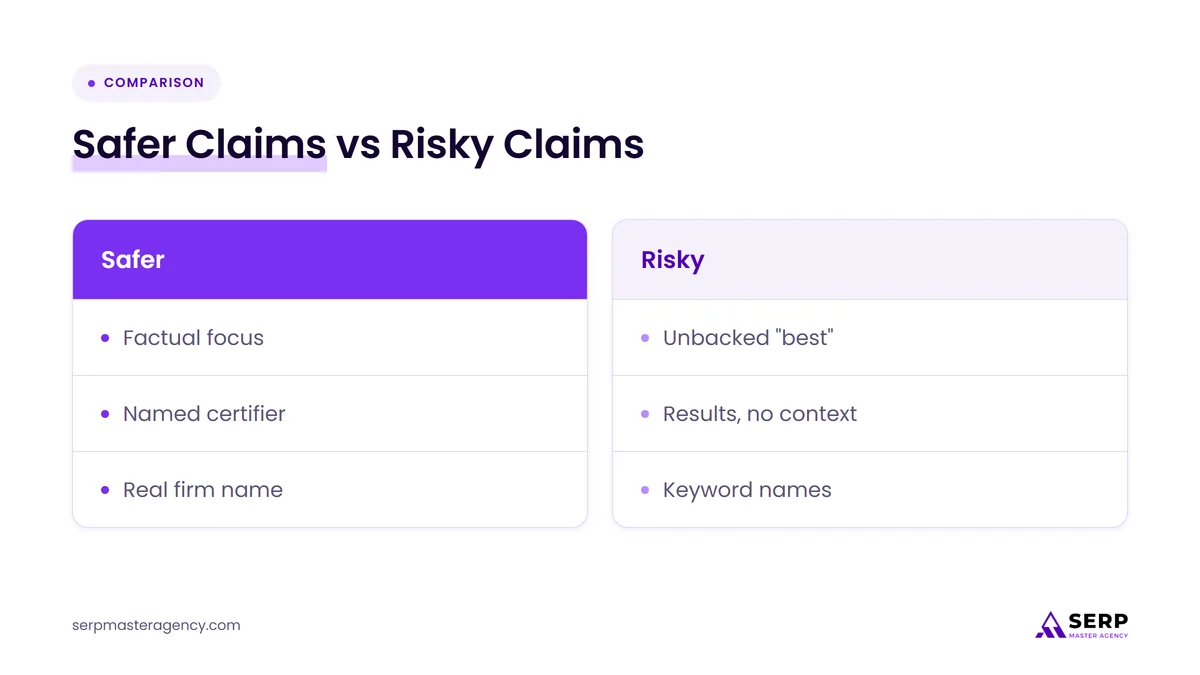
| SEO element | Safer approach | Risky approach |
|---|---|---|
| Practice area wording | “Our practice focuses on family law” | “Certified family law specialist” with no named certifying body |
| Page titles and headings | Factual service and location terms | “Best”, “top” or comparative claims you can’t back up |
| Case results | Shown only where your rules allow, with required context or disclaimers | Big settlement figures with no context |
| Review replies | Polite and general, with no case details | Confirming the reviewer was a client or discussing the matter |
| Business Profile name | Real-world firm name | Firm name plus practice area and city keywords |
This article is general marketing information, not legal or ethics advice. Your own jurisdiction’s rules and ethics opinions decide what is allowed.
Should law firms rely on legal directories?
Legal directories help law firms by adding consistent listings and third-party mentions that Google and AI tools can find, but they shouldn’t replace your own website and Business Profile. Treat directories as support for your prominence, and keep the detailed answers and attorney information on pages you own and control.
Make sure your firm name, address, phone number and practice areas match across every directory you use. Mismatched details make it harder for Google and AI assistants to trust which information is correct. If a directory charges for leads, review its wording against your bar’s rules on recommendations and referrals, as described above.
What should a law firm check every month?
A law firm should check its Business Profile details, new reviews and replies, calls and consultation requests from search, directory consistency, and whether practice area pages still match current law and procedure. Google changes its search features often, and legal content can go out of date when rules change, so a monthly check keeps the firm visible and accurate.
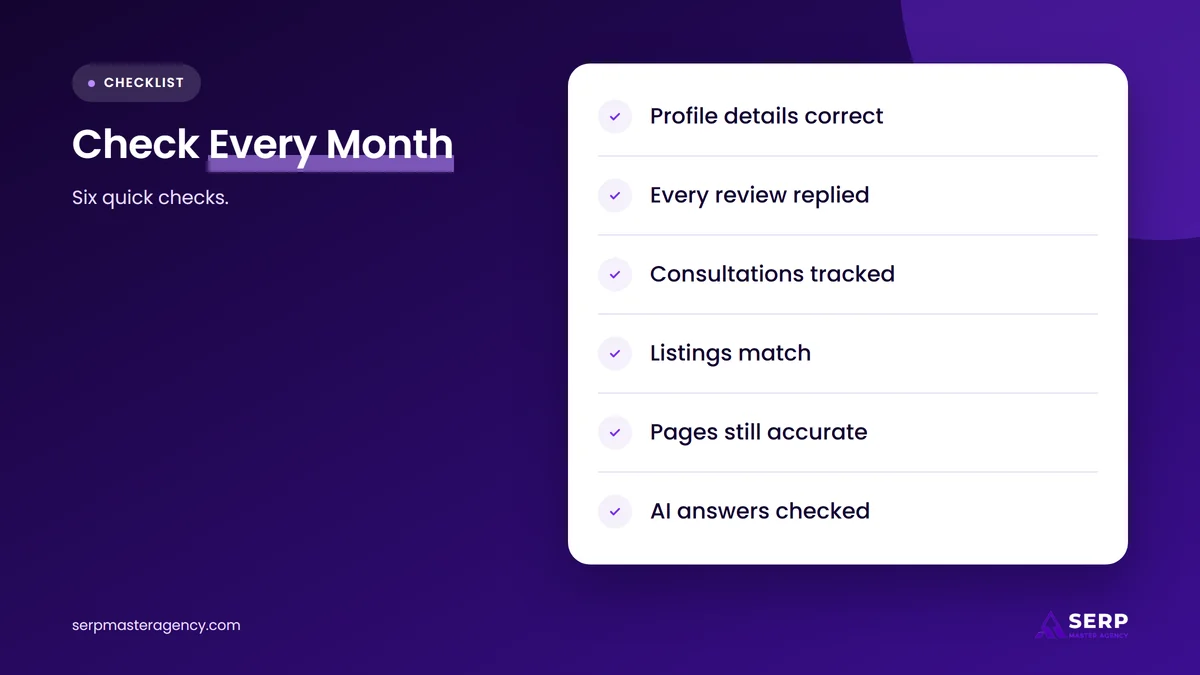
- Profile accuracy: hours, holiday hours, phone number, practice areas and attorney profiles are current, including for lawyers who have left.
- Reviews: new reviews came in and every one has a reply that respects confidentiality.
- Leads: track calls and consultation requests from your Business Profile and website, not only rankings.
- Listings: name, address and phone match across directories.
- Page accuracy: practice area pages reflect current law, fees information and any required disclosures.
- AI answers: ask Google AI Mode and ChatGPT your main questions, such as “estate planning lawyer near me”, and note whether and how your firm appears.
How does SERP Master Agency approach SEO for lawyers?
SERP Master Agency approaches law firm SEO by fixing the Google Business Profile and listings first, then building practice area and attorney pages that answer real client questions, then setting up a review routine that follows Google’s policies. We measure success by consultation requests from search, not rankings alone.
We start with an audit of the profile, the website and the local competitors, because the right first step depends on what is missing. Final wording on claims, case results and disclaimers always stays with the firm’s lawyers, since they know their own jurisdiction’s rules. See what is included on our lawyer SEO services page.
Frequently asked questions
How long does SEO take for a law firm?
Fixes to a Google Business Profile, such as correcting the name, category and hours, can show up soon after Google accepts the edits. New practice area and attorney pages usually take a few months to gain ground, and timelines are longer in competitive areas such as personal injury in large cities.
Can each attorney at a firm have a Google Business Profile?
Yes, if they meet Google’s rules for individual practitioners. Each attorney who works directly with clients at the verified office during stated hours can have a profile with only their name and an optional title such as “Esq.”. The office itself should also have its own profile for the firm.
Do law firms need special markup to appear in AI Overviews?
No. Google states that there are no additional requirements or special optimizations needed to appear in AI Overviews or AI Mode. Structured data such as LegalService or LocalBusiness markup can still help Google understand your details, as long as it matches what is visible on the page.
Can a lawyer call themselves a specialist on their website?
Under ABA Model Rule 7.2, a US lawyer may say they are certified as a specialist only if the certification comes from an approved or ABA-accredited organization that is named in the communication. Describing a practice focus is allowed but must not be misleading. Check your own state’s version of the rule.
How should a lawyer reply to a negative Google review?
Reply briefly and politely without confirming that the reviewer was a client or mentioning any details of a matter, because confidentiality duties still apply online. Invite the person to contact the office directly. Check whether your bar or regulator has issued guidance on replying to online reviews.
What should a law firm do next?
Start with the parts that decide urgent calls: an accurate Google Business Profile that follows the practitioner rules, steady reviews with careful replies, and consistent details across directories. Then build one clear page per practice area and attorney, so Google, AI Overviews and AI assistants have trustworthy answers to cite. Keep every claim inside your bar’s advertising rules, and track consultations, not just rankings. If you’d like help, our lawyer SEO work sits within the wider SEO services offered by SERP Master Agency.
Want more clients from Google and AI search?
SERP Master Agency helps law firms fix their Google Business Profile, build practice area pages that answer real client questions and track the consultations that come from search. Tell us about your firm and the areas you practice in, and we’ll show you where the quickest gains are.
Sources
- Google Search Central, “AI features and your website”, accessed November 4, 2026. https://developers.google.com/search/docs/appearance/ai-features
- Google Search Central, “Creating helpful, reliable, people-first content”, accessed November 4, 2026. https://developers.google.com/search/docs/fundamentals/creating-helpful-content
- Google Search Central, “Local Business (LocalBusiness) structured data”, accessed November 4, 2026. https://developers.google.com/search/docs/appearance/structured-data/local-business
- Google Business Profile Help, “Guidelines for representing your business on Google”, accessed November 4, 2026. https://support.google.com/business/answer/3038177
- Google Business Profile Help, “Tips to improve your local ranking on Google”, accessed November 4, 2026. https://support.google.com/business/answer/7091
- Google Maps, “Maps user contributed content policy: Fake engagement”, accessed November 4, 2026. https://support.google.com/contributionpolicy/answer/7400114
- Google (Shashi Thakur), “Ads in AI Mode expand to new markets”, October 28, 2026. https://blog.google/products/ads-commerce/ads-in-ai-mode-global/
- Search Engine Roundtable (Barry Schwartz), “Google Local Knowledge Panel As An AI Overview”, September 17, 2026. https://www.seroundtable.com/google-local-knowledge-panel-ai-overview-42105.html
- Search Engine Roundtable (Barry Schwartz), “October 2026 Google Webmaster Report”, October 1, 2026. https://www.seroundtable.com/october-2026-google-webmaster-report-42185.html
- BrightLocal, “Local Consumer Review Survey 2026: Star Ratings Keep Rising, Old Reviews Don’t Cut It”, February 11, 2026. https://www.brightlocal.com/research/local-consumer-review-survey/
- Minnesota Office of the Revisor of Statutes, “Minnesota Rules of Professional Conduct, Rule 7.2: Communications Concerning a Lawyer’s Services: Specific Rules” (state adoption of ABA Model Rule 7.2, with comments), amended September 1, 2022. https://www.revisor.mn.gov/court_rules/pr/subtype/cond/id/7.2/
- Solicitors Regulation Authority, “Transparency Rules”, version in effect from April 11, 2025. https://www.sra.org.uk/solicitors/standards-regulations/transparency-rules/
- Schema.org, “LegalService”, accessed November 4, 2026. https://schema.org/LegalService

Suraj Rana is a highly regarded SEO expert specializing in the dental industry. His expertise lies in crafting strategic SEO marketing plans to help new or expanding businesses increase their online visibility and attract more customers. Suraj Rana’s skills extend to improving website rankings and boosting organic search visibility, thereby enhancing web traffic and return on investment for businesses.