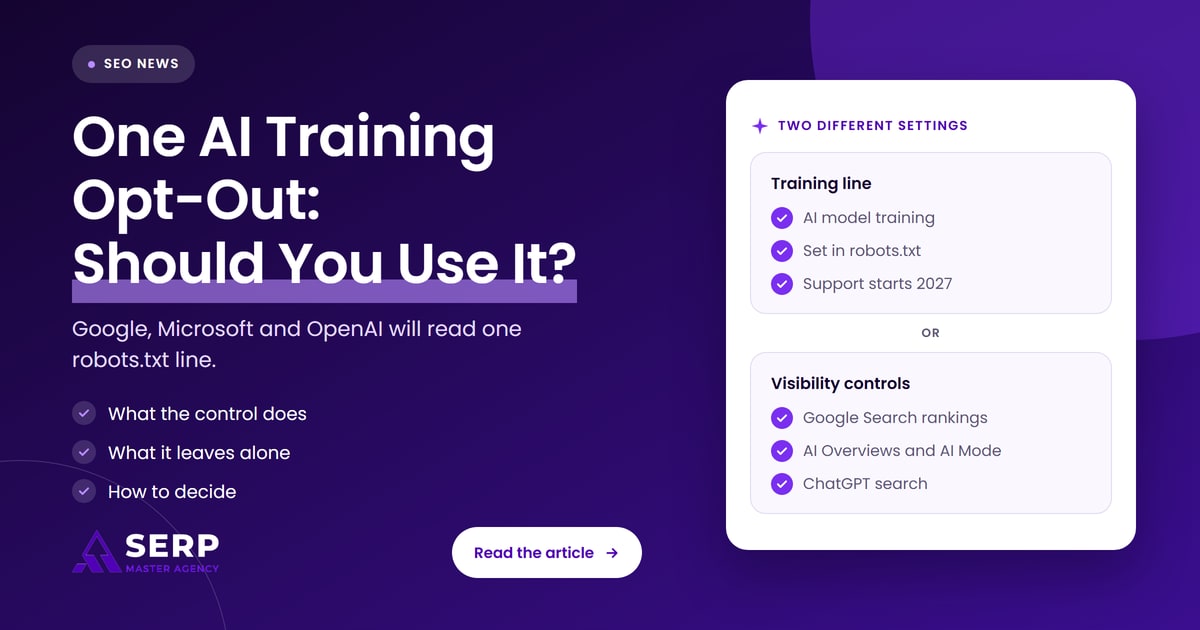
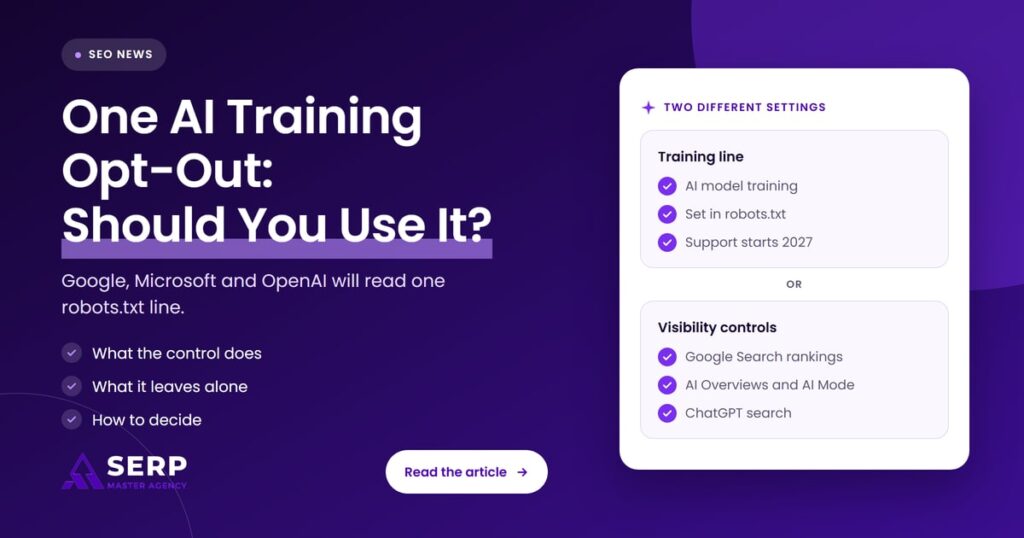
Quick answer: The shared AI training control is one line group in robots.txt, using the token __usage_ai-training, that tells participating AI companies whether your content may be used to train generative models. Google, Microsoft and OpenAI say they plan to honor it. It controls training, not Google Search rankings, so most businesses should decide based on how valuable and original their content is.
Key takeaways
- On October 30, 2026, Google, Microsoft and OpenAI announced plans to honor one shared robots.txt signal for AI training preferences.
- The signal comes from an individual IETF draft written by Kevin Kelley of Anthropic. It is not an official standard yet, and none of the three companies supports it today.
- Google says it aims to support the signal in 2027, Microsoft starts honoring its new options on February 1, 2027, and OpenAI says within the next few months.
- The training signal does not control crawling and, per Google and Microsoft, does not change eligibility for regular Google or Bing search results.
- AI Overviews and AI Mode have their own separate control in Search Console. Nothing in the announcements says the training line removes you from those features.
- A training opt-out can still have side effects, such as Gemini Apps grounding at Google, so read each provider’s rules before you add it.
What changed with AI training opt-outs?
Until now, a business that wanted to keep its content out of AI training had to block each company’s crawler by name, such as Google-Extended or GPTBot. The new shared control lets you state one training preference in robots.txt that every participating provider reads. Google, Microsoft and OpenAI announced their plans on October 30, 2026.
Google’s John Mueller wrote on the Google Search Central blog that site owners can use a “policy token” in robots.txt to set a broad training preference across AI providers that take part, instead of writing separate rules for each company. Microsoft published its own announcement on the Bing blog the same day, and Search Engine Journal reported that OpenAI also posted its plans.
The signal is defined in an IETF Internet-Draft called “Machine-Readable Training Preference Signal,” written by Kevin Kelley of Anthropic and submitted to the AI Preferences (AIPREF) working group. The draft is dated October 30, 2026, expires on May 3, 2027 unless it is replaced, and says plainly that it has no formal standing with the IETF.
The shared AI training control is a robots.txt rule group that uses the policy token __usage_ai-training in place of a crawler name. Allow and Disallow lines under it say which parts of your site may or may not be used to train generative AI models. It is a preference signal that participating companies agree to read, not a block.
The draft’s own example opts the whole site out of training except one folder:
User-Agent: __usage_ai-training
Disallow: /
Allow: /press-kit/
A few rules in the draft matter for business owners:
- It is about training only. The draft uses the AIPREF vocabulary, which defines AI training as using content “to modify the learned parameters of a generative AI model.” Models used only for tasks like classification or ranking are excluded.
- It does not control crawling. The draft says the token is not a directive for crawling behavior. To limit crawling, you still write rules for specific crawlers.
- Your wildcard rules do not count. A
User-Agent: *group never matches the token, so your existing robots.txt rules are not treated as a training preference. - No group means no preference. If your robots.txt has no
__usage_ai-traininggroup, you have not expressed a preference either way.
Who is supporting the control, and when?
Google, Microsoft and OpenAI have said they plan to honor the signal, but each on its own timeline and in its own way. None of them reads it yet. Anthropic, whose employee wrote the draft, has started development according to the author’s mailing list post, but has not given a date.
| Company | Planned timing | How it treats the shared line | Effect on regular search |
|---|---|---|---|
| 2027 (crawler docs say early 2027) | If you opt out with the shared line and do not mention Google-Extended, Google treats it as if you had disallowed Google-Extended | Google-Extended does not affect inclusion in Google Search and is not a ranking signal | |
| Microsoft | From February 1, 2027, as pages are crawled | Reads the shared line for training, plus page-level meta tags and headers that override robots.txt | Neither training nor grounding preferences change eligibility for regular Bing results |
| OpenAI | “Within the next few months,” per Search Engine Journal | Current robots.txt rules, such as GPTBot, stay in effect | OpenAI’s docs say GPTBot (training) and OAI-SearchBot (ChatGPT search) are separate settings |
| Anthropic | No date given | Development started, according to the draft’s author | Not stated |
How will Google handle the signal?
Google will map the shared opt-out onto its existing Google-Extended control. If your robots.txt opts out of training with the shared token and does not name Google-Extended, Google says it will read that as a Google-Extended disallow. Google says company-specific controls keep working alongside the shared signal.
This is where the detail matters. Google’s crawler documentation says Google-Extended covers two things: training future Gemini models and grounding, which means supplying content from the Search index to Gemini Apps and Vertex AI at the moment someone asks a question. Mueller’s post notes that sites which allow Google-Extended can appear in Gemini Apps responses and get clicks through grounding. Search Engine Journal found no method in Google’s crawler documentation that keeps content out of Gemini training while still allowing Gemini Apps grounding. So at Google, a training opt-out may also cost you visibility in Gemini Apps answers.
How will Microsoft handle the signal?
Microsoft splits AI use into two separate preferences: training and grounding. Training can be set site-wide with the shared robots.txt token or page by page with a meta tag or HTTP header. Grounding, which decides whether your pages inform answers in Copilot and Bing’s AI features, is set only at the page level.
Microsoft’s page-level training tag looks like this: <meta name="Bingbot" content="ai-training:disallow">. The grounding preference has three settings:
- Allow (the default): your content may help inform AI answers.
- DisallowExtended: grounding stays limited to Microsoft’s own experiences, such as Copilot and Bing’s AI features, and excludes third-party grounding services such as Web IQ.
- Disallow: your content is not used to inform AI answers.
Microsoft warns that choosing DisallowExtended or Disallow for grounding will reduce your brand’s visibility in AI experiences. It also says it will stop reading NoArchive and NoCache as training or grounding controls after March 1, 2027. If you used those tags to limit Copilot, you have work to do before that date.
How will OpenAI handle the signal?
Search Engine Journal reports that OpenAI aims to honor the shared signal within the next few months and that its current robots.txt policy stays in effect until then. OpenAI’s crawler documentation already separates training from search: GPTBot is for training, and OAI-SearchBot is what surfaces sites in ChatGPT search.
OpenAI’s documentation says disallowing GPTBot tells OpenAI your content should not be used to train its foundation models, and that each setting is independent. Its own example allows OAI-SearchBot while disallowing GPTBot. Search Engine Journal notes that neither OpenAI’s announcement nor its crawler documentation explains what happens if a shared-line rule and a GPTBot rule disagree, so keep the two consistent.
Does opting out of AI training affect your search or AI answer visibility?
Opting out of AI training does not remove you from regular Google or Bing results, according to both companies. It is also a different setting from the one that controls Google’s AI Overviews and AI Mode. The side effects are narrower: at Google it may affect Gemini Apps grounding, and Microsoft keeps grounding as its own separate choice.
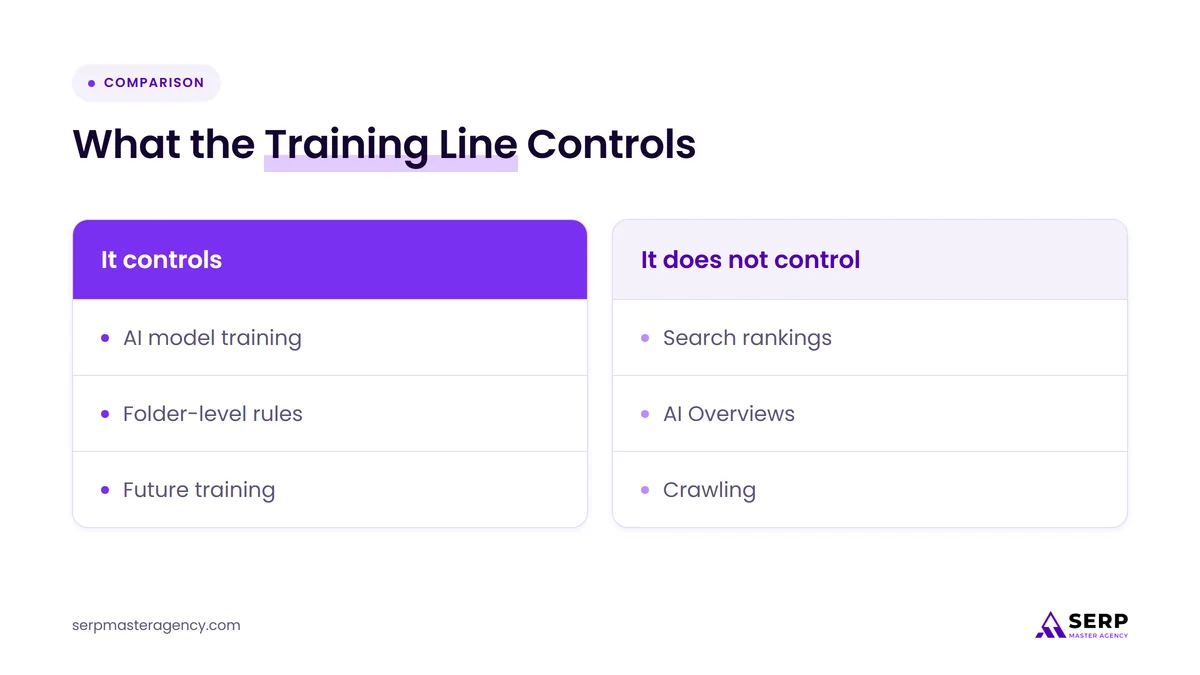
Keep these controls separate in your head, because they do different jobs:
- Shared training line (
__usage_ai-training): tells participating companies whether your content may train generative models. - Google-Extended: covers Gemini training and Gemini Apps and Vertex AI grounding. Google says it does not affect Google Search inclusion or rankings.
- Search generative AI control in Search Console: decides whether your site appears in AI Overviews, AI Mode and generative AI features in Discover. Google’s help page says this control does not limit AI training, and points to Google-Extended for that.
- Microsoft grounding preference: decides whether your pages inform Copilot and Bing AI answers.
- OAI-SearchBot: decides whether your site can appear in ChatGPT search answers.
- noindex: removes a page from Google Search entirely. Google lists this as the way to keep content out of Search.
The practical point: if your goal is to be named in AI answers, the training line is not the main lever. The controls for AI Overviews, ChatGPT search and Copilot grounding are. Our guide on getting cited by AI search tools covers what helps a business show up in those answers.
Every business with a public website is affected in principle, because the signal will apply to any robots.txt file that adds it. In practice, it matters most to businesses whose content is their product or their edge, and to anyone who already used NoArchive, NoCache or crawler-specific blocks to limit AI use.
Groups with the most at stake:
- Publishers and content businesses whose articles, guides or reviews are what they sell.
- Businesses with original research or data, such as industry reports, pricing studies or proprietary benchmarks.
- Course creators and paid communities who publish samples of premium material.
- Sites already blocking AI crawlers, which now have a single place to state the training preference, plus a Microsoft deadline for NoArchive and NoCache users.
- Local service businesses, such as trades, clinics and firms, whose pages mostly describe services, prices and locations. For them, being findable usually matters more than protecting the text.
Should your business block AI training on its website?
Block AI training if your written content is a product you sell or a real competitive asset, such as original research. Allow it, or simply leave the line out, if your site mainly exists to win customers and you want your brand known widely. Either way, the decision does not change your regular Google or Bing rankings.
There is no published data yet on what the shared line does to traffic, because no company reads it today. So the decision rests on what your content is for. Here is a simple way to think about it.
| Your situation | Reasonable starting choice | Why |
|---|---|---|
| You sell content, data or courses | Opt out of training, at least for paid or premium sections | Your content is the product, and training use gives it away |
| You publish original research to earn links and mentions | Opt out of training for raw data, allow a summary or press section | The draft lets you allow chosen folders, such as a press kit |
| You are a local or service business | Usually leave training allowed or express no preference | Your pages exist to make your business known, not to be sold |
| You rely on Gemini Apps visibility | Check Google-Extended before opting out | At Google, the shared opt-out maps to Google-Extended, which also covers Gemini Apps grounding |
| You used NoArchive or NoCache to limit Copilot | Set Microsoft’s new training and grounding preferences | Microsoft stops reading those tags for AI use after March 1, 2027 |
How do you decide in practice?
Decide in three steps: work out what your content is worth on its own, check which AI answers send you customers or mentions today, and then set each control to match. Most businesses will end up treating training and AI answer visibility as two separate decisions.
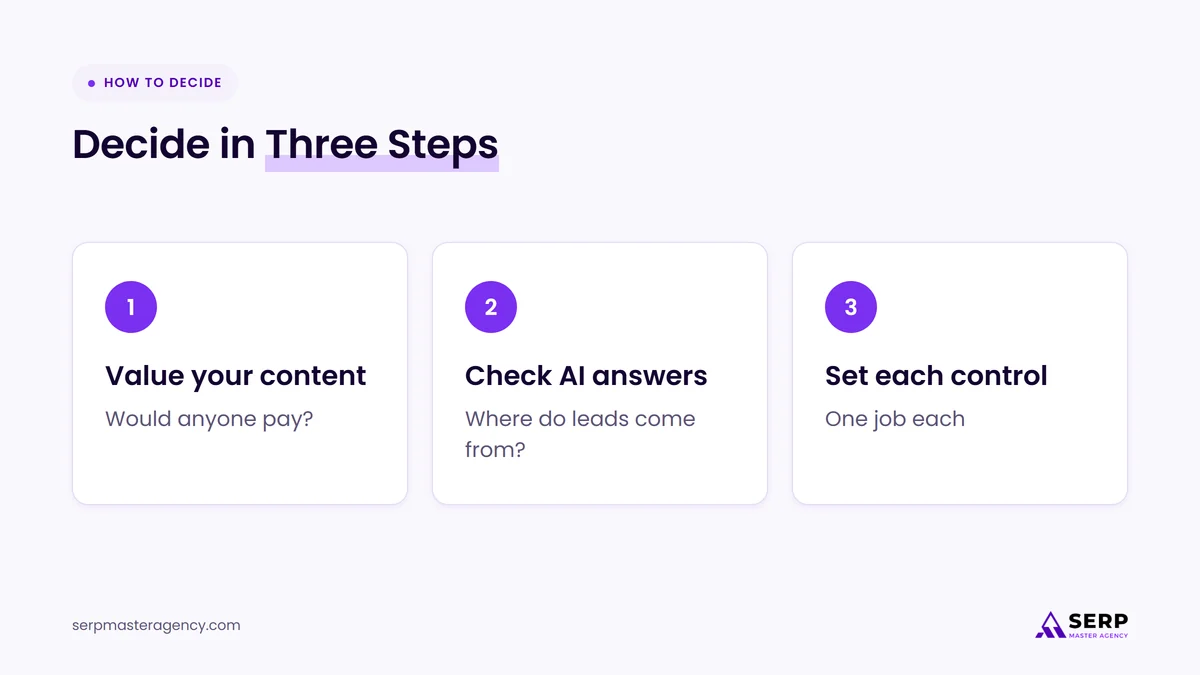
- Value your content. Ask whether anyone would pay for your pages as they are. If yes, training use is a cost to you. If your pages are mainly service descriptions, it probably is not.
- Check where AI already helps you. Look at Search Console’s generative AI performance report, which shows impressions from AI Overviews and AI Mode, and ask new customers whether they found you through ChatGPT, Copilot or Gemini.
- Match each control to its job. Use the training line for training, Search Console for AI Overviews and AI Mode, OAI-SearchBot for ChatGPT search, and Microsoft’s page-level grounding setting for Copilot.
- Choose by folder, not just by site. The draft supports Allow and Disallow paths, so you can protect a paid library and allow a press section.
- Review once support goes live. Each company is implementing the signal differently and on its own schedule, so revisit your choice in 2027.
What should you do now?
You do not need to change anything today, because no company reads the shared line yet. Use the time to audit your robots.txt, write down which AI controls you already use, and make the decision before the 2027 dates. Microsoft users relying on NoArchive or NoCache have the most pressing deadline.
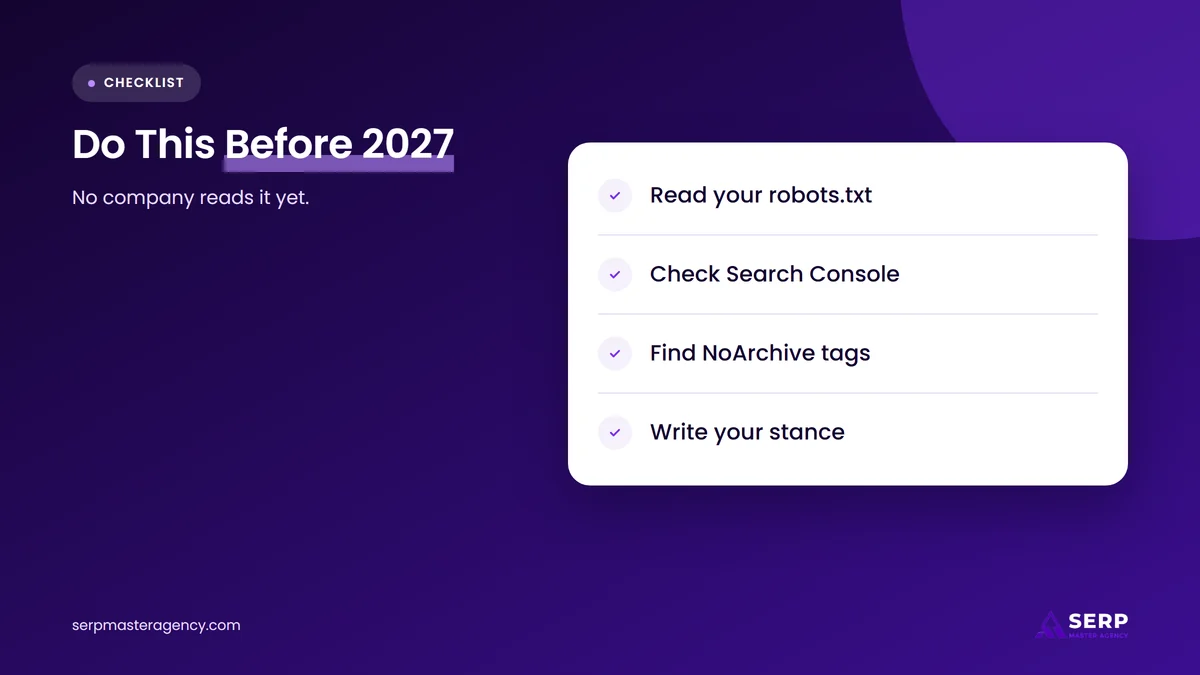
- Read your current robots.txt. Note any rules for Google-Extended, GPTBot, OAI-SearchBot or other AI crawlers, and check they still reflect what you want. Our technical SEO checklist covers robots.txt basics alongside other crawl settings.
- Check Search Console. Look at Settings, then Search generative AI, to see whether your site is included in AI Overviews and AI Mode. That setting is separate from training.
- Search your pages for NoArchive and NoCache. If you find them, plan Microsoft’s replacement preferences before March 1, 2027. Bing Webmaster Tools opens a temporary grounding setting on December 15, 2026.
- Decide your training stance in writing. One sentence is enough, such as “allow training except our paid guides,” so whoever manages the site applies it the same way everywhere.
- Add the shared line only when you are sure. If you opt out, keep crawler-specific rules consistent with it, since providers have not explained how conflicts are resolved.
- Watch for updates. Google says it will share more details, and the IETF draft may change before it expires on May 3, 2027.
If AI Overviews matter to your leads, our article on how AI Overviews change the way buyers find your business explains what drives visibility there.
Frequently asked questions
Will opting out of AI training remove my site from Google Search?
No. At Google, the shared opt-out is read as a Google-Extended disallow, and Google’s crawler documentation says Google-Extended does not affect a site’s inclusion in Google Search and is not a ranking signal. To remove a page from Google Search, Google points to noindex instead.
None of the announcements say so. Google’s control for AI Overviews, AI Mode and generative AI in Discover is the Search generative AI setting in Search Console, and Google’s help page says that setting does not limit AI training. The two are separate controls with separate jobs.
Not yet. Google aims to support it in 2027, and its crawler documentation says early 2027. Microsoft starts honoring its new options on February 1, 2027, as pages are crawled. Search Engine Journal reports that OpenAI aims to honor the signal within the next few months.
Do I still need GPTBot and Google-Extended rules?
Your existing rules keep working. Google, OpenAI and the draft’s author all say company-specific controls continue alongside the shared signal. Because the companies have not fully explained how conflicting rules are handled, make sure any crawler-specific rules agree with your shared training line.
Can I block AI training on only part of my website?
Yes. The shared line uses normal Allow and Disallow paths, so you can opt out of training site-wide and allow a folder such as a press kit, or the reverse. Microsoft also supports page-level training preferences through a meta tag or HTTP header.
Does blocking AI training remove content that was already used?
None of the announcements or the draft we read describe a way to remove content from models that have already been trained. Treat the signal as a choice about how your content is used from the point a company starts reading it.
The shared control makes one decision easier to state, but it is still only one decision. Opt out of training if your content is something you sell or a real competitive asset. Leave it allowed if your website exists mainly to make your business known. Then set AI Overviews, ChatGPT search and Copilot grounding on their own merits, because those controls decide whether you appear in AI answers. If you want a second opinion on your robots.txt and AI visibility settings, our SEO services at SERP Master Agency include technical and AI search reviews.
Not sure which AI controls your site should use?
Tell us what your website is for and where your customers come from. We’ll review your robots.txt and AI search settings and explain, in plain English, which choices protect your content and which keep your business visible.
Sources
- Google Search Central Blog, “Supporting a shared AI training control for websites”, October 30, 2026. https://developers.google.com/search/blog/2026/10/ai-training-control
- Search Engine Journal, “Google, Microsoft & OpenAI Plan To Honor Shared AI Training Opt-Out”, November 1, 2026. https://www.searchenginejournal.com/google-microsoft-openai-shared-ai-training-opt-out/595387/
- Microsoft Bing Blog, “Your content, your choice: clearer preferences for training and grounding”, October 30, 2026. https://blogs.bing.com/search/2026/10/your-content-your-choice-clearer-preferences-for-training-and-grounding/
- IETF, “Machine-Readable Training Preference Signal” (draft-kelley-aipref-training-preference-signal-00), October 30, 2026. https://datatracker.ietf.org/doc/draft-kelley-aipref-training-preference-signal/
- Google for Developers, “Google’s common crawlers” (Google-Extended), accessed November 4, 2026. https://developers.google.com/crawling/docs/crawlers-fetchers/google-common-crawlers
- Google Search Console Help, “Search generative AI control”, accessed November 4, 2026. https://support.google.com/webmasters/answer/16908024?hl=en
- Google Search Central Blog, “Introducing Search Generative AI performance reports in Search Console”, June 3, 2026. https://developers.google.com/search/blog/2026/06/gen-ai-performance-reports
- OpenAI, “Overview of OpenAI Crawlers”, accessed November 4, 2026. https://developers.openai.com/api/docs/bots

Suraj Rana is a highly regarded SEO expert specializing in the dental industry. His expertise lies in crafting strategic SEO marketing plans to help new or expanding businesses increase their online visibility and attract more customers. Suraj Rana’s skills extend to improving website rankings and boosting organic search visibility, thereby enhancing web traffic and return on investment for businesses.