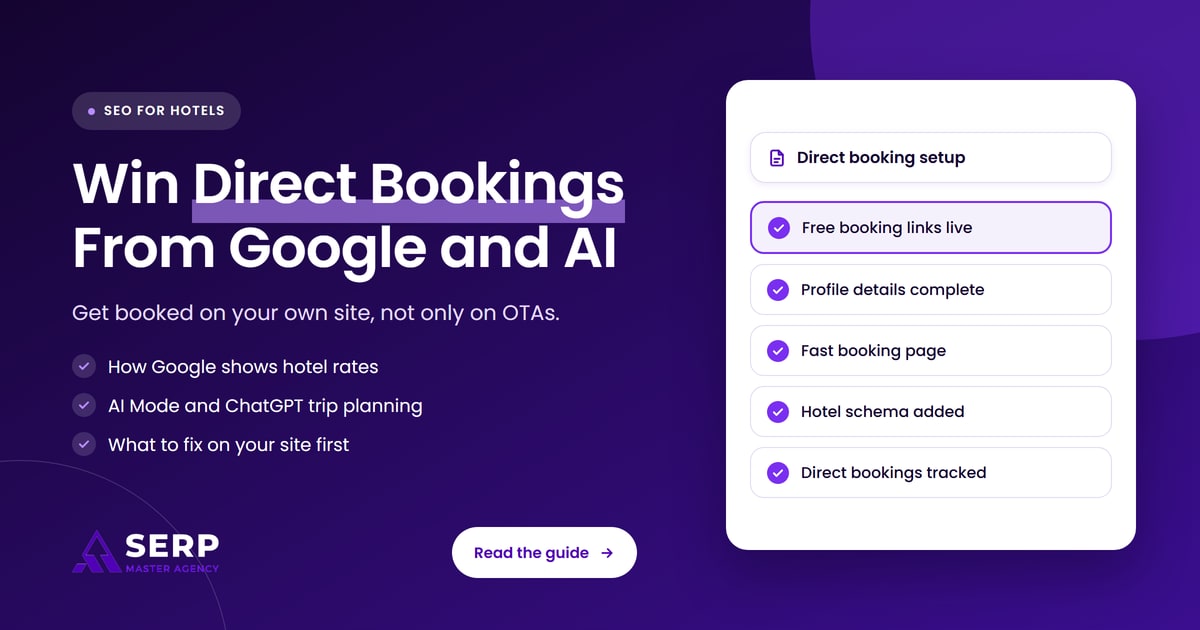
Quick answer: A hotel wins more direct bookings by making its own website a bookable option everywhere travelers search. That means sending live rates to Google so free booking links can show, completing the Google Business Profile, building a fast booking page with clear policies, adding hotel schema, and giving AI trip planners accurate, consistent facts to repeat.
Key takeaways
- Google shows free booking links in hotel search on Search and Maps. Clicks cost nothing, and bids have no effect on how the free links are ranked.
- To appear there, your rates must reach Google through Hotel Center or a connectivity partner. Google’s third-party rates feature for hotel ads ended on September 30, 2026.
- Since August 27, 2026, Google AI Mode can book hotels in the US through ten launch partners, mostly large chains and online travel agencies (OTAs).
- On October 15, 2026, Google said it would test a section at the top of AI answers for the official sites where a task gets done.
- OTAs still bring reach. The goal is not to leave them but to make your own site the easiest and clearest place to book.
What is SEO for hotels?
SEO for hotels is the work of making a hotel’s own website and Google listing appear, and convert, when travelers search Google, Google Maps or AI trip planners for somewhere to stay. It covers rate feeds, the Google Business Profile, room and location pages, reviews, structured data and the booking path, with direct bookings as the main goal.
Two terms come up throughout this guide:
- Direct booking: a reservation made on the hotel’s own website, booking engine or phone line, with no OTA in between.
- OTA: an online travel agency such as Booking.com or Expedia, which lists many hotels, takes the booking and charges the hotel a commission on each stay.
Hotel SEO is different from SEO for most local businesses because the search results are crowded with price boxes, OTA listings and now AI answers that can complete a booking. Our hotel SEO services page shows how we break that work down for independent and small group hotels.
Why do OTAs win so many hotel searches?
OTAs win many hotel searches because they combine huge inventories, large advertising budgets, thousands of reviews and booking apps that travelers already trust. A traveler searching a city or a hotel name often sees OTA links beside, or above, the hotel’s own site. Without live rates and a strong website, the hotel gives those clicks away.
Three gaps usually push guests from a hotel’s search listing to an OTA:
- No price on Google. If OTAs send rates for your property and you don’t, the price box shows only their links. A guest who wants to compare prices clicks one of them.
- A slow or confusing booking path. If your site makes guests hunt for rates, re-enter dates or leave for a separate booking engine with a different look, many go back to the OTA app they know.
- Missing facts. Parking, pets, check-in times, cancellation terms and room details are easy to find on OTA pages. If your site hides them, guests and AI tools rely on the OTA version.
None of this means OTAs are the enemy. They reach travelers you would never reach alone. The problem is paying commission on guests who were already looking for you by name.
How does Google show hotels to travelers today?
Google shows hotels in five main places: free booking links and paid hotel ads in the price module, the hotel’s own Business Profile, ordinary web results, and AI Mode answers. Each place pulls from your rate feed, your Business Profile and your website, so the same facts must match everywhere.
| Where travelers see you | What it shows | What feeds it | Cost to the hotel |
|---|---|---|---|
| Free booking links (Search and Maps) | Your site or hotel name with a room rate | Rates sent through Hotel Center or a connectivity partner | Free, no cost per click |
| Hotel ads | Paid rate links in the booking module | Your direct price feed linked to Google Ads | Paid |
| Google Business Profile | Photos, amenities, class, reviews, website link | Your verified profile, Google’s evaluation and guest reviews | Free |
| Organic web results | Your homepage, room and location pages | Your website content and links | Free |
| Google AI Mode | Hotel options with reviews, and booking through partners in the US | Google’s hotel data, partners and the wider web | Depends on how the guest books |
Two changes in the last few months matter here. On September 30, 2026, Google ended its third-party rates feature, which had let hotel ads run on prices Google sourced from other sites. Hotels that want to keep running hotel ads now need a direct price feed through an integration partner or their own Hotel Center account (Google Hotel Center Help). And on October 15, 2026, Google said it would test a dedicated section at the top of some AI responses for the “one or two official places on the web” to complete a specific task (Google, 2026). Google gave no hotel examples, but a hotel’s own booking page is the kind of official destination that section is designed around.
How do free booking links work, and how does a hotel get them?
Free booking links are unpaid listings in Google’s hotel results that show your website or hotel name with a room rate. Google charges nothing for clicks, and bids do not affect their order. To qualify, your rates must reach Google, either through your own Hotel Center account or through a connectivity partner such as your booking engine or channel manager.
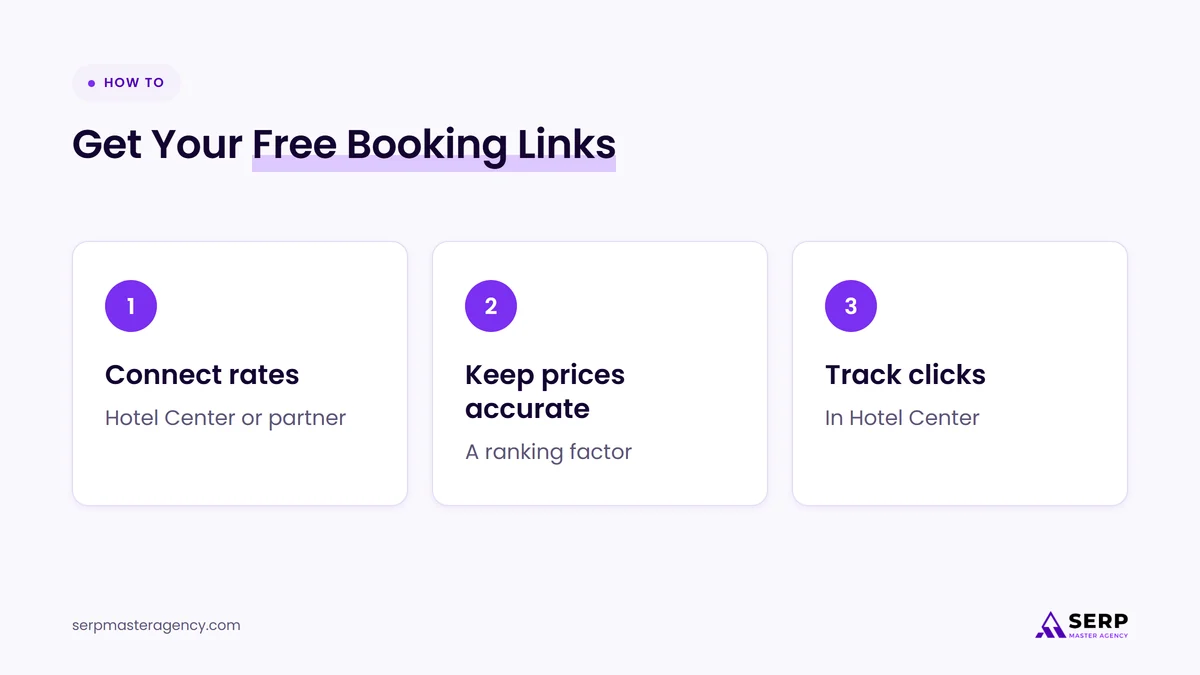
According to Google’s Hotel Center help pages, free booking links are ranked by consumer preference, the value offered to the user, the landing page experience and historical price accuracy. Paying for hotel ads does not move a property up or down in the free links. Here is how to get set up:
- Ask your booking engine or channel manager first. Google says hotels using a reservation system may already be connected through their provider, which can set up free booking links for them.
- If not, open a Hotel Center account. Hotels without an account can follow Google’s starter guide to become a Google hotel partner. Existing hotel ads partners are eligible automatically.
- Send prices and availability for all rooms. Google recommends this for the extra placements, and price accuracy is one of the ranking factors.
- Point each link at a real booking page. The landing page should show the dates, room and rate the guest clicked, not your homepage.
- Check clicks in Hotel Center Reports. Google reports how many people clicked your free booking links, so you can compare them with direct bookings.
Rate parity matters here. If your direct price is higher than the OTA rate shown beside it, the free link exists but rarely wins the click. Many hotels give direct bookers a reason to choose them, such as a better cancellation policy or a small included extra, within whatever their OTA contracts allow.
How should a hotel set up its Google Business Profile?
A hotel should claim and verify its Google Business Profile, then complete every amenity in the Hotel Details section, add real photos, set the website link to the official site, reply to reviews and keep facts such as pets, parking and policies identical to the website. Hotel rates and booking links on the profile come from Google’s hotel feeds, not the profile editor.
Google’s help page for hotel profiles sets out a few hotel-specific rules (Google Business Profile Help):
- Verification first. Your profile must be claimed and verified before you can edit amenities from the dashboard. Amenities are edited under Hotel Details, not by spreadsheet upload.
- Hours are fixed. Hotels can’t edit their listed hours, because Google treats them as open 24 hours for guests.
- Hotel class comes from Google. If your class rating is wrong or missing, you contact support rather than editing it.
- Rates and booking links come from feeds. They are driven by hotel ads and free booking links, which is another reason to set up your rate connection.
- On-site outlets can have their own profiles. A restaurant, spa or bar that non-guests can visit can have a separate profile, linked to the hotel with a “located in” relation.
- Sustainability practices can be listed. Useful if eco-minded travelers are part of your market.
Reviews deserve steady attention. Ask every guest, reply to good and bad reviews in a calm, specific way, and never offer discounts or freebies in exchange for a review. Google’s Maps content policy bans incentives for reviews and bans selectively asking only happy guests. Our guide to review signals that win international customers’ trust covers how overseas travelers read reviews.
What should a hotel website include to win direct bookings?
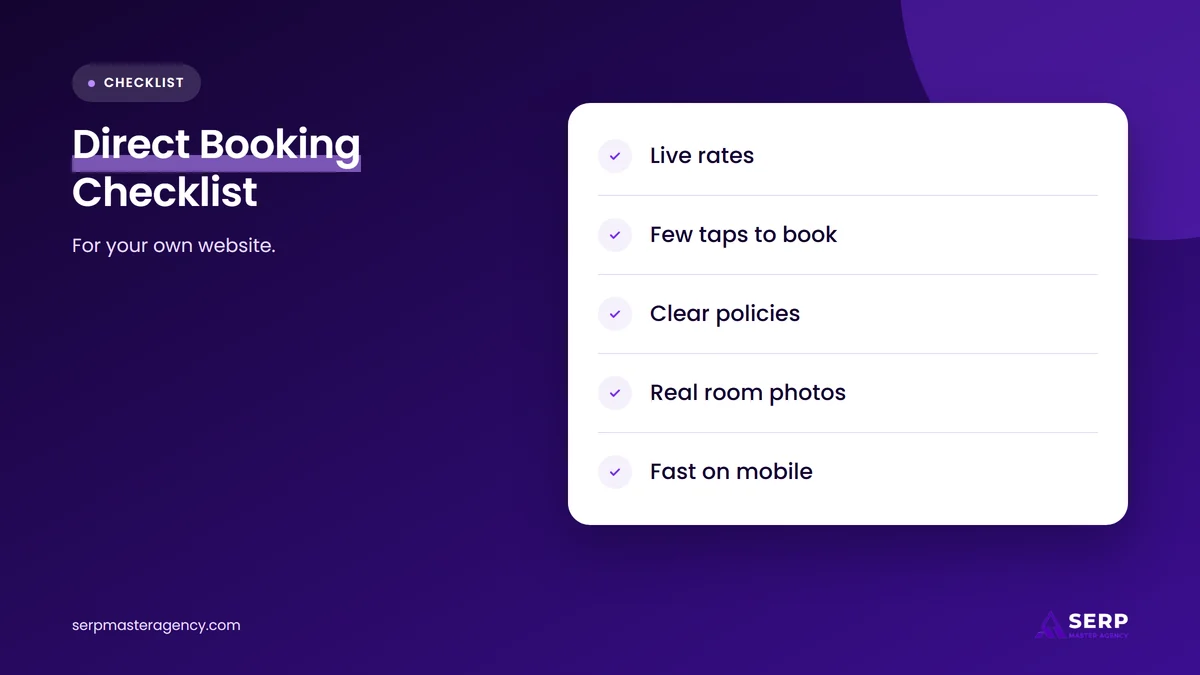
A hotel website wins direct bookings when it answers every booking question faster than an OTA page does. It needs live rates and availability, a booking path of a few taps on mobile, clear cancellation and deposit terms, real photos of each room type, and plain facts on location, parking, pets, accessibility and check-in times.
Build the site around the pages travelers and AI tools look for:
- A page for each room type. Bed setup, size, view, maximum guests, accessibility features and real photos, with a book button that keeps the room selected.
- A clear policies page. Check-in and check-out times, cancellation rules, deposits, pets, children, parking costs and resort or city fees, written in plain language.
- Location and getting-here content. Distance to the airport, stations and the attractions people actually visit, plus parking and public transport options.
- Reasons to book direct. If you offer a better cancellation policy, a welcome extra or flexible check-in for direct bookers, say so near the booking button.
- Pages for the trips you serve. Weddings, business travel, family stays, events or long stays, each with real details, not thin pages that swap a keyword.
- A fast mobile booking engine that looks like your site. Test it on a phone yourself. Count the taps from the homepage to a confirmed booking.
If many of your guests come from abroad, add the currencies and languages they use and make the address and directions easy to copy. Our guide to local SEO for businesses that serve international visitors explains how to set that up.
How can a hotel show up in AI trip planners like Google AI Mode and ChatGPT?
A hotel shows up in AI trip planners by giving them accurate, consistent facts to repeat. AI Mode draws on Google’s hotel data and reviews, while ChatGPT draws on the web and on travel apps such as Booking.com and Expedia. Matching details across your site, Business Profile and OTA listings make your hotel easier to describe and recommend correctly.
Here is what we know about each, with dates:
- Google AI Mode. On August 27, 2026, Google said hotel booking in AI Mode had started rolling out in the US in English. Travelers describe their trip, see a visual list of options with guest reviews, and can book with partners such as Booking.com, Expedia, Hilton, Marriott, IHG and Wyndham using Google Pay. The hotel or booking platform remains the merchant of record (Google, 2026).
- ChatGPT. Booking.com and Expedia launched apps inside ChatGPT in October 2025, letting users search hotels in a conversation (Skift, 2025). ChatGPT also answers travel questions from web pages, reviews and listings.
The AI Mode launch partners are large chains and OTAs. That means an independent hotel booked inside AI Mode today is likely to be booked through an OTA partner, with commission. You can’t control that, but you can make sure the traveler sees your official site as a clear alternative when they research:
- Keep facts identical everywhere. Name, address, phone, room types, amenities and policies should match on your site, Business Profile and every OTA listing.
- Answer the questions travelers type into AI tools. “Is there parking?”, “Is it walkable to the old town?”, “Is it good for families?” Put clear answers on your site in plain text, not only in images.
- Earn mentions beyond your own site. Local tourism sites, event venues, travel guides and genuine press coverage help AI systems understand what your hotel is known for.
- Keep rates live on Google. Free booking links put your own site next to the OTAs when travelers move from AI answers to price comparison.
For a wider look at how ChatGPT chooses businesses to mention, read our guide on how to get your business recommended by ChatGPT.
Which schema should a hotel website use?
A hotel website should use schema.org Hotel markup, a type of LodgingBusiness, on its homepage or main hotel page. It should include the name, address, phone, geo coordinates, check-in and check-out times, star rating where official, amenities and pet policy, with every value matching the visible page and the Google Business Profile.
Schema.org lists Hotel under LodgingBusiness, which is a type of LocalBusiness. Google’s LocalBusiness structured data documentation says to use the most specific LocalBusiness subtype that fits, and to keep the markup consistent with what users see. Useful properties include:
name,address,telephone,geoandurlcheckinTimeandcheckoutTimeamenityFeaturefor parking, pool, Wi-Fi and similar facilitiespetsAllowedandstarRating, only when accurateimagewith real photos of the property
Don’t add review or rating markup that copies OTA scores, and don’t mark up facts that aren’t on the page.
Should hotels stop using OTAs?
Most hotels should not stop using OTAs. OTAs bring reach, especially for new properties, international guests and quiet dates. The better plan is to shift repeat guests, brand searches and travelers who already know your hotel toward booking direct, while using OTAs for the demand you could not reach alone.
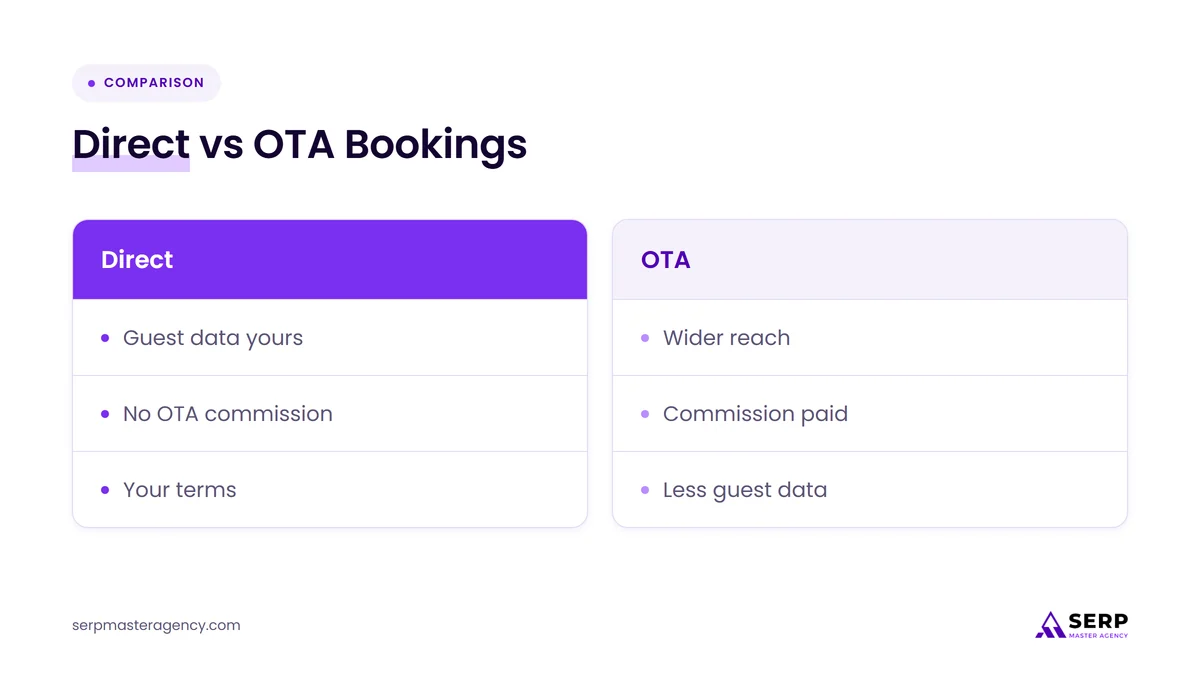
| Factor | Direct booking on your site | OTA booking |
|---|---|---|
| Commission | None to an OTA (booking engine fees may apply) | Commission on each stay, set by your contract |
| Guest relationship | You hold the contact details and history | The OTA controls much of the communication |
| Reach | People who find your site, listing or links | The OTA’s large audience and apps |
| Policies and extras | Set by you | Shaped by OTA rules and rate plans |
| Best for | Brand searches, repeat guests, local events | New markets, international guests, filling gaps |
A practical split is to protect your brand name first. When a traveler searches your hotel’s name, your official site, your free booking link and your Business Profile should be the clearest options on the page.
How do you measure direct bookings from search?
Measure direct bookings from search by connecting your booking engine to Google Analytics 4, tracking completed reservations as conversions, and tagging the links in your Business Profile and free booking links. Then compare clicks in Hotel Center Reports with bookings and revenue in your booking engine each month.
- Track the booking engine. Make sure confirmed bookings, not just booking-page visits, are recorded as conversions, including when the engine runs on a separate domain.
- Tag your Google links. Add UTM tags to the Business Profile website link and to free booking link landing pages so you can see which one produced each booking.
- Watch brand searches. Search Console shows how many people search your hotel’s name and how many click your site.
- Compare channel mix. Each month, compare direct bookings with OTA bookings in your property management system. A rising direct share is the result that matters.
What mistakes stop hotels getting direct bookings from Google?
The most common mistakes are sending no rates to Google, linking free booking links to the homepage, showing a direct price higher than the OTA price, hiding fees or policies, and letting the website, Business Profile and OTA listings disagree. Each one pushes the guest toward an OTA at the moment they are ready to book.
- Relying on hotel ads that used third-party rates and not replacing them with a direct feed after September 30, 2026.
- Letting the booking engine look like a different website, which makes guests unsure it’s official.
- Offering incentives for reviews, which breaks Google’s content policy.
- Publishing dozens of near-identical “hotel near [attraction]” pages with no real detail.
- Judging SEO by rankings alone instead of direct bookings and revenue.
Frequently asked questions
Are Google free booking links really free?
Yes. Google states that there is no cost for clicks on free booking links and that bids do not affect their ranking. You may still pay your booking engine or connectivity partner for the rate connection, and you pay for any hotel ads you choose to run alongside the free links.
Can an independent hotel get booked in Google AI Mode?
Not directly, yet. Hotel booking in AI Mode launched in the US with ten partners, mostly OTAs and large hotel chains. An independent hotel can still appear in AI Mode answers, and a guest who books through an OTA partner reaches it that way. Google has not announced direct booking for independent hotels.
Do I need a Hotel Center account to show my rates on Google?
Not always. Google says hotels that use a reservation system may already be connected through their provider, which can set up free booking links. If your provider doesn’t support Google, you can open a Hotel Center account using Google’s starter guide and send your rates yourself.
How long does hotel SEO take to work?
Some changes work quickly. Free booking links can show as soon as your rates are connected and accurate, and Business Profile fixes appear within days. Ranking new room, location and trip pages in organic results usually takes months, depending on how competitive your destination is.
Is ChatGPT a booking channel for hotels?
ChatGPT is mainly a research channel for hotels today. Booking.com and Expedia offer apps inside ChatGPT, so some searches lead to OTA bookings. For your own hotel, the goal is accurate facts on your site and across listings, so ChatGPT describes your property correctly and travelers can find your official site.
How can a hotel get more direct bookings instead of paying OTA commission?
A hotel gets more direct bookings by putting its own site next to the OTAs everywhere travelers compare: live rates for free booking links, a complete Business Profile, a fast booking page with clear policies, hotel schema, and consistent facts for AI trip planners. Keep OTAs for reach, and measure success by your direct share of bookings. If you want help with any of these steps, our SEO services at SERP Master Agency cover each one.
Want more guests booking on your own website?
Tell us about your hotel, your booking engine and where your bookings come from today. We’ll review your Google presence, rate setup and website and tell you plainly which fixes should come first.
Sources
- Google, “3 new ways to plan and book travel in Search”, August 27, 2026. https://blog.google/products-and-platforms/products/search/book-travel-ai-mode/
- Google, “More ways to connect with the web from Search”, October 15, 2026. https://blog.google/products-and-platforms/products/search/updates-ai-mode-overviews-explore-web/
- Google Hotel Center Help, “About hotel free booking links”, accessed November 13, 2026. https://support.google.com/hotelprices/answer/10472393
- Google Hotel Center Help, “Connect with more travelers using free booking links”, accessed November 13, 2026. https://support.google.com/hotelprices/answer/10472394
- Google Hotel Center Help, “About Google third-party rates for hotel ads”, accessed November 13, 2026. https://support.google.com/hotelprices/answer/14310302
- Google Business Profile Help, “Manage your hotel’s details”, accessed November 13, 2026. https://support.google.com/business/answer/9177958
- Google Maps User Contributed Content Policy, “Prohibited & restricted content”, accessed November 13, 2026. https://support.google.com/contributionpolicy/answer/7400114
- Google Search Central, “Local Business (LocalBusiness) structured data”, accessed November 13, 2026. https://developers.google.com/search/docs/appearance/structured-data/local-business
- Schema.org, “Hotel”, accessed November 13, 2026. https://schema.org/Hotel
- Skift, “ChatGPT Travel Apps Are Now a Thing – Starting with Booking.com and Expedia”, October 6, 2025. https://skift.com/2025/10/06/expedia-booking-chatgpt-apps-openai/

Suraj Rana is a highly regarded SEO expert specializing in the dental industry. His expertise lies in crafting strategic SEO marketing plans to help new or expanding businesses increase their online visibility and attract more customers. Suraj Rana’s skills extend to improving website rankings and boosting organic search visibility, thereby enhancing web traffic and return on investment for businesses.