Quick answer: Financial advisors get found in Google and AI search by publishing specialist pages for the clients they serve, showing who gives the advice, setting up Google Business Profile correctly, using reviews only within the SEC Marketing Rule or local rules, earning third-party mentions, and keeping firm details consistent. Compliance should approve every public page.
Key takeaways
- Google treats financial content as “Your Money or Your Life” (YMYL), so its quality raters apply very high standards to advisor websites.
- In an October 2026 study of 8,389 AI answers, 84 of the 100 firms on CNBC’s 2026 Financial Advisor 100 were never named.
- Specialists can do well in AI answers: one firm serving hockey players appeared in 85% of answers about advisors for NHL players.
- The SEC’s December 2025 risk alert found many advisor websites showing client reviews without clear, prominent disclosures.
- FINRA proposed a risk-based approach to reviewing retail communications in July 2026, but the current rule still applies until any change is approved.
- Rules differ in the UK, Canada, Australia and New Zealand. This post is general information, not legal advice, so check every change with your compliance team.
What is SEO for financial advisors?
SEO for financial advisors is the work of helping an advisory firm appear when prospective clients search Google, Google Maps and AI assistants such as ChatGPT, Gemini and Google AI Overviews. It covers the firm’s website, Google Business Profile, reviews and mentions elsewhere, all kept within the advertising rules that apply to the firm.
AI search means answers written by an AI tool rather than a plain list of links. When someone asks an assistant to recommend a fee-only planner for physicians, the tool pulls facts from websites, directories and articles, then names a few firms. Your aim is to be one of the sources it trusts and one of the firms it names.
Why is search visibility harder for financial advisors?
Search visibility is harder for financial advisors for two reasons. Google holds financial content to a higher standard because poor advice can harm people’s financial stability. And every web page, profile and social post may count as an advertisement, so it must pass the SEC Marketing Rule, FINRA Rule 2210 or a local regulator’s rules.
Google’s Search Quality Rater Guidelines call topics that can affect people’s health, financial stability or safety “Your Money or Your Life”, or YMYL, and ask raters to apply very high page quality standards to them. Google’s guidance on helpful content says that of experience, expertise, authoritativeness and trust (E-E-A-T), trust is the most important.
The rules side matters just as much. The SEC defines an advertisement broadly, as a direct or indirect communication that offers advisory services to prospective clients. A blog post, a reviews widget or a social post can fall inside that definition. Good SEO for an advisory firm is therefore compliant SEO from the first draft.
How did we choose these 7 ways?
We chose these seven ways by matching three things: what Google says it rewards on finance topics, what recent research shows AI tools cite when people ask for an advisor, and what regulators allow. Each way had to help both Google and AI search and be possible within US advertising rules.
| Way | Helps with | Main rule to check |
|---|---|---|
| 1. Specialist pages for the clients you serve | Niche questions in Google and AI answers | SEC general prohibitions, FINRA 2210 fair and balanced standard |
| 2. Show who gives the advice | Trust signals (E-E-A-T) on YMYL topics | Accurate credentials, no unsubstantiated claims |
| 3. Set up Google Business Profile correctly | Google Maps and “near me” searches | Google’s practitioner and naming guidelines |
| 4. Use reviews within the Marketing Rule | Trust and local ranking | SEC testimonial rules, Google review policy |
| 5. Answer client questions accurately | Informational searches and AI citations | Performance rules, principal approval |
| 6. Earn third-party mentions | Sources AI tools rely on | SEC third-party ratings rules |
| 7. Keep firm details consistent and structured | Entity recognition across Google and AI tools | Matching names and registrations everywhere |
What are the 7 ways financial advisors can get found in Google and AI search?
The seven ways are specialist pages, clear advisor bios, a correct Google Business Profile, compliant reviews, accurate answers to client questions, third-party mentions and consistent firm details. Together they give Google and AI tools a clear, trustworthy picture of who you help, who gives the advice and where you work.
1. Build a page for each type of client you serve best
A specialist page explains how your firm helps one group, such as physicians, business owners, retirees or people going through divorce. Specialist pages match the way people ask AI tools for help, because prospects rarely ask for “a financial advisor”. They ask for an advisor who understands their job, life stage or problem.
Recent research supports this. In October 2026, the public relations firm Gregory published a study of 8,389 answers from ChatGPT, Gemini and Google AI Overviews to 248 questions modeled on how affluent professionals look for advice. According to Wealth Management’s report on the study, 84 of the firms on CNBC’s 2026 Financial Advisor 100 were never named, while Hockey Wealth Group appeared in 85% of answers about advisors for NHL players. Size and rankings alone did not decide who was recommended. Gregory sells AI visibility services, so treat the figures as one firm’s research.
Make each specialist page useful on its own:
- Describe the planning issues that group faces, such as stock options for tech employees or practice sale planning for business owners.
- Explain your process and fee structure in plain language.
- Name the advisors who work with that group and link to their bios.
- Avoid claims you cannot back up, such as “the best advisor for doctors”. The SEC Marketing Rule bars material statements of fact you cannot substantiate.
2. Show who gives the advice and why they are qualified
Every advisor page should show a real person with real, checkable credentials. Google’s helpful content guidance asks whether pages carry a byline where one is expected and whether readers can learn about the author. On finance topics, where trust matters most, an anonymous website gives searchers and AI tools little reason to recommend you.
A strong advisor bio usually includes:
- The advisor’s full name, written the same way everywhere.
- Designations such as CFP, CFA or ChFC, written exactly as the issuing body allows.
- Registration details and a link to the public record, such as the SEC’s adviser search or FINRA BrokerCheck in the US.
- The types of clients the advisor works with and the services they provide.
- A byline on every article the advisor writes or reviews.
Keep bios factual. Years of experience, designations and memberships are easy to verify. Phrases like “top advisor” or “award-winning” may need supporting evidence and disclosures, so run them past compliance first.
3. Set up Google Business Profile the way Google allows
Google Business Profile puts your office on Google Maps and in local results, and AI tools often draw on the same business data. Google’s guidelines name financial planners as individual practitioners, which means specific rules apply to who can have a profile and how it must be named.
Google’s guidelines for representing your business say:
- Practitioner profiles: an advisor can have their own profile only if they are public-facing and can be contacted directly at the verified location during stated hours. Support staff should not have profiles.
- Solo advisors at a branded firm: if you are the only public-facing advisor at a location and represent a brand, share one profile named “[brand]: [your name]”.
- One profile per person: do not create separate profiles for each specialty, such as retirement planning and tax planning.
- Names: credentials such as “CFA” are allowed, but taglines, service descriptions and keywords are not and can lead to suspension.
Then complete the profile: the right primary category, real office hours, services, photos of your team and office, and a link to the most relevant page on your site. Our guide on how Google Business Profile affects local SEO covers the basics.
4. Use reviews and testimonials only within the Marketing Rule
Reviews help prospects trust you, but for SEC-registered advisers they are regulated. Since the Marketing Rule’s compliance date in November 2022, advisers may use testimonials and endorsements in advertisements only if they meet disclosure, oversight and disqualification conditions. Google’s own review policy adds further limits.
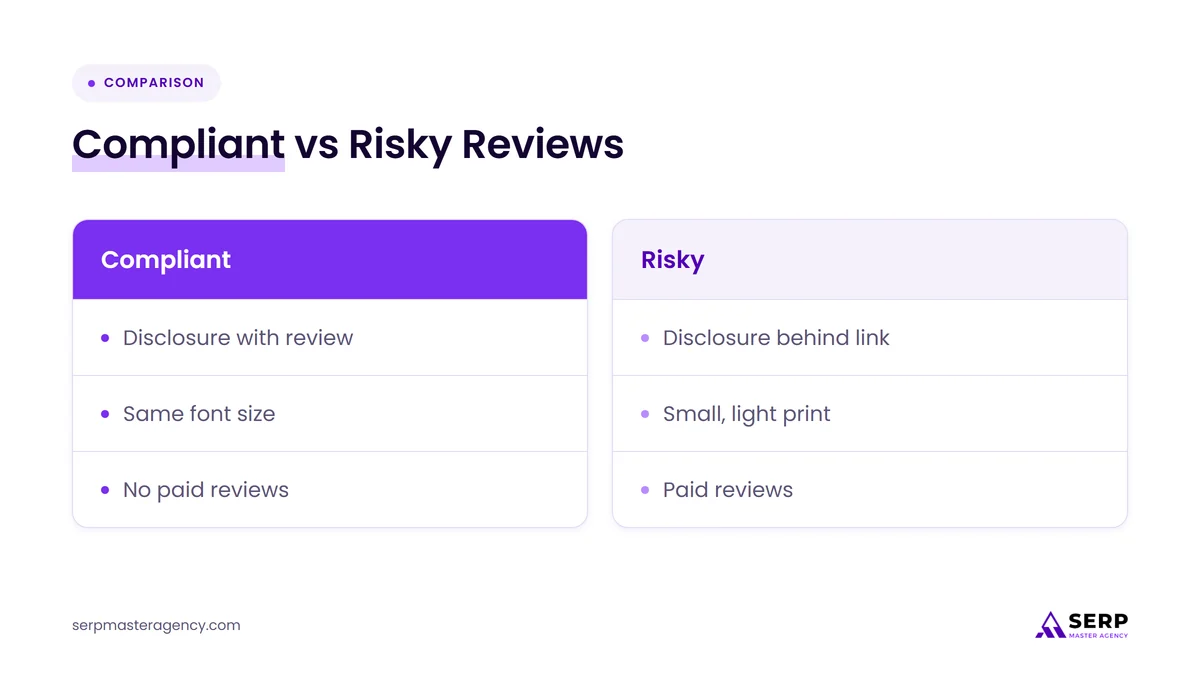
The SEC’s Division of Examinations published a risk alert on December 16, 2025 listing what examiners found. The most common problem was testimonials or endorsements shown without the required disclosures. Examiners also found:
- Disclosures placed behind a hyperlink instead of within the testimonial itself.
- Disclosures in a smaller or lighter font than the testimonial.
- Client reviews copied from third-party websites onto the adviser’s own site without saying they came from current or former clients.
- Gift cards given to clients for writing reviews on third-party websites.
- Paid promoters, lead-generation firms and social media influencers without proper written agreements or disclosures.
The required disclosures include whether the person is a client, whether they were paid and any material conflicts of interest. Paid promoters above the $1,000 de minimis threshold over 12 months need a written agreement.
Google’s rules point the same way. Its policy for Maps reviews bans offering money, discounts or free services for reviews, and it bans selectively asking only happy customers for reviews. Agree a written review process with your compliance team before you ask anyone, and decide whether and how reviews will appear on your website. Our guide on how reviews and ratings affect local SEO explains why reviews matter for rankings.
5. Answer the questions clients ask, accurately and in balance
Educational content earns visibility when it answers the questions prospects type into Google and AI tools, such as how to roll over a 401(k) or when to start Social Security. For financial firms, that content must also be fair and balanced, show risks alongside benefits, and follow strict rules on any performance figures.
The SEC Marketing Rule lists seven general prohibitions. Among them, an advertisement may not discuss potential benefits without fair and balanced treatment of material risks, and may not present performance results or time periods unfairly. The SEC staff’s Marketing Rule FAQ, updated January 15, 2026, repeats that any gross performance must be shown with net performance over the same period.
For broker-dealers, FINRA Rule 2210 currently requires an appropriately qualified registered principal to approve each retail communication before use or filing, with some exceptions. On July 9, 2026, FINRA’s Regulatory Notice 26-14 proposed replacing that blanket requirement with written, risk-based procedures and removing the distinction between static and interactive social media content. Comments closed on September 11, 2026. Until a final rule is approved, follow the current version.
Practical tips for content that ranks and passes review:
- Answer one question per page or section, starting with a short, direct answer.
- Leave out performance figures unless compliance has approved the exact presentation.
- Show who wrote and reviewed each article, and the date it was last updated.
- Review tax and contribution-limit pages every year, because outdated figures damage trust.
6. Earn mentions in places AI tools already trust
AI tools build answers from many sources, not only your website. Articles, directory listings, podcast pages and association profiles that describe your firm and specialty give Google and AI tools independent confirmation of who you are and who you help. Firm-focused coverage tends to carry more weight than a passing mention in a long list.
Your own site still matters most. In the Gregory study, firm websites were cited in 89.5% of AI answers, according to Wealth Management’s report. Third-party mentions add context to that foundation.
Ways to earn mentions:
- Offer comments to journalists covering your clients’ issues, such as equity compensation or small business exits.
- Keep profiles on professional association directories complete and up to date.
- Speak at events and on podcasts your target clients follow, and make sure the event page describes your specialty.
- Write for industry publications your clients read.
Be careful with rankings and awards. The Marketing Rule’s third-party ratings provisions require due diligence on how a rating was prepared and specific disclosures. The SEC’s 2025 risk alert found advisers that lacked information about the rating methodology or left out required disclosures.
7. Keep firm details consistent and add structured data
Consistent details help Google and AI tools recognize your firm as one entity. Your firm name, advisor names, address, phone number and registration details should match across your website, Google Business Profile, regulatory records, directories and social profiles. Structured data then states those facts in a format machines read directly.
Schema.org includes a FinancialService type for businesses that provide financial services, and Google’s documentation explains how to mark up local business details such as address, hours and phone number. Add Person markup for each advisor bio, using the same names and credentials shown on the page. Our beginner’s guide to schema markup for local SEO walks through the setup.
Then check how AI tools describe you. Ask ChatGPT, Gemini and Google AI Mode the questions your ideal clients would ask, and note whether your firm appears and whether the facts are right. Fix wrong details at the source, whether that is your site, a directory or an old profile.
Which advertising rules apply to financial advisor SEO?
The rules that apply depend on how your firm is registered and where you market. SEC-registered investment advisers follow the Marketing Rule. Broker-dealers and their representatives follow FINRA Rule 2210. Advisers outside the US follow their own regulators. Many firms answer to more than one set of rules, and state rules can also apply.
| Rule or policy | Who it applies to | What it means for SEO |
|---|---|---|
| SEC Marketing Rule (Rule 206(4)-1) | SEC-registered investment advisers | Website pages, reviews, ratings and performance must meet its conditions |
| FINRA Rule 2210 | FINRA member broker-dealers and their representatives | Retail communications need principal approval (a risk-based change is proposed) |
| FCA financial promotion rules (UK) | UK firms and anyone promoting regulated products | Rules apply on every channel, including social media |
| Google Business Profile guidelines | Every firm and practitioner on Google Maps | Practitioner eligibility, naming and review rules |
| Google Ads financial services verification | Advertisers in listed countries, including the UK, Australia and New Zealand | Paid search ads need verification before they run |
This table is a starting point, not legal advice. SERP Master Agency is a marketing agency, not a law firm or compliance consultant. Your chief compliance officer or legal counsel has the final word on what you can publish.
What changes for advisors in the UK, Canada, Australia and New Zealand?
Outside the US, the same seven ways still work, but different regulators set the advertising rules. UK firms follow the Financial Conduct Authority’s financial promotion rules. Canadian, Australian and New Zealand firms follow their own securities and financial markets regulators. Check every page, profile and campaign with your compliance adviser before it goes live.
A few points worth knowing:
- UK: the FCA’s guidance on financial promotions on social media (FG24/1, March 2024) says its rules are technology neutral and apply across all channels. It also warns that unauthorised influencers who promote regulated products without approval may be committing a criminal offence.
- Google Ads: Google requires financial services verification before ads run in listed countries. The UK has required it since September 6, 2021, Australia since August 30, 2022 and New Zealand since November 7, 2024. The US and Canada were not on Google’s list as of November 2026.
- Spelling: UK, Australian and New Zealand readers often search for “financial adviser” with an “e”. Use the spelling your clients use on pages aimed at them.
How should financial advisors work with compliance on SEO?
Financial advisors should build compliance review into the SEO process rather than adding it at the end. A simple workflow covers drafting, review, publishing and record-keeping, so pages go live faster and every version is on file if an examiner asks. Agree the workflow before any new pages are written.
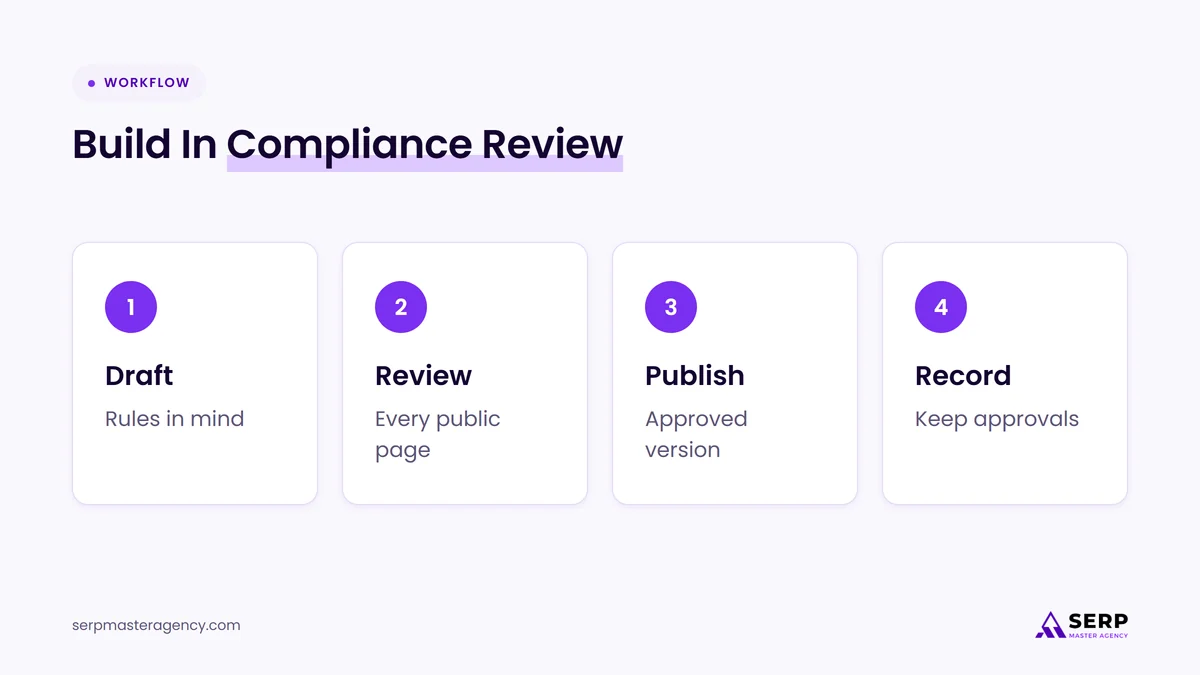
- Draft with the rules in mind. Write without performance figures, superlatives or reviews unless compliance has approved the exact wording and disclosures.
- Send every public page for review. That includes web pages, Business Profile posts, directory profiles and social posts, not just blog articles.
- Publish the approved version only. Small edits made after approval, such as a new headline, can change the meaning, so send them back for review.
- Keep records. Save the approved version, the approval date and the reviewer. The SEC’s books and records rule requires advisers to keep documentation supporting their reasonable belief that testimonials and endorsements comply.
What should a financial advisor check every month?
A financial advisor should check every month that profile details are correct, new reviews have been handled under the agreed process, pages with dated figures are still accurate, and AI tools describe the firm correctly. Regular checks catch small problems, such as a changed phone number or an outdated tax figure, before prospects or examiners see them.
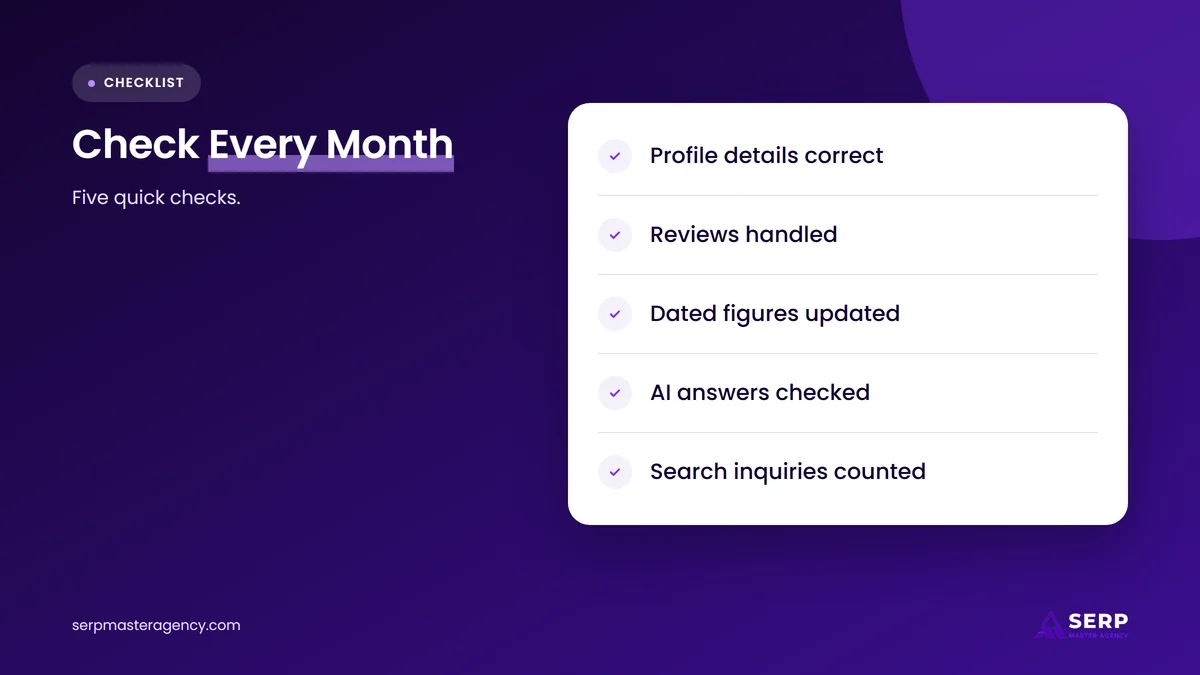
- Confirm your Google Business Profile hours, phone number and categories are still correct.
- Handle new reviews under your written review process, including any responses.
- Review pages with tax figures, contribution limits or dates.
- Ask two or three AI tools your clients’ main questions and record whether your firm appears.
- Count inquiries from search, and ask new clients how they found you.
How does SERP Master Agency help financial advisors?
SERP Master Agency helps financial advisors with specialist pages, Google Business Profile setup, technical SEO and structured data, and AI search visibility checks. We work alongside your compliance team, so drafts go to them for approval, and we do not write performance claims, rankings or testimonials into your content without their sign-off.
We usually start by reviewing how your firm appears today in Google, on Maps and in AI answers to the questions your ideal clients ask. That shows which of the seven ways will make the biggest difference first. You can see what the service covers on our financial advisor SEO page.
Frequently asked questions
Can financial advisors ask clients for Google reviews?
It depends on your registration and your compliance team’s view. Google allows businesses to ask for genuine reviews but bans incentives and selectively asking only happy customers. SEC-registered advisers must also consider whether reviews they request, share or display become testimonials under the Marketing Rule. Agree a written process with compliance first.
Does the SEC Marketing Rule apply to my website?
For SEC-registered investment advisers, it very likely does. The rule covers communications that offer advisory services to prospective clients, which describes most advisory firm websites. The SEC’s December 2025 risk alert specifically found non-compliant testimonials on advisers’ websites. Ask your chief compliance officer which pages count as advertisements.
How do financial advisors show up in ChatGPT?
No AI company publishes exactly how it chooses which firms to name. Advisors improve their chances by publishing clear specialist pages, keeping firm details consistent across the web, earning coverage that describes their specialty and checking regularly how AI tools describe them. Firm websites were cited in 89.5% of answers in one 2026 study.
Can an individual advisor have their own Google Business Profile?
Yes, if the advisor is public-facing and can be contacted directly at the verified location during stated hours. A solo advisor representing a branded firm should share one profile with the brand, named in the format “[brand]: [advisor name]”. Support staff should not have profiles.
How long does SEO take for a financial advisory firm?
Profile and listing fixes can show results within weeks, while new specialist pages and third-party mentions usually take several months to build visibility. Compliance review adds time to each piece of content, so plan publishing schedules with your reviewer’s workload in mind and judge progress by inquiries, not only rankings.
Where should a financial advisor start?
Start with the client group you serve best. Build one strong specialist page for that group, make sure the advisors behind it have clear bios, and check that your Google Business Profile follows Google’s practitioner rules. Agree a review process with compliance before you add reviews or ratings anywhere. Then check monthly how Google and AI tools describe your firm. If you want help, our SEO services at SERP Master Agency cover every step in this guide.
Want prospects to find your firm when they ask AI for an advisor?
Tell us who your ideal clients are and where your firm is registered. We’ll review how you appear in Google, on Maps and in AI answers today, and suggest which changes to make first, ready for your compliance team to review.
Sources
- U.S. Securities and Exchange Commission, Division of Examinations, “Additional Observations Regarding Advisers’ Compliance with the Advisers Act Marketing Rule” (Risk Alert), December 16, 2025. https://www.sec.gov/files/exams-riskalert-mrkt-rule-2512-508.pdf
- U.S. Securities and Exchange Commission, “Investment Adviser Marketing” (Final Rule, Release No. IA-5653), Federal Register, March 5, 2021. https://www.federalregister.gov/documents/2021/03/05/2020-28868/investment-adviser-marketing
- U.S. Securities and Exchange Commission, “Investment Adviser Marketing” (Small Entity Compliance Guide), April 28, 2021. https://www.sec.gov/resources-small-businesses/small-business-compliance-guides/investment-adviser-marketing
- U.S. Securities and Exchange Commission, Division of Investment Management, “Marketing Compliance: Frequently Asked Questions”, updated January 15, 2026. https://www.sec.gov/investment/marketing-faq
- FINRA, “Rule 2210. Communications with the Public”, accessed November 12, 2026. https://www.finra.org/rules-guidance/rulebooks/finra-rules/2210
- FINRA, “Regulatory Notice 26-14: FINRA Requests Comment on Proposed Changes to Modernize Rule 2210 (Communications with the Public)”, July 9, 2026. https://www.finra.org/rules-guidance/notices/26-14
- Google, “Search Quality Rater Guidelines”, September 11, 2025. https://guidelines.raterhub.com/searchqualityevaluatorguidelines.pdf
- Google Search Central, “Creating Helpful, Reliable, People-First Content”, accessed November 12, 2026. https://developers.google.com/search/docs/fundamentals/creating-helpful-content
- Google Business Profile Help, “Guidelines for representing your business on Google”, accessed November 12, 2026. https://support.google.com/business/answer/3038177
- Google Maps User Contributed Content Policy Help, “Prohibited & restricted content”, accessed November 12, 2026. https://support.google.com/contributionpolicy/answer/7400114
- Google Advertising Policies Help, “Financial Services Verification: Relevant Regulators and Enforcement Dates”, accessed November 12, 2026. https://support.google.com/adspolicy/answer/12390454
- Google Search Central, “Local Business (LocalBusiness) structured data”, accessed November 12, 2026. https://developers.google.com/search/docs/appearance/structured-data/local-business
- Schema.org, “FinancialService”, accessed November 12, 2026. https://schema.org/FinancialService
- Financial Conduct Authority, “FG24/1: Finalised guidance on financial promotions on social media”, March 26, 2024. https://www.fca.org.uk/publications/finalised-guidance/fg24-1-finalised-guidance-financial-promotions-social-media
- Wealth Management (Patrick Donachie), “Report Finds RIA Industry Rankings, Scale Don’t Guarantee AI Search Visibility”, October 28, 2026. https://www.wealthmanagement.com/artificial-intelligence/report-finds-ria-industry-rankings-scale-dont-guarantee-ai-search-visibility

Suraj Rana is a highly regarded SEO expert specializing in the dental industry. His expertise lies in crafting strategic SEO marketing plans to help new or expanding businesses increase their online visibility and attract more customers. Suraj Rana’s skills extend to improving website rankings and boosting organic search visibility, thereby enhancing web traffic and return on investment for businesses.