Quick answer: The November 2026 core update is a broad change to how Google ranks pages in Search, released on November 10, 2026 and expected to take up to two weeks to roll out. It is not a penalty. Don’t make changes while it rolls out. Wait until it finishes, then compare your Search Console data.
Key takeaways
- Google released the November 2026 core update on November 10, 2026. Its Search Status Dashboard says the rollout may take up to two weeks.
- The update applies globally and to all languages, so businesses in the US, UK, Canada, Australia and New Zealand can all see movement.
- Core updates don’t target specific sites. A drop usually means other pages are now judged more useful for a search, not that your site broke a rule.
- Google recommends waiting at least a full week after the rollout completes before analyzing your site in Search Console.
- Small drops rarely need action. Large, lasting drops call for an honest review of your content against Google’s helpful content questions.
What did Google announce on November 10, 2026?
Google announced that it had released the November 2026 core update to Google Search on November 10, 2026. The Search Status Dashboard lists it as a ranking incident that applies globally and to all languages, with a rollout that may take up to two weeks. Google described it as a regular update.
Here is what Google and the first coverage confirm:
- Release time. The Search Status Dashboard logged the update at 10:06 am Pacific time on November 10, 2026. Search Engine Roundtable reported the announcement at about 1:07 pm Eastern time.
- Purpose. Google said the update is designed to “better surface relevant, satisfying content for searchers from all types of sites.”
- Timing. Google said “The rollout may take up to 2 weeks to complete.” If it runs the full two weeks, it would finish around November 24, 2026.
- Scope. It covers all regions and all languages.
- Earlier movement. Search Engine Roundtable’s Barry Schwartz noted ranking volatility earlier in the same week, before the announcement, and suggested it may have come from unannounced refreshes.
This is the third core update Google has confirmed in 2026, after the March 2026 update (March 27 to April 8) and the May 2026 update (May 21 to June 2), according to Search Engine Roundtable’s list of past updates.
What is a Google core update?
A Google core update is a broad change to the main systems Google uses to rank search results. Google makes these changes several times a year to improve result quality overall. In its own words, core updates are broad in nature and don’t target specific sites or individual web pages, which is why they are not penalties.
A few related terms come up in coverage of this update:
- Rollout: the period while Google applies the update across its systems and data centers. Rankings can move up and down several times during it.
- Search Status Dashboard: Google’s official page that lists ranking updates and their start and end dates. It is the place to check whether a rollout has finished.
- Manual action: a penalty a human reviewer applies for breaking Google’s spam policies. It is reported in Search Console. A core update is not a manual action.
- Refresh: a smaller, often unannounced adjustment to ranking systems between named updates.
Search Engine Roundtable also notes that core updates can affect Google Discover, featured snippets and other search features, not only the main blue links.
Who is affected by the November 2026 core update?
Any website that gets traffic from Google Search can be affected, in any country and any language. Google says most sites don’t notice core updates at all. Sites that do see changes are usually in competitive searches where Google is now weighing content quality and usefulness differently between pages.
| Type of business | What could move | What to watch |
|---|---|---|
| Local service business | Service and location pages in organic results | Calls and form leads from organic search |
| Ecommerce store | Category pages, product pages and buying guides | Organic sessions and revenue by landing page |
| Professional services firm | Practice pages, guides and blog articles | Enquiries and which queries bring them |
| Content or publishing site | Articles, plus Google Discover and featured snippets | Traffic split by search type and by section |
Your Google Business Profile ranking in the local map pack works differently from organic web results, so don’t assume a change there is caused by this update without checking the dates and your other data first.
Should you change your website while the update rolls out?
No. Rankings often move up, down and back again during a rollout, so changes made now are based on numbers that are not final. Google’s guidance is to first confirm the update has finished on the Search Status Dashboard, then wait at least a full week before analyzing your data in Search Console.
That gives a rough calendar for this update:
- November 10 to around November 24, 2026: the rollout window, if it takes the full two weeks. Watch, but don’t rewrite pages.
- The day Google marks it complete: note the end date on the Search Status Dashboard.
- At least one full week after that: run your Search Console comparison. If the update ends on November 24, that is around December 1, 2026 or later.
Use the waiting time for work that helps no matter what the update does: make sure call and form tracking works, so you can judge the update by leads, not only by rankings. Our guide on measuring SEO by leads and revenue explains how to set that up.
How do you check if the core update affected your site?
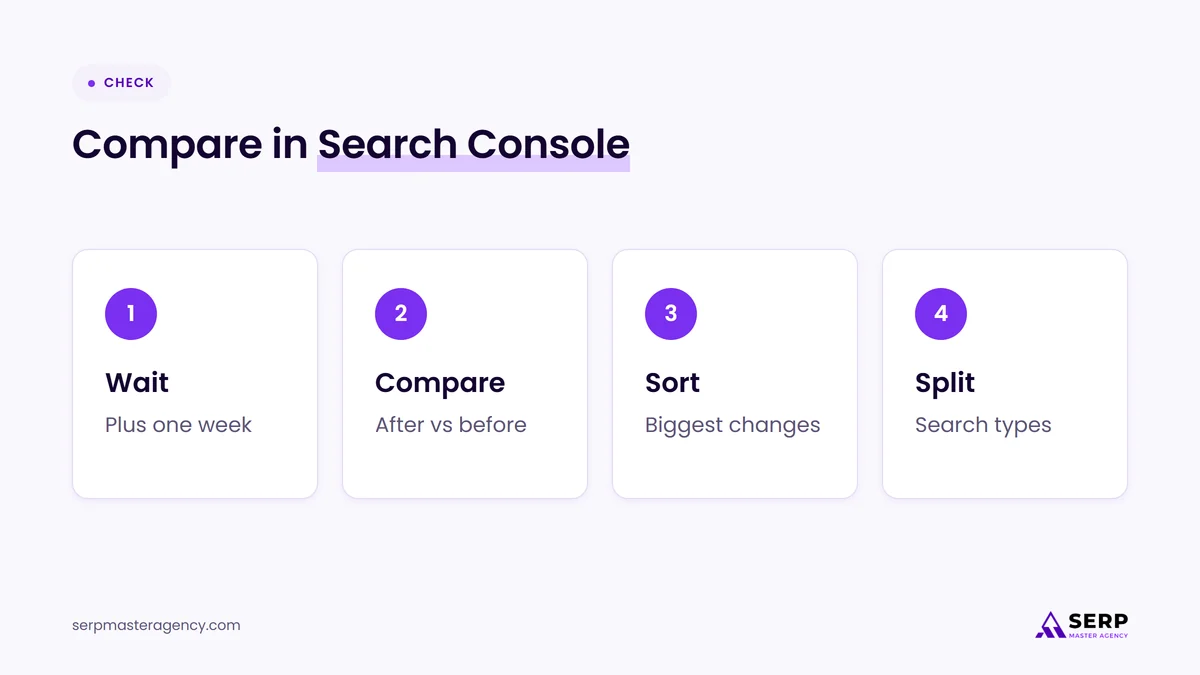
Use the Performance report in Google Search Console. Once the update has finished and a full week has passed, compare the week after the rollout ended with the week before it began. Google suggests this comparison because it isolates the update. Then look at your top pages and queries to find exactly where clicks changed.
- Open the Performance report. In Search Console, go to Performance, then Search results.
- Set a compare date range. Choose a custom comparison: the week after the rollout ended against the week before it started. For this update, the “before” week ends on November 9, 2026. Because some volatility was reported earlier that week, you can also check an earlier week as a second baseline.
- Sort by the biggest change. On the Pages and Queries tabs, sort by the difference in clicks to find the pages and searches that moved most.
- Check search types separately. Google recommends looking at web search, Google Images, video and News one at a time, because a drop can sit in just one of them.
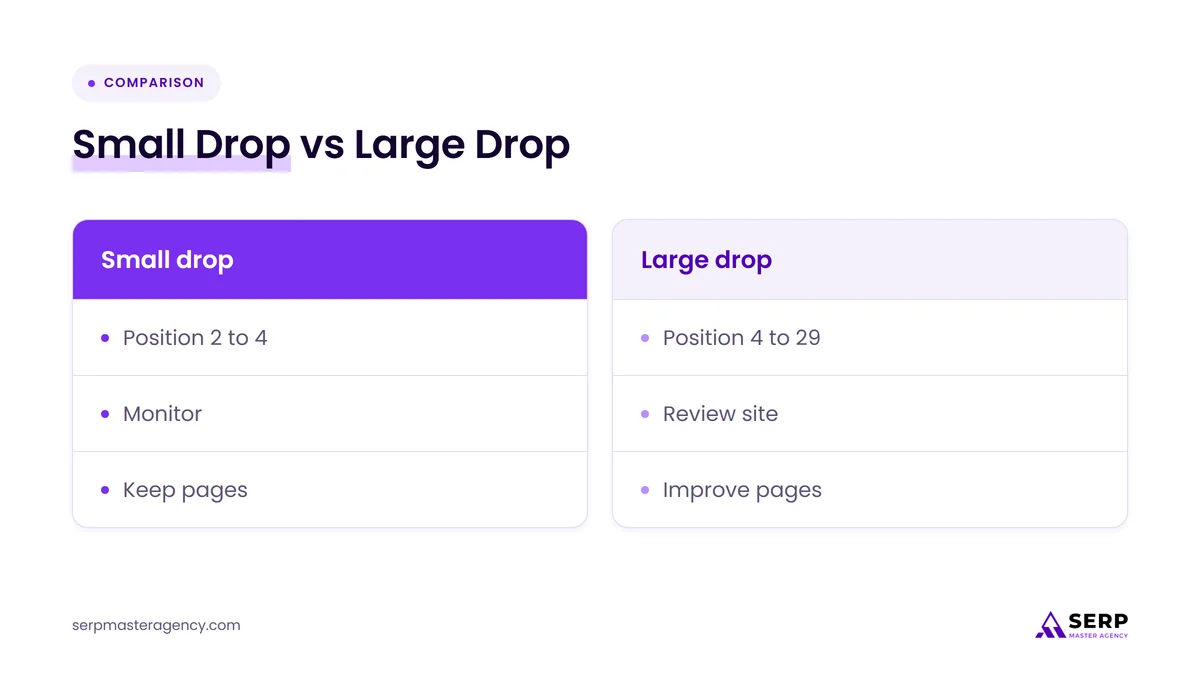
- Look at positions, not just clicks. A page moving from position 2 to position 4 is a different problem from one moving from position 4 to position 29.
- Rule out other causes. Seasonal demand, a site change, tracking errors or a manual action can all look like an update hit. Check the Manual actions report and your own change log.
If you changed your site structure or URLs recently, check redirects before blaming the update. Our article on how redirects pass rankings covers what to look for.
How do small drops and large drops compare?
Google’s guidance separates two situations. A small drop, such as moving from position 2 to position 4, usually doesn’t need drastic action, and Google advises against changing content that already performs well. A large, lasting drop, such as falling from position 4 to position 29, deserves a deeper review of the whole site.
| Factor | Small drop | Large, lasting drop |
|---|---|---|
| Example from Google | Position 2 to position 4 | Position 4 to position 29 |
| What it usually means | Other pages are now judged slightly more relevant | Google sees a wider gap in usefulness or quality |
| What to do | Monitor, and avoid rewriting pages that still perform | Review the site as a whole, then the most affected pages |
| Who should review | Your team or agency, as part of normal reporting | Ideally someone not connected to the site, for an honest view |
| When to expect change | Rankings often settle on their own | Possibly several months, or the next core update |
If your traffic went up, the same rule applies in reverse: don’t change pages that are now doing well. Study what those pages do right and apply it to weaker pages over time.
What should you improve if your traffic dropped?
Improve how useful your pages are to the people searching, not how well they match a checklist. Google points site owners to its guidance on helpful, reliable, people-first content and its self-assessment questions. Start with the whole site, then the pages that lost the most, and compare them with the pages that now rank above you.
Questions from Google’s helpful content guidance that are worth asking about each affected page:
- Originality. Does the page give original information, research or analysis, or does it repeat what others say?
- Expertise. Is it written or reviewed by someone who clearly knows the topic, such as the owner, a qualified staff member or a specialist?
- Who, how and why. Is it clear who wrote the page, how it was made (including any use of AI), and that its purpose is to help a customer, not to attract search traffic?
- Completeness. Would a customer leave with their question fully answered, or would they need to search again?
- Trust. Are prices, service areas, credentials and contact details accurate and easy to find?
For a service business, the most useful fixes are usually specific: real details about how you work, what a job involves, what it costs or what affects the price, and the areas you serve. If your site has many thin, near-identical pages made mainly for search, Google says removing that content may help, but only as a last resort. Our article on mass-producing AI content explains why volume alone is a weak plan.
What should you avoid doing after a core update?
Avoid quick fixes. Google specifically warns against “quick fix” changes, such as removing page elements because of a supposed SEO rule. Don’t rewrite pages mid-rollout, don’t delete content in a panic, and don’t buy links or shortcuts promising fast recovery. These moves can cause new problems without addressing the reason your pages lost ground.
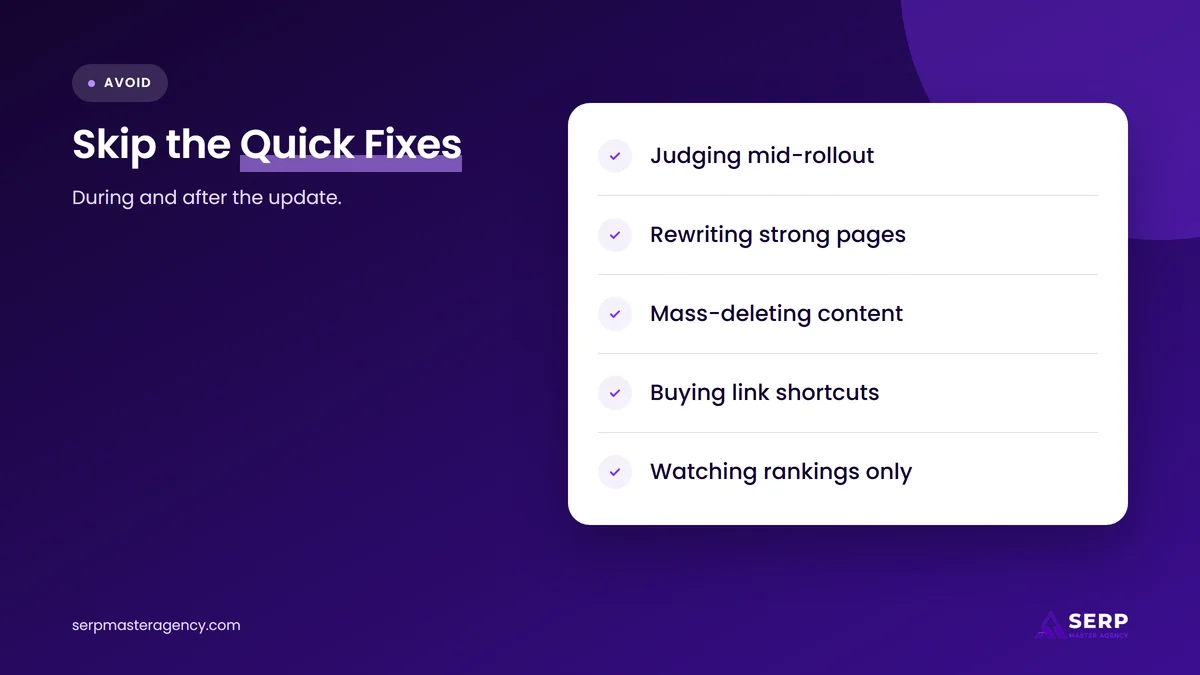
- Don’t judge mid-rollout. A ranking drop on day three may reverse by day ten.
- Don’t rewrite strong pages. Google advises against changing content that already performs well.
- Don’t mass-delete pages. Google calls deleting content a last resort, for pages made mainly for search engines.
- Don’t chase single tricks. Changing word counts, keyword density or page elements because of a rumored rule is the kind of quick fix Google warns against.
- Don’t buy a recovery shortcut. Link packages and sudden AI content volume can break Google’s spam policies and create a bigger problem.
- Don’t judge on rankings alone. Track calls, forms and sales from organic search, because that is what affects your business.
How long does it take to recover from a core update?
It varies. Google says some changes can take effect within days, but its systems may need several months to learn and confirm that a site is consistently helpful. If improvements show no effect after a few months, recovery may come with the next core update. Google also says improvements don’t always lead to visible ranking gains.
Past core updates show why patience matters. Search Engine Roundtable’s history lists rollouts that took six days (December 2024) and others that ran for weeks, such as the March 2024 update, which ran from March 5 to April 19, 2024. Google has confirmed several core updates a year, so the next chance to recover is usually months, not years, away.
If you track results over a longer period, our guide on recovering rankings after a Google core update walks through a fuller recovery plan, including for sites that serve several countries.
Frequently asked questions
When will the November 2026 core update finish?
Google said the rollout may take up to two weeks from November 10, 2026, which points to around November 24, 2026. Google marks the end date on its Search Status Dashboard, so check there rather than assuming a date. Rollouts can finish earlier or later than the estimate.
Is the November 2026 core update a penalty?
No. Google says core updates are broad changes that don’t target specific sites or pages. A drop usually means other pages are now judged more useful for those searches. A penalty for spam is a manual action, and it appears in the Manual actions report in Google Search Console.
Does the core update affect sites outside the US?
Yes. The Search Status Dashboard says the November 2026 core update applies globally and to all languages. Businesses in the UK, Canada, Australia, New Zealand and other markets can see ranking changes in the same rollout window as US sites.
Should I stop publishing content during a core update?
No. You can keep publishing helpful content and running normal work during the rollout. What you should avoid is reacting to day-to-day ranking moves by rewriting or deleting existing pages. Wait until the update is complete and a full week has passed, then review your data.
Can AI-written content cause a drop in a core update?
Google’s guidance focuses on whether content is helpful and made for people, not on whether AI was used. Content produced mainly to attract search visits, with little original value, is what its guidance warns against. Be open about how content is made and have someone with real expertise review it.
What should your business do this week?
Very little, on purpose. Note November 10, 2026 as the start date, confirm your lead tracking works, and wait for Google to mark the rollout complete. A full week after that, compare your Search Console data and decide whether you have a small drop to watch or a large one to review. Our SEO services include post-update reviews like this, and you can learn more about how we work at SERP Master Agency.
Worried about how the core update will hit your traffic?
SERP Master Agency helps business owners in the US, UK, Canada, Australia and New Zealand read their Search Console data and plan sensible next steps after Google updates. Tell us what you’re seeing, and once the rollout ends we’ll tell you whether anything on your site needs to change.
Sources
- Google Search Status Dashboard, “November 2026 core update”, November 10, 2026. https://status.search.google.com/incidents/WLxcJyC6jMWMfryxsKMc
- Google Search Central, “Google Search’s core updates and your website”, accessed November 11, 2026. https://developers.google.com/search/docs/appearance/core-updates
- Google Search Central, “Creating helpful, reliable, people-first content”, accessed November 11, 2026. https://developers.google.com/search/docs/fundamentals/creating-helpful-content
- Search Engine Roundtable, “Google November 2026 Core Update Is Rolling Out”, November 10, 2026. https://www.seroundtable.com/google-november-2026-core-update-42504.html

Suraj Rana is a highly regarded SEO expert specializing in the dental industry. His expertise lies in crafting strategic SEO marketing plans to help new or expanding businesses increase their online visibility and attract more customers. Suraj Rana’s skills extend to improving website rankings and boosting organic search visibility, thereby enhancing web traffic and return on investment for businesses.