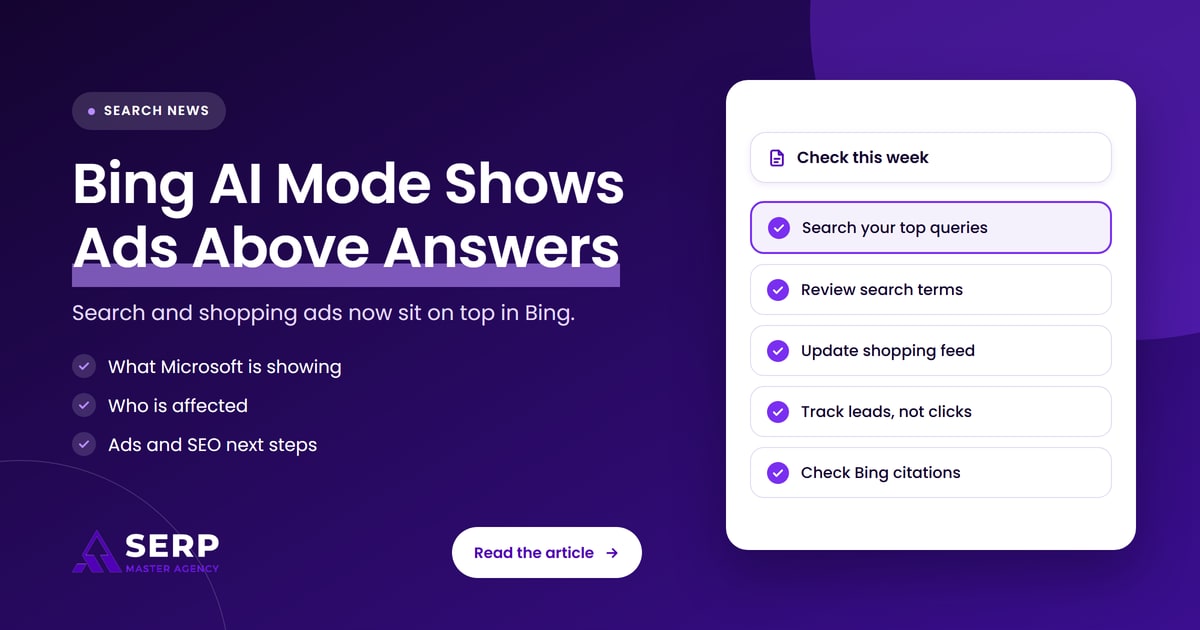
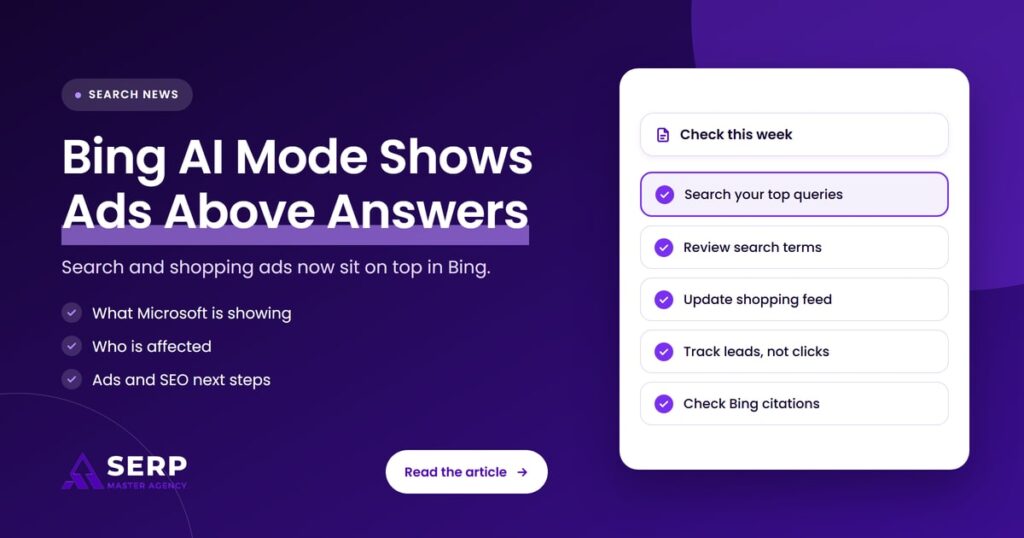
Quick answer: Microsoft is now showing standard search ads and shopping ads at the top of Bing AI Mode, the AI search experience formerly called Copilot Search, including on follow-up questions. The sponsored labels are subtle and Microsoft has not commented. Don’t move budget yet: check your search terms, tracking and Bing visibility first.
Key takeaways
- Search Engine Roundtable reported on November 9, 2026 that Bing AI Mode now shows search ads and shopping ads above the AI answer.
- Ads also appear on follow-up questions in the same conversation, the format Google calls multiturn ads.
- The sponsored labels are easy to miss, and Microsoft has made no public statement about the change.
- Microsoft Advertising said in April 2026 that its AI Max feature can deliver ads on Copilot Search and Copilot Answers, so AI placements are part of its plan.
- Advertisers should watch search terms and lead quality. SEO teams should check how often Bing cites their pages, because the organic answer now sits below paid placements.
What changed with ads in Bing AI Mode?
Bing AI Mode now shows paid search ads and shopping ads at the top of its results, above the AI-written answer. Search Engine Roundtable reported the change on November 9, 2026, after examples were shared publicly. Ads also show on follow-up questions, and the sponsored labels are subtle enough that readers can miss them.
Here is what the report describes:
- Ads above the answer. Search Engine Roundtable’s Barry Schwartz wrote that Microsoft is showing ads at the top of Bing AI Mode results. The first examples came from Sachin Patel, whose screenshots show sponsored ads with sitelinks above the answer.
- Two ad types. Both regular search ads and shopping ads appear at the top. Schwartz found the shopping ads while trying to reproduce Patel’s examples.
- Ads on follow-up questions. The ads also appear when a searcher asks a follow-up question in the same AI Mode session.
- Quiet labels. Schwartz wrote that he did not notice at first that the results were ads.
- No official word. The report included no statement from Microsoft, and we found no Microsoft announcement about this placement as of November 10, 2026.
The placement is a shift from how Microsoft first described ads in its AI search. In an October 2024 Microsoft Advertising blog post, Paul Longo wrote that ads in Copilot would appear below Copilot’s organic response, and that the format would expand over time to Copilot experiences in Bing and Edge. The new sightings put ads above the answer instead.
What is Bing AI Mode?
Bing AI Mode is Microsoft’s conversational AI search experience inside Bing. It writes an answer to a question, cites web sources and lets people ask follow-up questions. Until recently it was labeled Copilot Search. Microsoft began testing the AI Mode name in Bing’s search tabs in September 2026.
Search Engine Roundtable first reported the rename test on September 25, 2026. An update to that article, dated October 13, 2026, says the AI Mode tab appeared to be fully rolled out, showing across browsers and on mobile. AI Mode is also the name Google uses for its own AI search experience, so the two products now share a label.
Two other terms come up in this story:
- Multiturn ads: ads that appear on follow-up questions in an AI conversation, not only on the first search. Google uses this name for the same idea in Google AI Mode.
- Sponsored label: the marker that tells a searcher a result is paid. In March 2026, Search Engine Roundtable also reported Bing testing a sponsored label that was almost transparent.
Who is affected by ads in Bing AI Mode?
Three groups are affected: businesses that run Microsoft Advertising search or shopping campaigns, businesses that get organic traffic or AI citations from Bing, and searchers who may not notice the ads. The reports don’t say which countries or industries see the ads, so treat it as an early rollout or a test.
| Who you are | What this change means | What to watch |
|---|---|---|
| Microsoft Advertising search advertiser | Your ads may now show at the top of AI answers and on follow-up questions | New search terms, cost per lead, lead quality |
| Ecommerce store running shopping ads | Product ads can appear above the AI answer | Product feed accuracy, prices, return on ad spend |
| Business relying on organic Bing traffic | The AI answer that cites your pages now sits below paid placements | Citations, clicks and leads from Bing |
| Business not advertising on Bing | Competitors who advertise can appear above any answer that mentions you | Who advertises on your main service and brand searches |
If you sell to customers in the US, UK, Canada, Australia or New Zealand, check the searches that matter to you rather than assuming the ads are, or are not, live in your market.
How do ads and organic answers compare in Bing AI Mode?
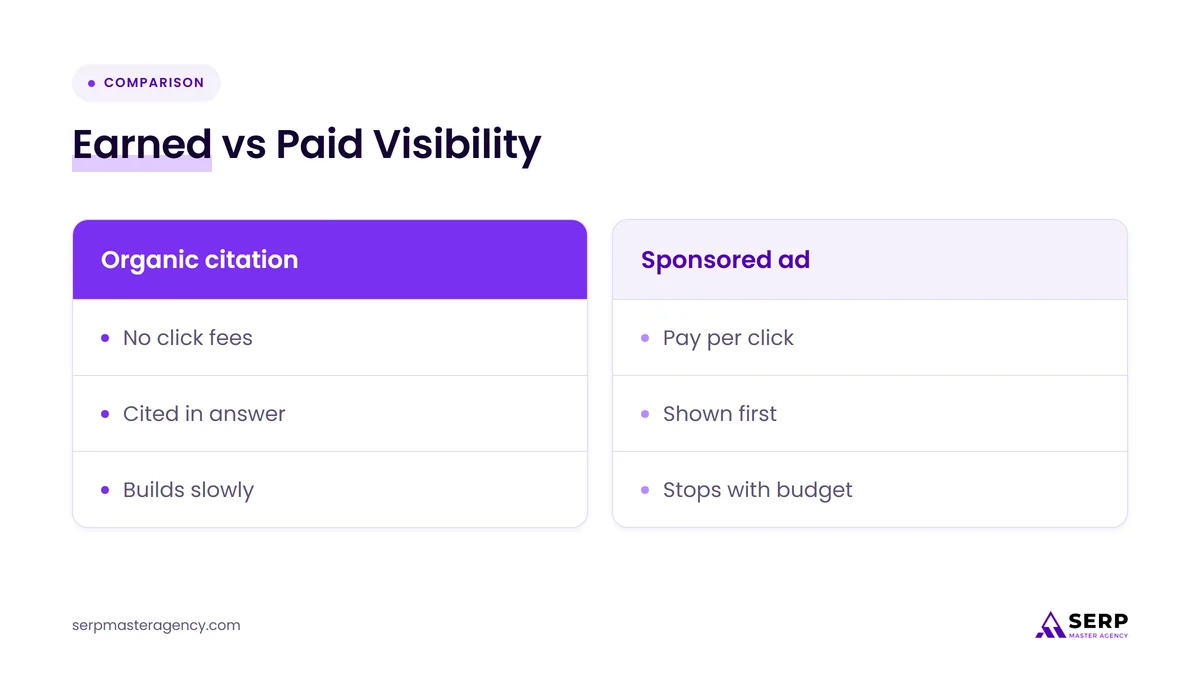
A sponsored ad in Bing AI Mode is bought per click and disappears when the budget stops. An organic citation is earned by your pages and costs nothing per click, but it takes time to build. With ads now placed above the answer, paid placements get the first look while organic citations sit inside the answer below.
| Factor | Organic citation in the AI answer | Sponsored ad above the answer |
|---|---|---|
| How you get it | Bing picks your page as a source | You bid through Microsoft Advertising |
| Cost | No fee per click | Paid per click |
| Position | Inside the AI answer | Above the AI answer, per current reports |
| Speed | Builds over months | Can start as soon as a campaign is eligible |
| Control over wording | Low: Bing writes the answer | High: you write the ad |
| How to measure it | Bing Webmaster Tools AI Performance report, plus leads in analytics | Microsoft Advertising reports, plus conversion tracking |
Neither one replaces the other. Many businesses will want both: organic citations for steady visibility and ads for the searches where a lead is worth paying for.
How do ads get into Bing AI Mode?
Microsoft has not explained how ads are chosen for Bing AI Mode. What is public is that Microsoft Advertising said in April 2026 that AI Max, an opt-in feature for Search campaigns, can deliver ads on Copilot Search and Copilot Answers as well as on Bing. Which other campaigns qualify for this placement is not confirmed.
In that April 21, 2026 post, Tim Frank, Corporate Vice President of Microsoft AI Monetization, described AI Max as using AI to improve Search campaign performance through expanded query matching, asset personalization and smarter URL routing. The post says advertisers opt into AI Max and that Microsoft provides search term and asset reporting so advertisers can see how AI affects their results. It also said AI Max would be available in an open pilot in May.
Two practical points follow from this:
- Check your settings. If someone else manages your account, ask whether AI Max is switched on and which campaigns use it.
- Read the search terms report. AI placements answer longer, more specific questions. Your ads may match searches you never targeted directly, and that report is where you see them.
Google is moving the same way. Search Engine Roundtable reported on October 28, 2026 that Google launched multiturn ads in Google AI Mode in the US and is expanding AI Mode ads to more countries, including Australia, Canada and New Zealand, with the UK planned for later in the quarter. Our article on Google ads inside AI Mode conversations covers that change.
What should Microsoft Ads advertisers do now?
Microsoft Ads advertisers should check the searches that matter to them in Bing AI Mode, review their search terms report for new long questions, add negative keywords where needed, and judge results on leads and sales rather than clicks. There is no reason to raise or cut budgets until your own data shows a change.
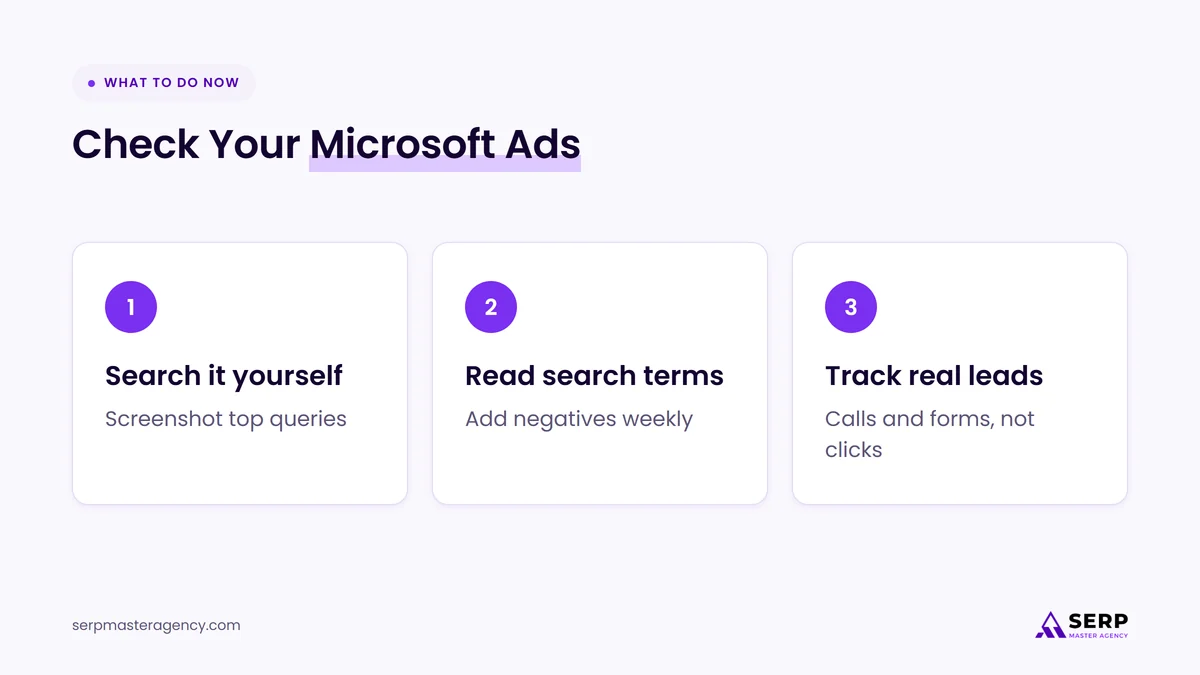
- Search it yourself. Open Bing AI Mode and search your five to ten most valuable services or products. Ask a follow-up question each time. Screenshot who appears above the answer, including any competitor bidding on your brand name.
- Review search terms weekly. Look for longer, question-style searches that started recently. Add negative keywords for any that don’t fit, such as job searches, DIY questions or services you don’t offer.
- Check AI Max and broad match settings. Know which campaigns use AI Max or broad match, because these settings decide how widely your ads can match conversational questions.
- Fix your shopping feed. If you run shopping ads, make sure titles, prices, stock levels and images in Microsoft Merchant Center are current. A wrong price is more visible at the top of an AI answer.
- Track leads, not clicks. Confirm that calls, form fills and sales are tracked as conversions in Microsoft Advertising. If they aren’t, you can’t tell whether these placements pay.
- Compare before and after. Note today’s date and compare cost per lead for the next four to six weeks against the previous period. Make budget decisions on that, not on screenshots.
If your paid search results have already been disappointing, these placements won’t fix that on their own. Our guide on why businesses struggle with PPC results covers the usual causes. If you also advertise in ChatGPT, the same discipline applies to the ChatGPT Ads bidding changes.
Does this change your SEO plan for Bing?
It shouldn’t change your SEO plan much, but it raises the stakes for being cited. With ads now placed above the AI answer, the organic answer gets less of the first look, so the businesses Bing cites inside that answer need clear, accurate pages. The basics still decide whether Bing can find and cite you.
Start with these checks:
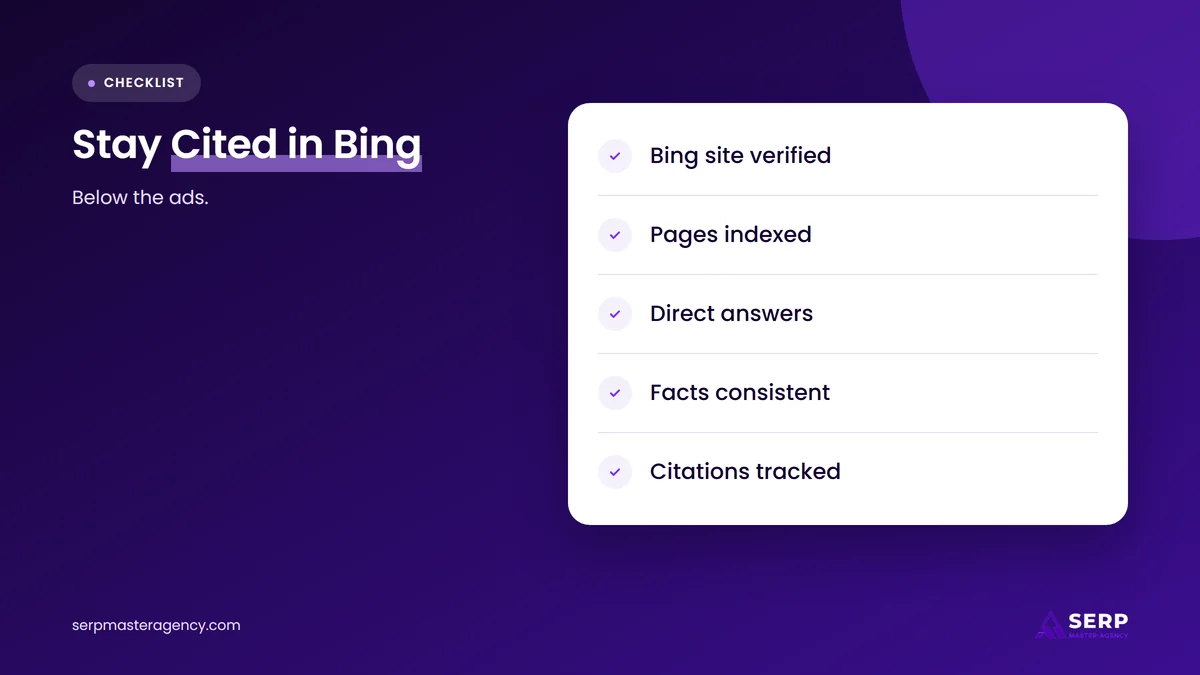
- Verify your site in Bing Webmaster Tools. If you have only set up Google Search Console, add Bing too. Without it, you can’t see how Bing treats your site.
- Use the AI Performance report. Microsoft launched it in public preview in February 2026. It shows how often your content is cited across Microsoft Copilot, AI-generated summaries in Bing and select partner integrations, which pages are cited and the grounding queries behind them.
- Make sure key pages are indexed in Bing. Check your service, product and location pages, not only your homepage.
- Answer questions directly. AI answers are built from clear passages. Open each service page with a plain answer to the question a customer would ask.
- Keep business facts consistent. Your name, address, phone number, prices and opening hours should match across your site and listings, so the AI answer gets them right.
If you sell internationally, Bing can matter more in some markets than your Google data suggests. Our guide to optimising for Bing and other search engines beyond Google covers the setup in more detail.
What is still unknown?
Several details are still unknown: whether this is a test or a full rollout, which countries see it, which campaign types are eligible, and whether advertisers can report on or opt out of the AI Mode placement. Microsoft has not commented, so treat any confident claim about these details with caution until it does.
Questions worth asking your account manager or agency:
- Can we see performance for AI Mode placements separately from standard Bing results?
- Can we exclude a campaign from AI placements if lead quality drops?
- Are shopping ads in AI Mode drawn from our existing shopping campaigns?
- Will the sponsored label change? Microsoft has tested label designs before.
What is likely to happen next?
Ads in AI answers are spreading across search. Google has ads in AI Mode, including on follow-up questions in the US, Microsoft has said its AI Max feature targets Copilot Search, and ChatGPT now runs ads too. Expect more ad formats inside AI answers and more questions about how clearly they are labeled.
If you are weighing ads in AI assistants too, our article on whether your business should advertise in ChatGPT covers that decision. For business owners, the takeaway is to plan for both sides. Paid placements in AI answers will keep growing, and so will the value of being the source an AI answer cites. A business that tracks leads by channel will be able to tell which one is paying off.
Frequently asked questions
Is Bing AI Mode the same as Copilot Search?
Yes. Bing AI Mode is the new name for the AI search experience that Bing previously labeled Copilot Search. Microsoft began testing the AI Mode label in Bing’s search tabs in September 2026, and by mid-October 2026 the tab appeared to be fully rolled out across browsers and mobile.
What types of ads appear in Bing AI Mode?
Search Engine Roundtable reported that both standard search ads and shopping ads appear at the top of Bing AI Mode results, above the AI-written answer. Examples shared publicly also showed search ads with sitelinks. Ads appear on follow-up questions in the same conversation, not only on the first search.
Do I need a new campaign to show ads in Bing AI Mode?
Microsoft has not said. Its April 2026 announcement said the opt-in AI Max feature for Search campaigns can deliver ads on Copilot Search and Copilot Answers. Beyond that, eligibility is not confirmed, so ask your Microsoft Advertising account team before building anything new.
How can I tell if an answer in Bing AI Mode is an ad?
Look for a sponsored label near the top of the result. Reports describe these labels as subtle, and the journalist who reported the change said he did not notice the ads at first. If a result above the AI answer links to a business with sitelinks or product images, check closely for the label.
Should I stop SEO and only advertise in Bing AI Mode?
No. Ads stop when the budget stops, while organic citations keep working without a fee per click. Ads sit above the answer, but the businesses Bing cites inside the answer still get seen. Most businesses that rely on search do best with SEO as the base and ads for their most valuable searches.
Should your business change its Bing plans now?
Not yet, beyond a few checks. If you advertise on Microsoft Advertising, look at Bing AI Mode yourself, read your search terms, confirm your conversion tracking and compare cost per lead over the next month. If you rely on organic traffic, verify your site in Bing Webmaster Tools and use the AI Performance report to see how often Bing cites you. Our SEO services cover both sides, and you can learn more about how we work at SERP Master Agency.
Want to know how Bing AI Mode ads affect your search plan?
SERP Master Agency helps business owners in the US, UK, Canada, Australia and New Zealand stay visible in Google, Bing and AI search. Tell us about your business and how you get leads today, and we’ll tell you whether anything in your plan needs to change.
Sources
- Search Engine Roundtable, “Bing Ads At Top Of AI Mode Results”, November 9, 2026. https://www.seroundtable.com/bing-ads-top-ai-mode-results-42479.html
- Search Engine Roundtable, “Bing Tests Replacing Copilot With AI Mode In Search Tabs”, September 25, 2026 (updated October 13, 2026). https://www.seroundtable.com/bing-ai-mode-search-tabs-42165.html
- Search Engine Roundtable, “Bing Tests Sponsored Label That Is Almost Transparent”, March 31, 2026. https://www.seroundtable.com/bing-transparent-sponsored-label-41131.html
- Microsoft Advertising, “Win across all three eras of the web”, April 21, 2026. https://about.ads.microsoft.com/en/blog/post/april-2026/win-across-all-three-eras-of-the-web
- Microsoft Advertising, “Transforming audience engagement with generative AI”, October 2, 2024. https://about.ads.microsoft.com/en/blog/post/october-2024/transforming-audience-engagement-with-generative-ai
- Microsoft Bing Blogs, “Introducing AI Performance in Bing Webmaster Tools Public Preview”, February 10, 2026. https://blogs.bing.com/webmaster/February-2026/Introducing-AI-Performance-in-Bing-Webmaster-Tools-Public-Preview
- Search Engine Roundtable, “Google Expands Ads In AI Mode To More Countries & Multiturn Ads In U.S.”, October 28, 2026. https://www.seroundtable.com/google-expands-ads-ai-mode-42412.html

Suraj Rana is a highly regarded SEO expert specializing in the dental industry. His expertise lies in crafting strategic SEO marketing plans to help new or expanding businesses increase their online visibility and attract more customers. Suraj Rana’s skills extend to improving website rankings and boosting organic search visibility, thereby enhancing web traffic and return on investment for businesses.