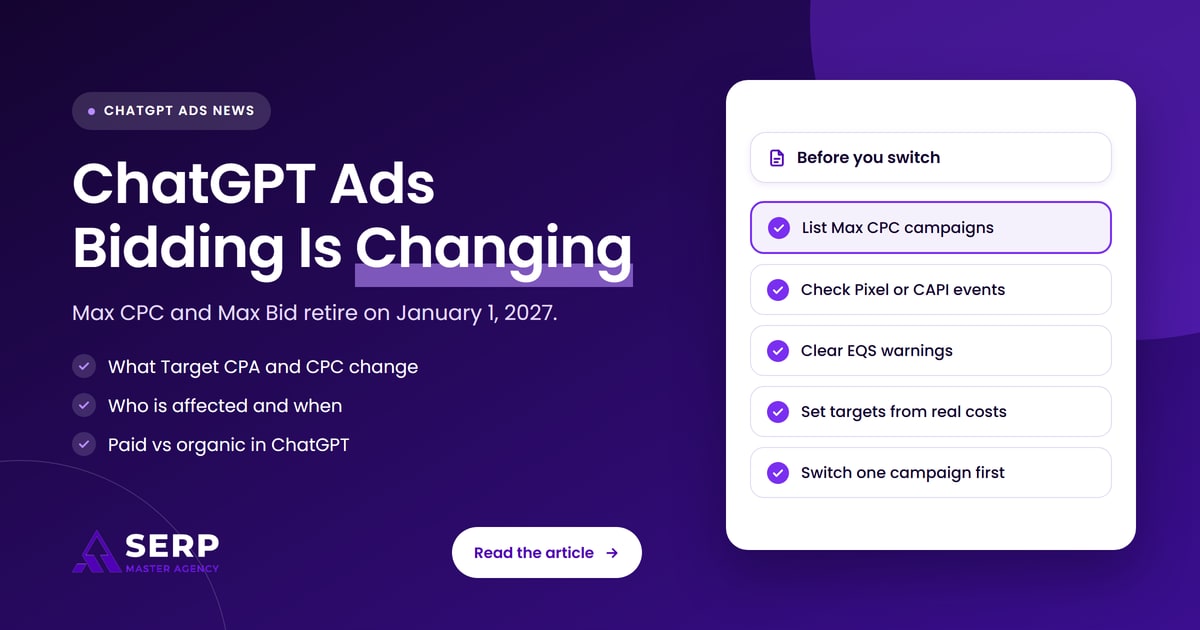
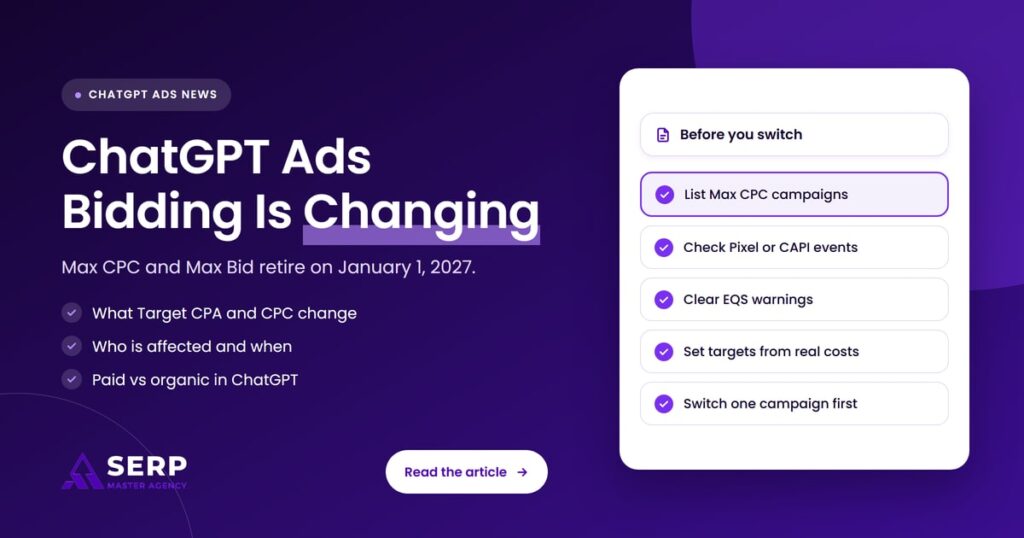
Quick answer: From November 9, 2026, ChatGPT Ads lets advertisers set a cost target in Ads Manager: Target CPA for conversion campaigns and Target CPC for click campaigns. The older Max Bid and Max CPC options retire on January 1, 2027. Before then, check your conversion tracking, set targets from recent real costs and switch campaigns on your own schedule.
Key takeaways
- OpenAI emailed ChatGPT Ads advertisers about the change, and the new bidding options went live on Monday, November 9, 2026, according to Search Engine Roundtable.
- Target CPA replaces Max Bid for new conversion campaigns. Target CPC replaces Max CPC for new click campaigns.
- Target CPC works on an average: the system can bid above or below your target in each auction, unlike Max CPC, which caps every bid.
- Existing Max Bid and Max CPC campaigns keep running until you switch them. On January 1, 2027, any that are left move to Target CPA or Target CPC.
- “Maximize results” automatic bidding is now called intelligent bidding.
- OpenAI warns that targets set too tightly, or weak conversion signals, can reduce delivery and leave budget unspent.
What changed in ChatGPT Ads bidding on November 9, 2026?
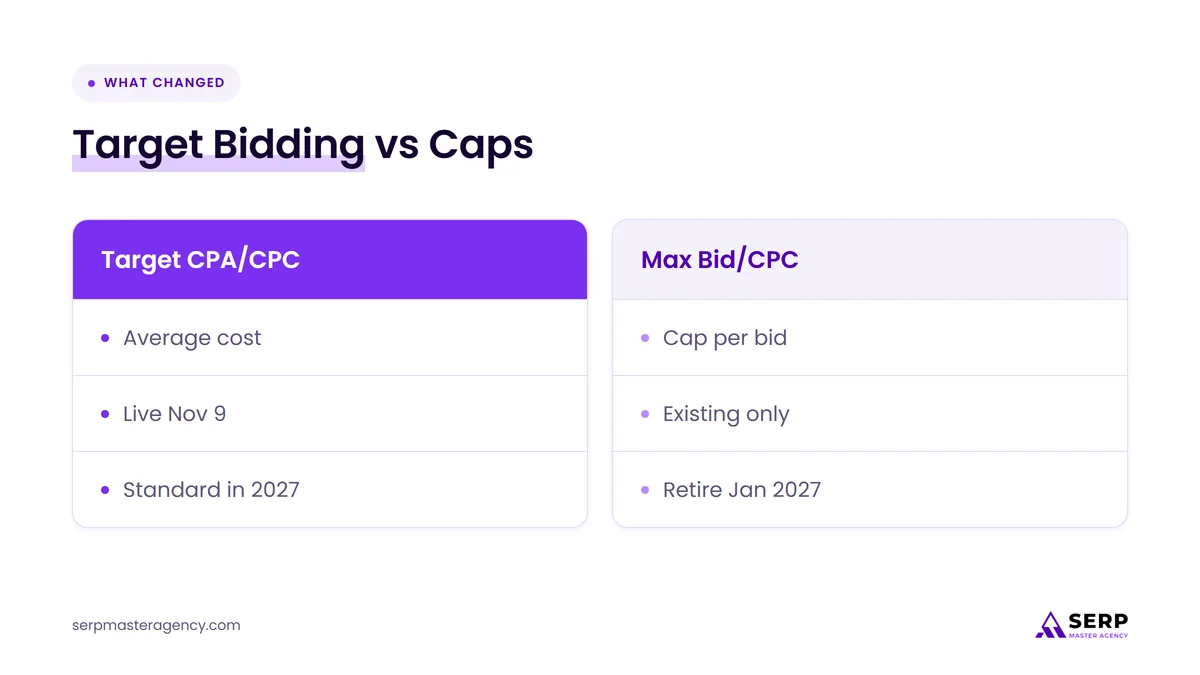
On November 9, 2026, ChatGPT Ads added cost targets to Ads Manager. Conversion campaigns can use Target CPA, which aims for an average cost per conversion, and click campaigns can use Target CPC, which aims for an average cost per click. The older Max Bid and Max CPC options retire on January 1, 2027.
OpenAI told advertisers about the change by email, and Search Engine Roundtable reported it on November 5, 2026. OpenAI’s wording was that advertisers “can optionally choose a cost target in Ads Manager” when they create a campaign or update an existing one. We could not find a public OpenAI help page that describes the change, so this post relies on that report of OpenAI’s email.
Here is the timeline in one place:
| Date | What happens | What it means for you |
|---|---|---|
| November 5, 2026 | OpenAI emails ChatGPT Ads advertisers about the bidding change | Review your campaigns and your conversion tracking |
| November 9, 2026 | Target CPA and Target CPC launch in Ads Manager | New campaigns use cost targets; existing ones can be switched |
| November 9 to December 31, 2026 | Existing Max Bid and Max CPC campaigns keep running unless you switch them | Your window to move campaigns on your own terms |
| January 1, 2027 | Max Bid and Max CPC retire | Remaining campaigns move to Target CPA or Target CPC |
What are Max Bid and Max CPC?
Max Bid and Max CPC are the bid caps ChatGPT Ads used before this change. Max Bid was the option for conversion campaigns. Max CPC, short for maximum cost per click, was the option for click campaigns and set the most you would pay for a single click. Both put a ceiling on each individual bid.
What are Target CPA and Target CPC?
Target CPA (target cost per acquisition) is a bidding option where you set the average amount you want to pay for each conversion, such as a lead or a sale. Target CPC (target cost per click) does the same for clicks. In both cases, the ad system adjusts bids and delivery to hit that average over time.
What is intelligent bidding in ChatGPT Ads?
Intelligent bidding is the new name for the “Maximize results” automatic bidding option, also called autobid. According to the report of OpenAI’s email, only the name has changed: it still adjusts bids and delivery automatically. If your campaigns already use it, you have nothing to switch, but expect the new label in Ads Manager.
How is Target CPC different from Max CPC?
Max CPC sets a hard limit on what you pay for any single click. Target CPC sets the average you want to pay, and the system may bid above or below that figure in each auction to reach it. So with Target CPC, a single click can cost more than your target, as long as the average stays near it.
That difference matters for anyone who runs ChatGPT Ads on a tight budget. With a cap, you know the most a click can ever cost. With a target, you hand more control to the system in exchange for, in theory, better placements where they count. The same logic applies to Target CPA: you set the average cost per conversion you want, not the maximum for each one.
| Old option | New option | |
|---|---|---|
| Conversion campaigns | Max Bid | Target CPA: an average cost per conversion |
| Click campaigns | Max CPC: a cap on each click | Target CPC: an average cost per click, with bids above or below it per auction |
| Automatic bidding | Maximize results (autobid) | Intelligent bidding (same behavior, new name) |
| Retirement date | January 1, 2027 | Becomes the standard option |
Who is affected by the ChatGPT Ads bidding change?
The change affects any business running ChatGPT Ads campaigns on Max Bid or Max CPC. Those campaigns keep running for now but will be moved to Target CPA or Target CPC on January 1, 2027. Advertisers already on automatic bidding only see a new name, and businesses that don’t advertise in ChatGPT see no direct change.
- Advertisers on Max CPC click campaigns. You lose the hard cap per click. Your costs per click can now vary more from auction to auction.
- Advertisers on Max Bid conversion campaigns. You move to an average cost per conversion, which only works well if ChatGPT Ads receives accurate conversion data from your site.
- Advertisers on “Maximize results”. Your campaigns now show as intelligent bidding. No switch is needed.
- Businesses thinking about ChatGPT Ads. Any new campaign you start will use the new options, so set up tracking before you launch. Our earlier post, ChatGPT Ads Are Expanding: Should Your Business Advertise in ChatGPT?, covers whether testing the platform makes sense at all.
What should you do before Max CPC retires?
Use the weeks before January 1, 2027 to switch on your own terms rather than waiting for the automatic move. Check that your conversion tracking sends the right event, set each target from your recent actual cost per conversion or click, switch campaigns one at a time and watch spend and delivery closely for the first weeks.
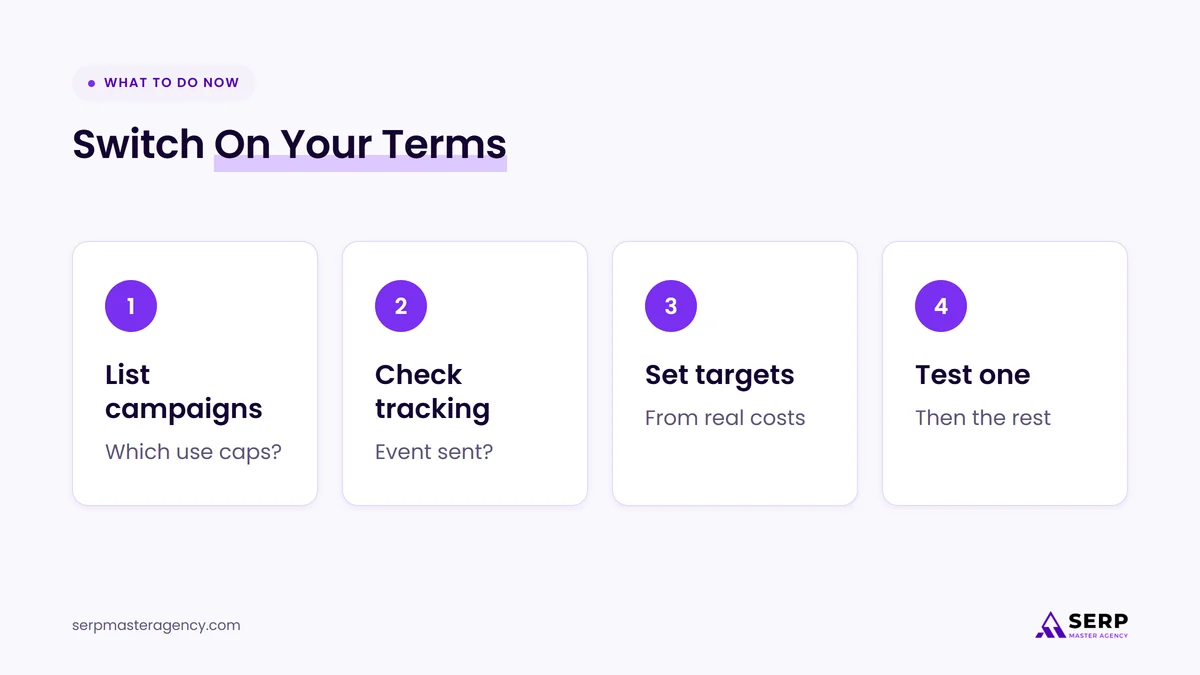
- List every campaign and its bidding option. Note which use Max Bid, which use Max CPC and which already use automatic bidding. Only the first two need action.
- Check your conversion signals. OpenAI recommends confirming that your Pixel or Conversions API sends the selected conversion event to the linked data source. If the event you optimize for isn’t arriving, Target CPA has nothing reliable to aim at.
- Fix the warnings Ads Manager shows you. OpenAI points advertisers to Event Quality Score (EQS) warnings as the way to find and fix gaps in conversion signals.
- Set targets from real results. OpenAI’s advice is to base each target on your recent actual CPA or CPC, not on the number you wish you were paying.
- Switch one campaign first. This step is our suggestion, not OpenAI’s: move a single campaign, watch spend, delivery and cost per lead for a couple of weeks, then switch the rest.
- Review before the deadline. Anything still on Max Bid or Max CPC on January 1, 2027 will be moved for you, so decide before then whether each campaign is worth keeping.
If you run search ads elsewhere, the same habits apply. Our PPC advertising services page explains how we manage paid campaigns across channels.
How do you know your conversion tracking is ready for Target CPA?
Your tracking is ready when the conversion event you optimize for, such as a form submission, call or purchase, reaches ChatGPT Ads every time it happens. Confirm the Pixel or Conversions API sends that event to the linked data source, clear any Event Quality Score warnings and compare the counts with your own records.
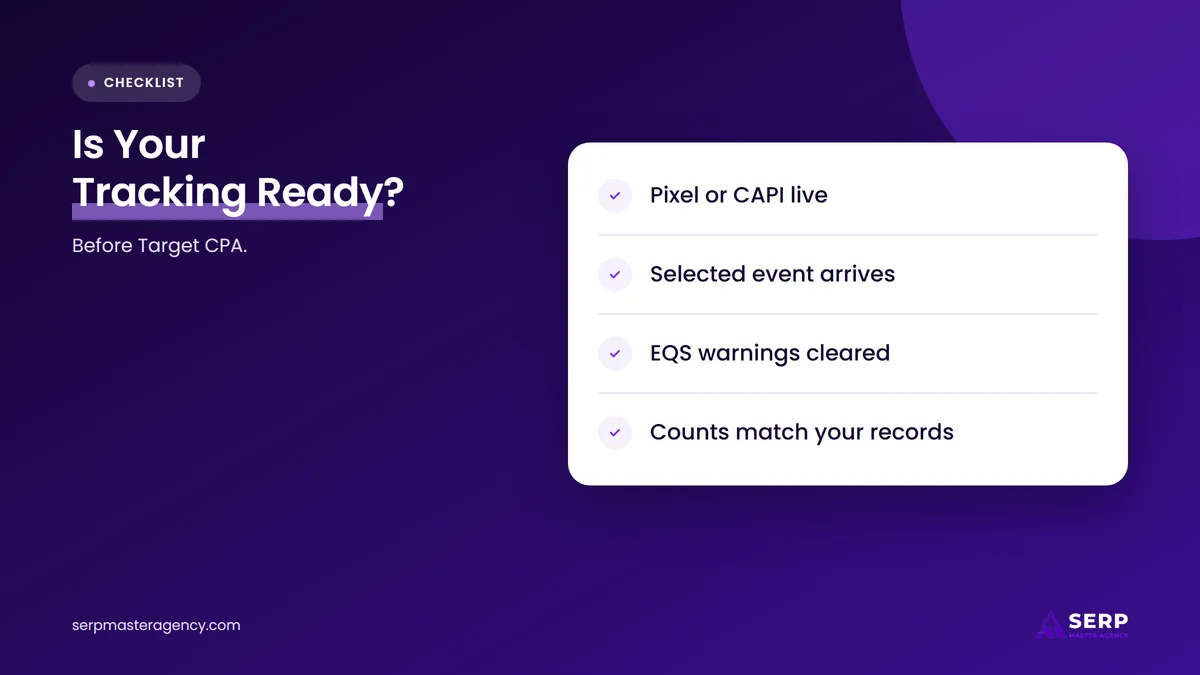
A simple way to test this is to compare the conversions Ads Manager reports for a week with the leads or sales your business actually recorded in the same week. If the numbers are far apart, fix the tracking before you set a target. Our guide to measuring marketing by leads and revenue shows how to set up that kind of check for any channel.
What happens if your target is too strict?
If you set a target well below what your campaign actually costs, or your conversion signals are weak, the system may show your ads less often. OpenAI warns that restrictive targets or weak conversion signals can reduce delivery and leave budget unspent. That can look like savings, but it usually means fewer leads.
The fix is to start from your recent real numbers and adjust gradually. If your campaign has been getting leads at a certain cost, use that as the starting target rather than cutting it sharply on day one. Once delivery is steady, you can test lower targets in small steps and watch whether lead volume holds.
What does this mean for your organic visibility in ChatGPT?
The bidding change only affects paid placements. It does not change how ChatGPT chooses which businesses to mention or cite in its answers. Organic visibility in ChatGPT still depends on clear, trusted information about your business across your website and the wider web, and it costs nothing per click.
For most businesses, paid and organic work best together. Ads buy a place in a conversation today, at a price that will now be set by targets and auctions. Organic visibility builds a place in answers that keeps working when an ad budget runs out. Our guide on how to get your business recommended by ChatGPT covers the organic side step by step, and SEO vs AEO vs GEO explains how AI visibility fits with traditional search.
What is likely to come next?
This section is our view, not something OpenAI has announced. Moving from bid caps to cost targets makes ChatGPT Ads work more like other large ad platforms, where the system controls bids and the advertiser controls goals and data. That shift makes accurate conversion tracking and honest targets more important than manual bid tweaks.
We would expect the advertisers who do best on ChatGPT Ads to be the ones who know their real cost per lead from every channel, organic included. If you can see that organic search and AI answers already bring in leads at a lower cost, you can set paid targets with confidence instead of guessing.
Frequently asked questions
When do Max Bid and Max CPC retire in ChatGPT Ads?
Max Bid and Max CPC retire on January 1, 2027. Until then, existing campaigns that use them keep running unless you switch them. On that date, remaining Max Bid conversion campaigns move to Target CPA and remaining Max CPC click campaigns move to Target CPC.
Do I have to switch my ChatGPT Ads campaigns on November 9?
No. From November 9, 2026, you can choose a cost target when you create a campaign or update an existing one, but existing Max Bid and Max CPC campaigns keep running as they are. OpenAI recommends reviewing campaigns now and starting the move, so you switch on your schedule rather than on January 1, 2027.
Can Target CPC cost more than my target for a single click?
Yes. Target CPC lets the system bid above or below your target in each auction to reach the average you set. Unlike Max CPC, which capped every bid, a single click under Target CPC can cost more than your target, while the average aims to stay near it.
What is intelligent bidding in ChatGPT Ads?
Intelligent bidding is the new name for the “Maximize results” automatic bidding option, also known as autobid. It still adjusts bids and delivery automatically. If your campaigns already use it, you don’t need to switch anything.
Why might my ChatGPT Ads budget go unspent after switching?
OpenAI warns that restrictive targets or weak conversion signals can reduce delivery and leave budget unspent. If your target is far below your recent actual cost, or your Pixel or Conversions API isn’t sending the selected event reliably, the system may show your ads less often.
Should you change your ChatGPT Ads bidding now?
If you run ChatGPT Ads on Max Bid or Max CPC, start now: check your tracking, set targets from recent real costs and switch campaigns one at a time well before January 1, 2027. If you don’t advertise in ChatGPT, nothing changes for you, and organic visibility in AI answers remains the steadier long-term investment. At SERP Master Agency, our SEO services help businesses earn that organic visibility in Google and AI search, so paid campaigns are an addition, not the only way customers find you.
Want to be found in ChatGPT without paying for every click?
SERP Master Agency helps businesses in the US, UK, Canada, Australia and New Zealand build visibility in Google and AI answers. Tell us where your leads come from today, and we’ll show you where organic search can do more of the work.
Sources
- Search Engine Roundtable (Barry Schwartz), “OpenAI Updates ChatGPT Ads Bidding Options For Max Bid or Max CPC”, November 5, 2026. https://www.seroundtable.com/openai-updates-chatgpt-ads-bidding-options-42470.html

Suraj Rana is a highly regarded SEO expert specializing in the dental industry. His expertise lies in crafting strategic SEO marketing plans to help new or expanding businesses increase their online visibility and attract more customers. Suraj Rana’s skills extend to improving website rankings and boosting organic search visibility, thereby enhancing web traffic and return on investment for businesses.