Quick answer: SEO gets your pages found and ranked in search results. AEO (answer engine optimization) shapes content so AI tools and search features can lift it as a direct answer. GEO (generative engine optimization) aims to get your business mentioned and cited in AI-written responses. Most businesses should start with SEO, because AEO and GEO build on it.
Key takeaways
- SEO, AEO and GEO are three layers of the same job: helping people find your business, whether they search Google or ask an AI tool.
- Google says there are no extra requirements to appear in AI Overviews or AI Mode beyond being indexed and eligible to show a snippet.
- In a November 2026 interview, Google’s John Mueller said AI systems build on SEO, so technical SEO stays important.
- AEO is mostly about how you write: clear questions, direct answers and well-structured pages.
- GEO adds work beyond your own site: consistent business details, mentions on other sites and letting AI search crawlers reach your pages.
- Start with an SEO foundation, add AEO to your key pages, then build GEO signals once the basics are in place.
What are SEO, AEO and GEO?
SEO, AEO and GEO are three related ways of making a business visible in search. SEO focuses on ranking pages in search results. AEO focuses on being the direct answer to a question. GEO focuses on being mentioned or cited inside AI-generated responses from tools such as Google AI Mode, ChatGPT and Perplexity.
What is SEO?
Search engine optimization (SEO) is the work of helping search engines find, understand and rank your website so people can click through to it. It covers technical health, such as crawling, indexing and page speed, plus useful content, a clear site structure and signals of trust such as reviews and links from other sites.
What is AEO?
Answer engine optimization (AEO) is the practice of structuring content so that search features and AI tools can pull a clear answer from it. In practice that means question-style headings, short direct answers near the top of each section, plain definitions, tables, numbered steps and FAQ sections. The goal is to be the answer people see, not only a link below it.
What is GEO?
Generative engine optimization (GEO) is the practice of improving how often your business and content are included and cited in answers written by generative AI. The term comes from a research paper first published in November 2023 by researchers who tested ways to make content more visible in AI responses. GEO looks beyond your own site to how AI tools describe your business across the web.
In that study, the researchers reported that some content changes could boost visibility in generative engine responses by up to 40% in their tests (Aggarwal et al., 2023). Treat that as a research finding on a test benchmark, not a promise for any single business.
How do SEO, AEO and GEO compare?
SEO, AEO and GEO differ mainly in where your business shows up and how success is measured. SEO aims for ranked links, AEO aims for direct answers and GEO aims for mentions and citations in AI responses. They share the same foundation: a crawlable site with helpful, accurate content that people and machines can trust.
| Factor | SEO | AEO | GEO |
|---|---|---|---|
| Main goal | Rank pages and earn clicks | Be the direct answer to a question | Be mentioned or cited in AI-written answers |
| Where it shows up | Google and Bing results, Google Maps | Featured snippets, AI Overviews, voice and chat answers | ChatGPT, Perplexity, Google AI Mode, Gemini and similar tools |
| Main work | Technical fixes, keyword-focused pages, links, reviews | Question headings, direct answers, tables, FAQs, structured data | Consistent business details, third-party mentions, crawler access, clear facts |
| How you measure it | Rankings, clicks, calls and leads | Answer placements and the queries that trigger them | How often AI tools mention, cite or recommend you |
| Depends on | Nothing else: it is the base layer | Pages that are already indexed and trusted | Pages that are indexed plus a consistent presence across the web |
| Best first step | Fix crawling, indexing and core service pages | Rewrite top pages to answer real customer questions | Check what AI tools say about your business today |
Is AEO or GEO replacing SEO?
No. AEO and GEO are not replacing SEO, because AI search tools still rely on pages they can find, crawl and trust. Google’s own documentation says the same SEO best practices apply to its AI features, and Google’s John Mueller said in November 2026 that AI systems build on SEO, so technical SEO stays important.
Here is what Google has said on the record:
- No special requirements. Google’s “AI features and your website” page says a page only needs to be indexed and eligible to be shown in Search with a snippet to appear in AI Overviews or AI Mode. It states there are no additional technical requirements and no need for special AI files or new markup.
- The same principles apply. In a May 2025 post on succeeding in AI search, Google recommended unique, satisfying content, a good page experience, pages Google can access and structured data that matches the visible content. It noted that meeting the technical requirements covers you for AI formats too.
- Technical SEO stays key. In an interview reported by Search Engine Journal on November 2, 2026, Mueller said AI systems build on SEO. He described the way AI crawlers fetch content as “another flavor of technical SEO” rather than a sign that SEO is finished.
- Watch your vendor. In the same interview, Mueller advised businesses to monitor what any SEO vendor is actually doing, noting that old tactics such as keyword stuffing are now being sold as AI SEO.
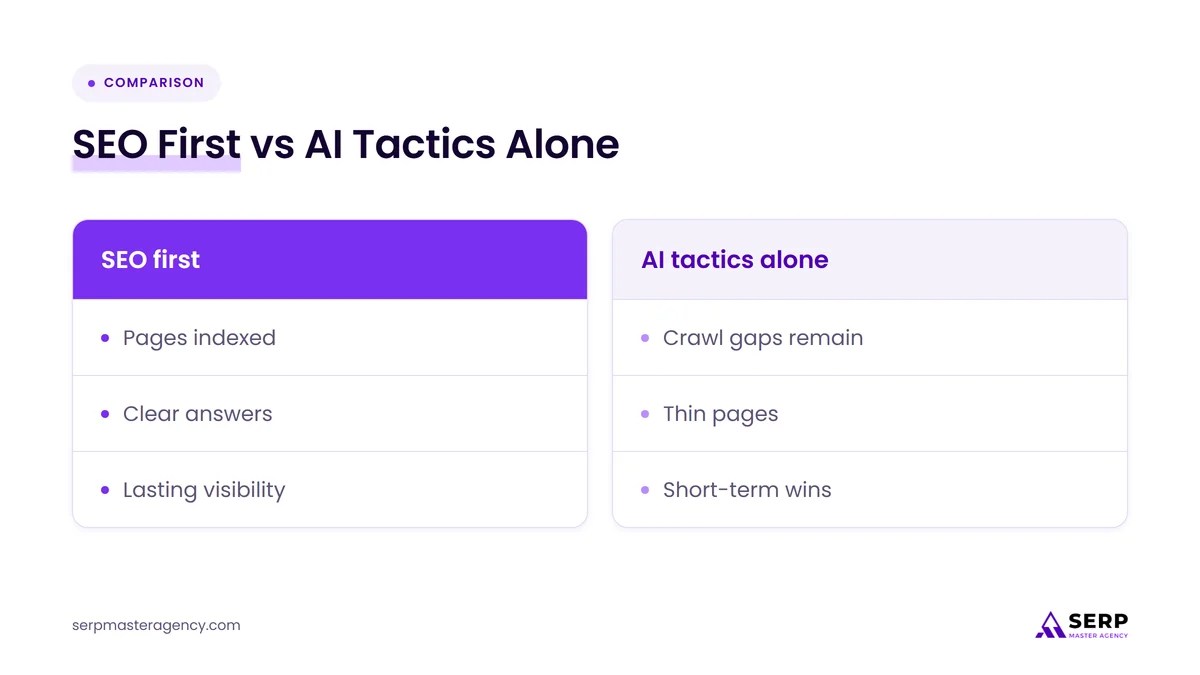
The practical lesson for a business owner: be wary of anyone selling AEO or GEO as a separate product that skips the basics. If your site has crawling problems or thin service pages, no AI tactic will fix that.
What does each one look like in practice?
In practice, SEO work fixes and builds your website, AEO work rewrites pages so they answer questions clearly, and GEO work strengthens how your business appears across the web. Many tasks overlap. A clear service page with accurate details helps rankings, direct answers and AI citations at the same time.
What does SEO work include?
SEO work includes making sure search engines can crawl and index your pages, fixing technical errors, building a page for each main service and location, improving page speed, earning reviews and links, and tracking calls and leads. For a local business it also covers your Google Business Profile and consistent listings on directories.
Our technical SEO checklist covers the crawling and indexing basics that every AI search tool relies on.
What does AEO work include?
AEO work includes rewriting key pages so each section opens with a short, direct answer, using headings phrased as real customer questions, adding definitions, comparison tables and numbered steps, and building FAQ sections. It also includes structured data that matches what is visible on the page, which Google’s guidance calls out specifically.
- List the 10 to 20 questions customers ask most before they buy.
- Make sure each question is answered clearly on a relevant page.
- Put the answer in the first two or three sentences, then add detail.
- Keep prices, service areas and hours accurate and easy to find.
Schema markup is one part of this work. Our beginner’s guide to schema markup for local SEO explains how to add it.
What does GEO work include?
GEO work includes checking how AI tools currently describe your business, making your name, address, phone and services consistent everywhere, earning mentions on trusted sites in your industry, and making sure AI search crawlers can reach your pages. The aim is for AI tools to find the same clear facts about you wherever they look.
Crawler access matters more than many owners realize. OpenAI’s crawler documentation says sites that block its OAI-SearchBot crawler will not be shown in ChatGPT search answers, while blocking GPTBot only signals that content should not be used for model training. The two settings are separate, so a business can allow one and block the other.
For a step-by-step look at ChatGPT specifically, read our guide on how to get your business recommended by ChatGPT.
Where should a business start?
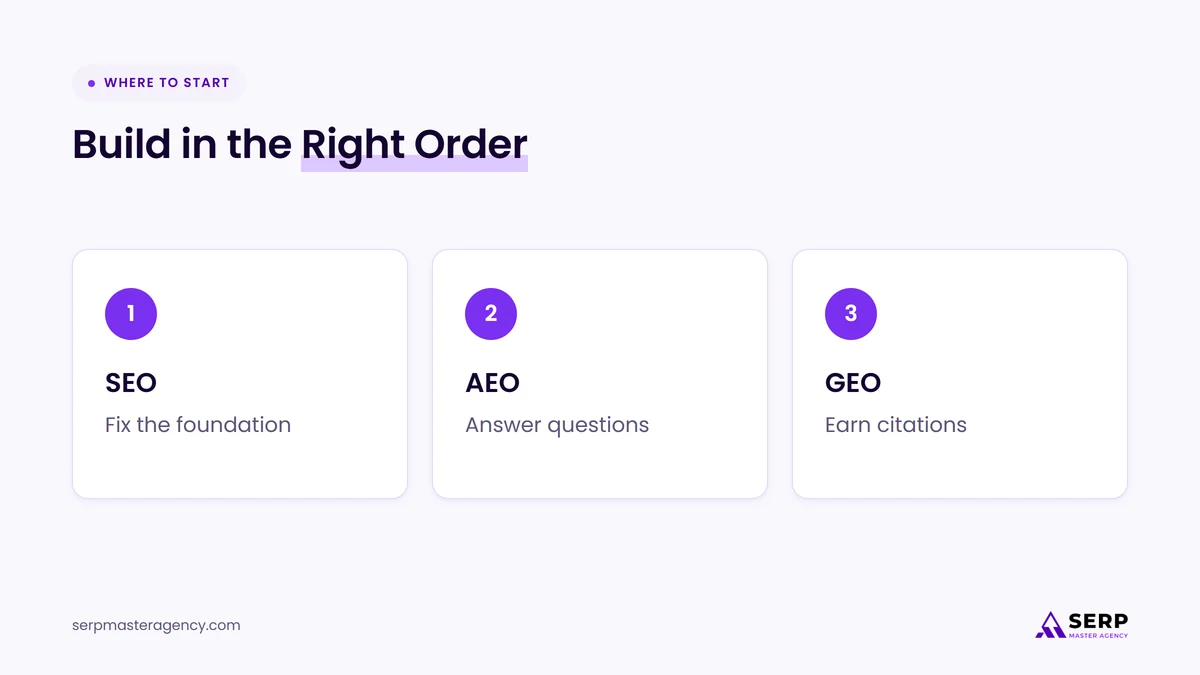
A business should start with SEO, because AEO and GEO only work on pages that search engines and AI tools can already find and trust. Fix technical problems and build strong service pages first, then rewrite those pages to answer questions directly, and then work on mentions and consistency across the web.
- Check your foundation. Confirm your important pages are indexed in Google Search Console, your site loads quickly on mobile and nothing in your robots.txt file blocks search or AI search crawlers by accident.
- Build one strong page per service. Each main service, and each main location if you serve several, should have its own page with clear details, prices or price ranges where you can share them, and proof such as reviews.
- Add answers to those pages. Rewrite the top of each page so it answers the main question in two or three sentences, then add a short FAQ based on what customers actually ask.
- Make your details consistent. Match your business name, address, phone, hours and services across your website, Google Business Profile and major directories.
- Earn mentions beyond your site. Look for industry directories, local news, trade associations and partner sites where a mention of your business would be natural and accurate.
- Check AI answers regularly. Once a month, ask ChatGPT, Google AI Mode and Perplexity the questions your customers ask, and note whether your business appears and whether the details are correct.
Which one matters most for your type of business?
The right balance depends on how your customers search. Local service businesses usually get the most from SEO and Google Business Profile work first. Businesses that sell complex or high-value services benefit more from AEO, because buyers ask detailed questions. Brands in categories where people ask AI for recommendations should add GEO earlier.
- Local service businesses such as plumbers, electricians, cleaners and salons: most leads still come from Google and Google Maps, so start with SEO and your Google Business Profile, then add AEO to service pages. Our local SEO services page explains what that work covers.
- Professional services such as law firms, accountants and consultants: buyers research before they call, so AEO on your service and FAQ pages pays off early.
- Ecommerce and product brands: SEO on product and category pages comes first, with GEO helping when shoppers ask AI tools to compare options.
- B2B companies: long sales cycles mean buyers ask detailed questions, so AEO content and GEO mentions on industry sites both matter.
How do you measure SEO, AEO and GEO?
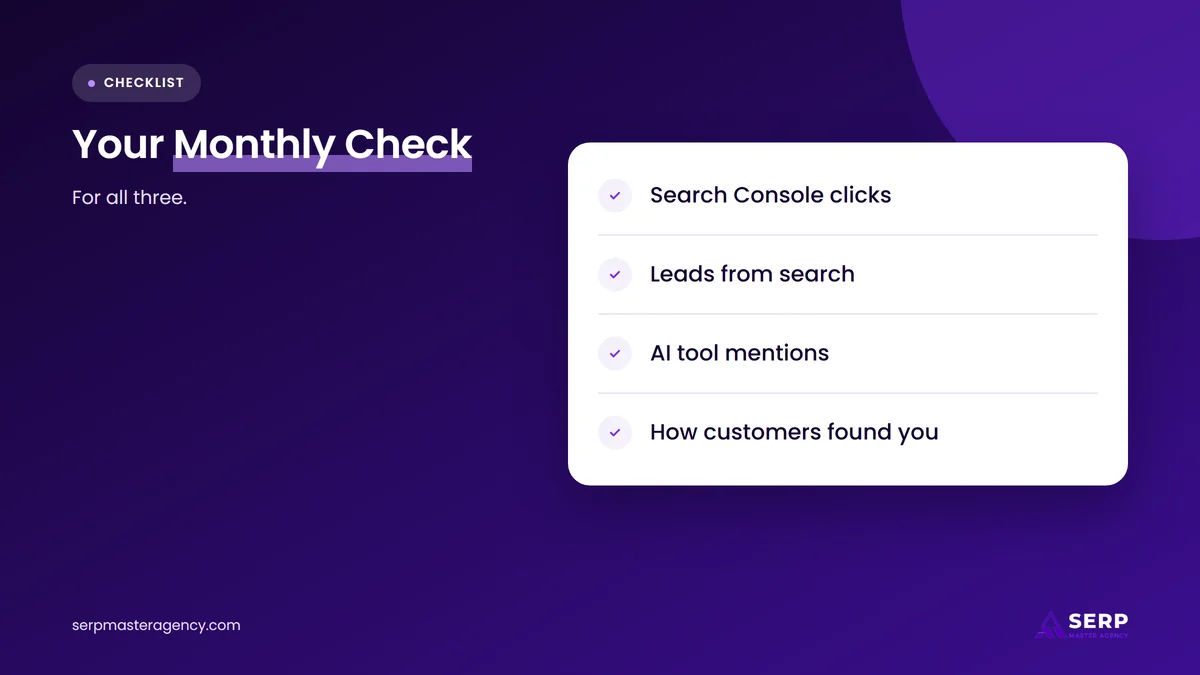
Measure SEO by rankings, clicks, calls and leads. Measure AEO by which questions your pages answer in search features. Measure GEO by how often AI tools mention or cite your business, which today is mostly a manual check. For all three, the number that matters most is new customers, not visibility on its own.
Google’s documentation says clicks from AI Overviews and AI Mode are counted in the Search Console Performance report under the “Web” search type. That means AI search traffic from Google is already part of your normal Search Console numbers, even though it is not broken out separately there.
A simple monthly routine looks like this:
- Check clicks and top queries in Google Search Console.
- Track calls, form fills and bookings from organic search in your analytics.
- Ask the main AI tools five to ten of your customers’ common questions and record whether you appear.
- Ask new customers how they found you, and add “an AI tool” as an option.
Frequently asked questions
Is AEO the same as GEO?
Not quite, although the terms overlap and people often use them interchangeably. AEO usually refers to structuring content so it can be pulled out as a direct answer. GEO usually refers to the wider effort to be mentioned and cited in AI-generated responses, including signals from other websites. Both depend on good SEO.
Do I need a separate AEO or GEO agency?
Usually not. Google says there are no special requirements for its AI features beyond standard SEO, so AEO and GEO work fits best inside a good SEO plan. Be cautious of anyone selling AI search optimization as a separate product without checking your site’s technical health and content first.
Do I need special files or markup for AI search?
Not for Google. Google’s “AI features and your website” page says no new machine-readable or AI-specific files and no special markup are needed to appear in AI Overviews or AI Mode. Structured data still helps search engines understand your pages, as long as it matches the visible content.
Can a small business do AEO and GEO on its own?
Yes, many of the first steps are simple. A small business can rewrite its main pages to answer customer questions directly, keep its details consistent across listings and check monthly what AI tools say about it. Technical problems and competitive markets are where outside help usually earns its cost.
How long does it take to see results from AEO and GEO?
There is no fixed timeline. Changes only show up after search engines and AI tools recrawl your pages, and AI answers can vary from one day to the next. Treat AEO and GEO as ongoing work alongside SEO, and judge progress over several months by leads, not by a single AI answer.
So which does your business need?
Most businesses need all three, in order: SEO first, AEO on key pages next, then GEO as your foundation matures. If your site has technical problems or thin service pages, fix those before paying for anything labeled AI optimization. If your basics are solid, the fastest gains usually come from rewriting key pages to answer customer questions clearly. You can see how we handle all three in our SEO services at SERP Master Agency.
Not sure where your business should start?
Tell us about your business, your website and how customers find you today. We’ll look at your SEO foundation and how AI tools describe your business, then tell you honestly which of SEO, AEO and GEO deserves your budget first.
Sources
- Search Engine Journal, “Google Says Technical SEO Remains Key For AI SEO”, November 2, 2026. https://www.searchenginejournal.com/google-says-technical-seo-remains-key-for-ai-seo/595550/
- Google Search Central, “AI features and your website”, accessed November 8, 2026. https://developers.google.com/search/docs/appearance/ai-features
- Google Search Central Blog, “Top ways to ensure your content performs well in Google’s AI experiences on Search”, May 21, 2025. https://developers.google.com/search/blog/2025/05/succeeding-in-ai-search
- Aggarwal et al., arXiv, “GEO: Generative Engine Optimization”, November 16, 2023 (revised June 28, 2024). https://arxiv.org/abs/2311.09735
- OpenAI, “Overview of OpenAI Crawlers”, accessed November 8, 2026. https://developers.openai.com/api/docs/bots

Suraj Rana is a highly regarded SEO expert specializing in the dental industry. His expertise lies in crafting strategic SEO marketing plans to help new or expanding businesses increase their online visibility and attract more customers. Suraj Rana’s skills extend to improving website rankings and boosting organic search visibility, thereby enhancing web traffic and return on investment for businesses.