Quick answer: A roofing company wins repair and storm searches by preparing before the weather turns. That means a complete Google Business Profile with real service areas and honest hours, one useful page per service and main area, a steady flow of genuine reviews, fast replies to every call and message, and Local Services Ads ready to switch on when demand jumps.
Key takeaways
- Storm demand arrives in days, but the rankings that catch it take months to build. Do the profile, page and review work in the quiet season.
- Most roofers are service-area businesses on Google: hide your home address, set up to 20 service areas and keep the area within about two hours’ drive of your base.
- Storm and city pages are fine when each one helps a real customer. Near-identical pages with swapped city names match Google’s description of doorway abuse.
- Ask every customer for a review, with no incentives and no filtering out unhappy customers. Google prohibits both.
- Response speed counts twice: Google lists responsiveness as a Local Services Ads ranking factor, and missed calls can still count as charged leads.
- Insurance-claim content should explain the process, not promise to cover deductibles. Several US states ban that, and Virginia’s updated rules take effect on January 1, 2027.
What is SEO for roofing companies?
SEO for roofing companies is the work of making a roofing business appear when nearby homeowners search Google, Google Maps or AI tools for roof repair, replacement or storm damage help. It covers the Google Business Profile, service and area pages, reviews, structured data and response speed, all aimed at turning searches into inspections and signed jobs.
Roofing search splits into three kinds of demand, and each needs a different answer from your website and profile:
- Urgent repair: “roof leak repair near me”, “emergency roof tarp”. The homeowner has water coming in and calls one of the first businesses they see.
- Storm surges: “hail damage roof inspection”, “storm damage roofer [town]”. Searches jump in the days after a storm and fade within weeks.
- Planned projects: “roof replacement cost”, “metal roof vs shingles”. The homeowner compares options, reads reviews and asks for several quotes.
A roofer who only plans for one of these leaves the other two to competitors. You can see how we approach all three on our roofing SEO page.
Why is storm demand so hard for roofers to capture?
Storm demand is hard to capture because it arrives faster than rankings can move. When hail or high winds hit, searches for inspections and repairs jump within hours, and the roofers already showing in the map pack, AI answers and ads take most of the calls. Work started after the storm usually ranks too late to help.
Three things make storm weeks different from normal weeks:
- Competition spikes. Out-of-area crews may arrive and advertise in the same towns, so the local map pack and ad space get crowded.
- Homeowners are wary. Many homeowners are wary of storm chasers, so they look harder at reviews, licenses and how long a business has been local.
- Speed decides the job. A homeowner with a leak often calls several roofers and books whoever answers and arrives first.
The practical lesson is to treat the quiet season as storm preparation. Your profile, pages and reviews should already be in place before the forecast changes.
How should a service-area roofer set up a Google Business Profile?
A service-area roofer should run one Google Business Profile with the business’s real name, an accurate primary category, the home or office address hidden if customers don’t visit it, up to 20 service areas within about two hours’ drive, and hours that match when someone actually answers the phone.
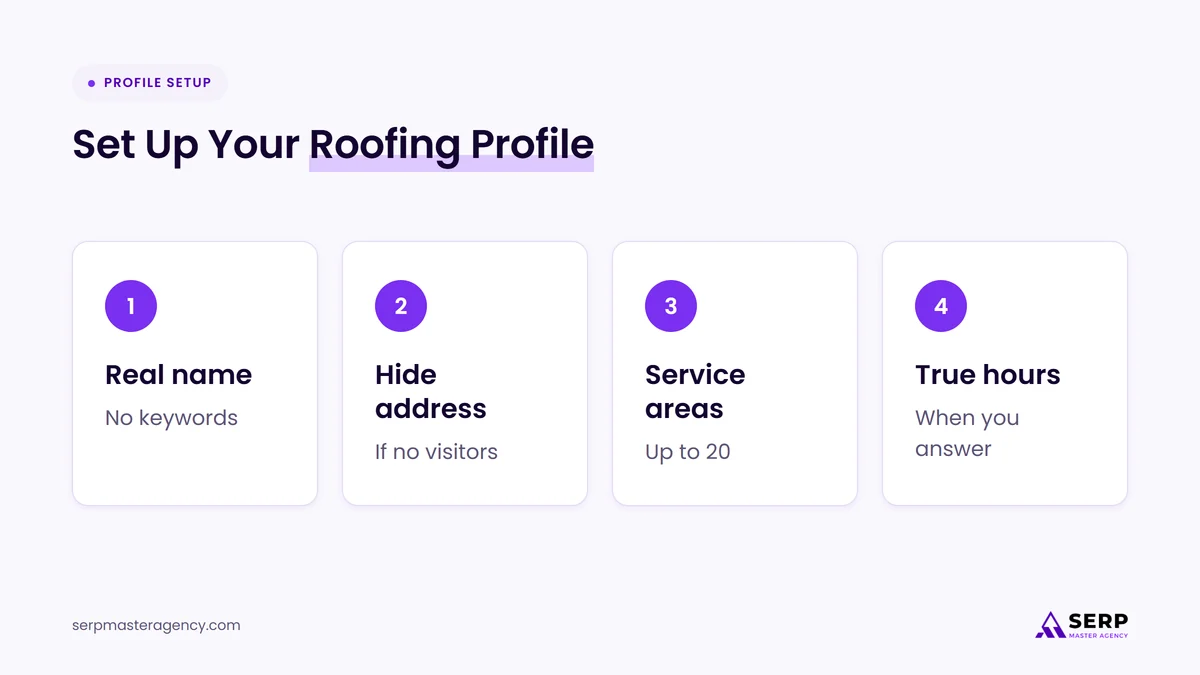
Google’s own help pages set the rules for service-area businesses (Google Business Profile Help):
- One profile for the whole area. Service-area businesses should have one profile for their central office with a designated service area. Don’t create extra profiles for every town you cover.
- Hide the address if customers don’t visit. If you don’t serve customers at your business address, Google says to remove it from the profile and use service areas instead.
- Set up to 20 service areas. Use cities, postal codes or other areas, and keep the overall boundary within about two hours of driving time from your base.
- No virtual offices. A rented mailing address you don’t work from is not eligible. A co-working office only counts if it has signage, is staffed and receives customers during business hours.
- Use your real business name. Adding keywords such as “Best Storm Roofing [City]” to the name breaks Google’s guidelines and can get a profile suspended.
After the basics, fill in every service you offer, including repairs, inspections, replacements and gutter work if you do it, and add photos of real jobs. During storm weeks, use profile posts and updates to say which areas you are currently serving and how quickly you can inspect.
How do you build storm and emergency pages without doorway spam?
Build storm and emergency pages around real customer needs, not around keywords. Each page should explain one service or one area in useful detail: what damage looks like, what to do first, how inspections and claims work, and which towns you serve. Pages that only swap a city name into the same text risk being treated as doorway spam.
Google’s spam policies describe doorway abuse as sites or pages created to rank for specific, similar search queries. Its examples include creating multiple pages aimed at specific regions or cities that funnel users to one page, and substantially similar pages that are closer to search results than a clear, browsable site structure. Google’s scaled content abuse policy also covers generating many pages mainly to manipulate rankings (Google Search Central).
| Page type | Helpful version | Doorway risk |
|---|---|---|
| Storm damage page | Explains signs of hail and wind damage, temporary protection, inspection steps and the claim process | A thin page per storm date with the same text and a phone number |
| Emergency repair page | States real response times, what you can do after hours and what the homeowner should do while waiting | Promises “24/7” service you don’t actually staff |
| City or area page | Covers local roof types, permit notes, jobs completed in that area and photos from those jobs | Dozens of pages with only the town name changed |
| Service page | One page each for repair, replacement, inspection and materials you install | One page per keyword variation, such as “roof repair” and “roofing repair” |
A sensible structure for most roofers is a small set of strong pages: one per core service, one storm damage page that you update after major weather, and area pages only for the towns where you genuinely have work and something specific to say. If you serve more towns than you can describe well, list them on the service pages instead.
How should roofers get reviews within Google’s rules?
Roofers should ask every customer for a review after the job is finished, with the same neutral request, no rewards and no filtering. Google prohibits offering incentives for reviews, discouraging negative reviews and selectively asking only happy customers. Reply to every review, good or bad, and keep the requests steady across the year, not only after storms.
Google’s Maps content policy is specific about what merchants must not do (Google Maps User Contributed Content Policy):
- Offer incentives such as payment, discounts or free goods or services in exchange for a review, or for changing or removing a negative review.
- Discourage or prohibit negative reviews, or selectively ask only satisfied customers for reviews.
- Ask customers to include specific content in their review.
Google’s review help page adds that reviews must reflect a genuine experience, and that offering discounts or free services for reviews is considered fake and misleading content (Google Business Profile Help). For roofers, that rules out common tactics like “$50 off gutter cleaning for a five-star review” or only sending the review link to customers who rated the job highly on a survey.
What works within the rules is simple: send the review link by text or email on the day the job is signed off, include it on the final invoice, and reply to every review without sharing the customer’s personal details. Reviews that mention the work done, such as a leak repair or a full replacement, also give future customers useful detail without you asking for specific wording.
Which schema should a roofing website use?
A roofing website should use LocalBusiness structured data with the most specific type available, which is RoofingContractor. Mark up the business name, phone number, URL, opening hours and the areas you serve, and only include an address if it is shown on the page. The markup must match what visitors can see.
Google’s LocalBusiness documentation recommends using the most specific LocalBusiness subtype possible (Google Search Central, updated September 2026). On Schema.org, RoofingContractor sits under LocalBusiness and HomeAndConstructionBusiness, so it is the right type for a roofing company (Schema.org). If you also do gutters or siding, you can list more than one type, as Google’s documentation shows for businesses with several services.
A few practical points for roofers:
- Address: Google lists address as a required property for LocalBusiness rich results. If you hide your address on your profile and site, don’t add one to your markup that visitors can’t see.
- Area served: Use
areaServedto list the towns or regions you cover, matching your profile’s service areas. - Hours: Match your markup, your website and your profile. If emergency call-outs run later than office hours, explain that on the page.
- Consistency: Your name, phone and website should match across your site, profile and directories. Fix any old listings that show a former phone number or address.
How should roofers write about insurance claims?
Roofers should write about insurance claims as plain guidance: how to document damage, when to call the insurer, what an inspection report includes and how long the process usually takes. Avoid promising to cover or waive deductibles or to handle the claim like an adjuster, because several US states restrict those offers by law.
Insurance questions are some of the most common searches after a storm, and a clear, honest page can earn trust that an ad can’t. Useful topics include:
- What to photograph before and after temporary repairs
- The difference between a roofer’s inspection and the insurer’s adjuster visit
- What the homeowner pays, including the deductible, and what the insurer decides
- How you document damage for the homeowner’s claim
Keep the legal limits in mind. In Colorado, a roofing contractor may not advertise or promise to pay, waive or rebate an insurance deductible, and may not claim to be or act as a public insurance adjuster (Colorado Revised Statutes, section 6-22-105). Virginia updated its rules in 2026, with changes effective January 1, 2027: contractors may not offer rebates or anything of value for a roof inspection or for filing a roof damage claim, and advertisements soliciting this work must state that the owner is responsible for the deductible (Code of Virginia, section 59.1-618). Rules vary by state, province and country, so check local law, or ask a lawyer, before publishing claim-related offers. Readers outside the US should check their own consumer and insurance rules too.
How fast does a roofer need to respond to storm leads?
A roofer needs to respond to storm leads as fast as possible, ideally answering live during business hours and replying to messages within minutes. Homeowners with active leaks often contact several roofers, and Google’s Local Services Ads ranking takes responsiveness into account, so slow replies cost both the job and future visibility.
Google’s Local Services Ads help pages are direct about this. Ad ranking depends on your bid and how likely your ad is to result in a lead, which includes your responsiveness to customer inquiries, and Google notes that missed calls may negatively affect responsiveness. Profile quality factors include your rating, number of reviews and average response time (Local Services Help).
Missed calls also cost money. Under Google’s lead rules, a missed call during business hours can count as a valid, charged lead if the customer stays on the line for more than 20 seconds (Local Services Help). Before storm season:
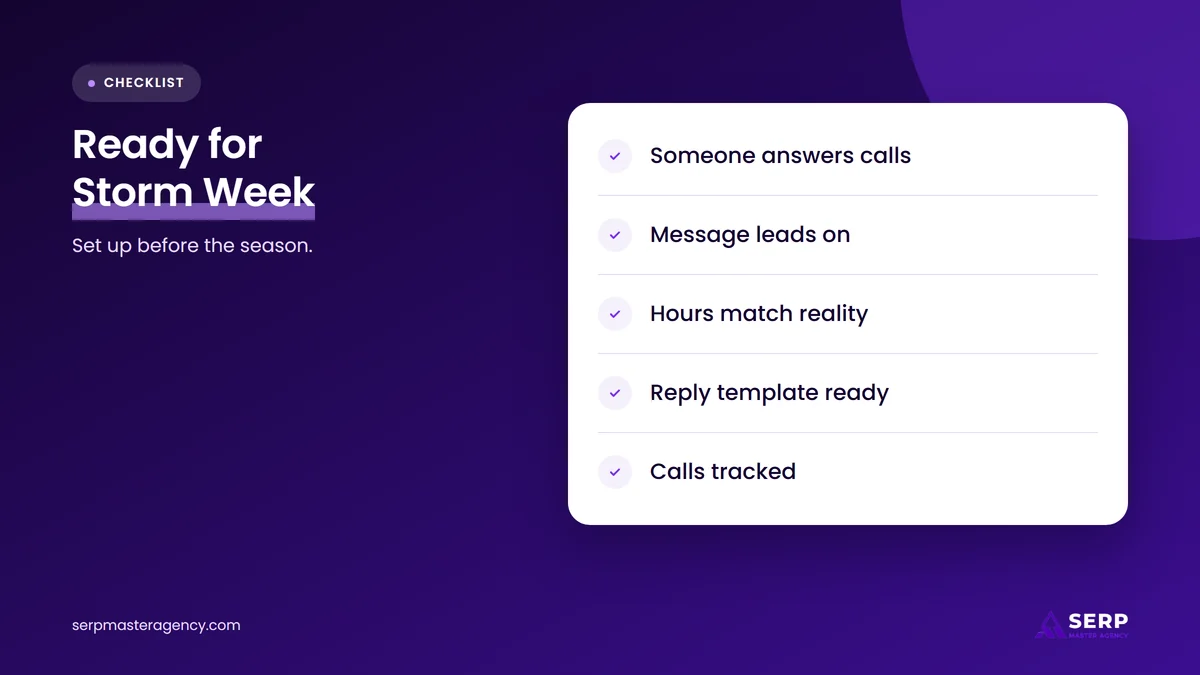
- Decide who answers the phone when crews are on roofs, and set call forwarding or an answering service.
- Turn on message leads so homeowners can reach you at night, then reply first thing in the morning.
- Set your Business Profile and ad hours to match when someone really answers.
- Prepare a short reply template for storm inquiries that asks for address, photos and the type of damage.
- Track every call and form from Google, so you know which channel brought each job.
Should roofers use Local Services Ads or SEO?
Most roofers do best with both. Local Services Ads put a business at the top of urgent searches quickly and charge per lead, which suits storm surges. SEO and the map pack build visibility that keeps working when ad budgets pause, and they feed the information AI tools use when recommending local businesses.
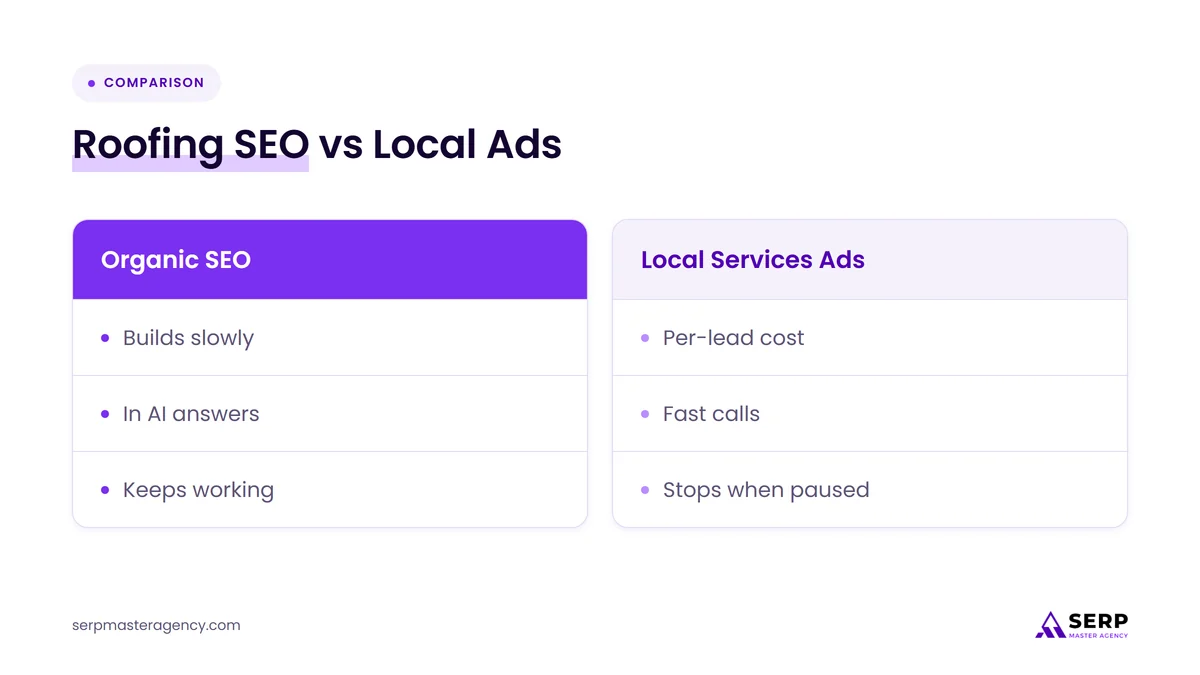
| Factor | Organic SEO and map pack | Local Services Ads |
|---|---|---|
| Cost model | Ongoing work, no cost per click or lead | Pay per valid lead |
| Speed | Builds over months | Can show quickly once approved |
| Storm weeks | Captures demand if already ranking | Budget can be raised to meet demand |
| When you stop | Visibility fades slowly | Ads stop showing |
| AI search | Feeds the facts AI tools draw on | Separate ad placement |
Local Services Ads are also changing. Google is moving them into Google Ads as a Performance Max campaign type with pay-per-lead goals. Roofing is named in the first phase, which started in August 2026 for select US advertisers, while service-area businesses without storefronts are in the broader group scheduled for late 2026. Non-US accounts follow in 2027. Google says performance reports won’t move across, so download or screenshot your history first (Google Ads Help).
AI search is a third channel to watch. Since November 4, 2026, Google AI Mode in the US can show home service providers with direct booking and quote links through partners including Angi, Thumbtack, Housecall Pro and Jobber (Search Engine Roundtable; Search Engine Journal). Our article on AI Mode booking and quote links for home services explains what that means for trades. The plumbing and HVAC versions of this playbook, in our guides to SEO for plumbers and local SEO fixes for HVAC companies, cover the same channels for other trades.
What should a roofer do before the next storm season?
Before the next storm season, a roofer should finish the work that takes longest to show results: a complete Business Profile, a small set of useful service and storm pages, steady reviews and a tested plan for answering calls. These pieces take months to build, so starting in a quiet period is what lets you catch demand later.
- Profile: real name, correct category, hidden address if needed, accurate service areas and honest hours.
- Pages: one page per core service, one storm damage page and area pages only where you have something real to say.
- Reviews: one neutral request to every customer, with replies to every review.
- Schema: RoofingContractor markup that matches what visitors see.
- Claims content: plain guidance with no deductible offers.
- Response plan: who answers, message leads switched on and call tracking in place.
- Ads: Local Services Ads set up and ready to scale, with old reports saved before migration.
Frequently asked questions
Can a roofer rank in a town without an office there?
Yes. A service-area roofer can appear for searches in towns inside its service area without an office in each one. Distance still matters, so you will usually rank more strongly nearer your base. Strong service pages, reviews that mention local jobs and useful area pages help in towns further away.
Are storm damage landing pages against Google’s rules?
No, not by themselves. A storm damage page that explains damage signs, inspections and claims is helpful content. The risk comes from many near-identical pages created only to rank for each town or storm, which matches Google’s description of doorway abuse.
Can I offer a discount to customers who leave a review?
No. Google prohibits offering payment, discounts or free goods or services in exchange for a review, or for changing or removing a negative review. Ask every customer the same way, with no reward and no screening of unhappy customers first.
Should a roofing company show its address on Google?
Only if customers visit that address during business hours. If you work from home or meet customers only at their properties, Google says to remove the address and set service areas instead. Virtual offices and mailing addresses you don’t work from are not eligible.
Do Local Services Ads replace roofing SEO?
No. Local Services Ads bring leads quickly and stop when the budget stops. SEO builds visibility in the map pack, organic results and AI answers that keeps working over time. Most roofers use ads to cover storm surges and SEO as their steady base.
How does a roofer win local searches when demand spikes?
A roofer wins storm and repair searches by being ready before the spike: a correct service-area profile, useful pages that avoid doorway tactics, genuine reviews, matching schema, honest claims content and a team that answers fast. Local Services Ads cover the surge, and SEO keeps the calls coming when the weather calms. If you want help putting this in place, our SEO services at SERP Master Agency cover each step.
Want your roofing company ready before the next storm?
Tell us where you work, which jobs you want more of and how you handle leads today. We’ll review your profile, pages and reviews and tell you plainly what to fix first.
Sources
- Google Search Central, “Spam policies for Google web search”, accessed November 7, 2026. https://developers.google.com/search/docs/essentials/spam-policies
- Google Business Profile Help, “Guidelines for representing your business on Google”, accessed November 7, 2026. https://support.google.com/business/answer/3038177
- Google Business Profile Help, “Manage your service areas for service-area & hybrid businesses”, accessed November 7, 2026. https://support.google.com/business/answer/9157481
- Google Business Profile Help, “Tips to get more reviews”, accessed November 7, 2026. https://support.google.com/business/answer/3474122
- Google Maps User Contributed Content Policy, “Prohibited & restricted content”, accessed November 7, 2026. https://support.google.com/contributionpolicy/answer/7400114
- Google Search Central, “Local Business (LocalBusiness) structured data”, updated September 8, 2026. https://developers.google.com/search/docs/appearance/structured-data/local-business
- Schema.org, “RoofingContractor”, accessed November 7, 2026. https://schema.org/RoofingContractor
- Google Local Services Help, “About ad rankings”, accessed November 7, 2026. https://support.google.com/localservices/answer/7527305
- Google Local Services Help, “How leads work”, accessed November 7, 2026. https://support.google.com/localservices/answer/7195435
- Google Ads Help, “Local Services Ads transition to Performance Max campaigns with pay-per-lead goals”, accessed November 7, 2026. https://support.google.com/google-ads/answer/17213585
- Search Engine Roundtable, “Google AI Mode Integrates With Home Services Booking”, November 5, 2026. https://www.seroundtable.com/google-ai-mode-home-services-booking-42459.html
- Search Engine Journal, “Google AI Mode Adds Booking & Quote Links For Home Services”, November 4, 2026. https://www.searchenginejournal.com/google-ai-mode-home-services-booking-quote-links/595871/
- Colorado General Assembly via Colorado Public Law, “C.R.S. 6-22-105”, accessed November 7, 2026. https://colorado.public.law/statutes/crs_6-22-105
- Virginia Law, “Code of Virginia section 59.1-618 (effective January 1, 2027)”, updated 2026. https://law.lis.virginia.gov/vacodeupdates/title59.1/section59.1-618/

Suraj Rana is a highly regarded SEO expert specializing in the dental industry. His expertise lies in crafting strategic SEO marketing plans to help new or expanding businesses increase their online visibility and attract more customers. Suraj Rana’s skills extend to improving website rankings and boosting organic search visibility, thereby enhancing web traffic and return on investment for businesses.