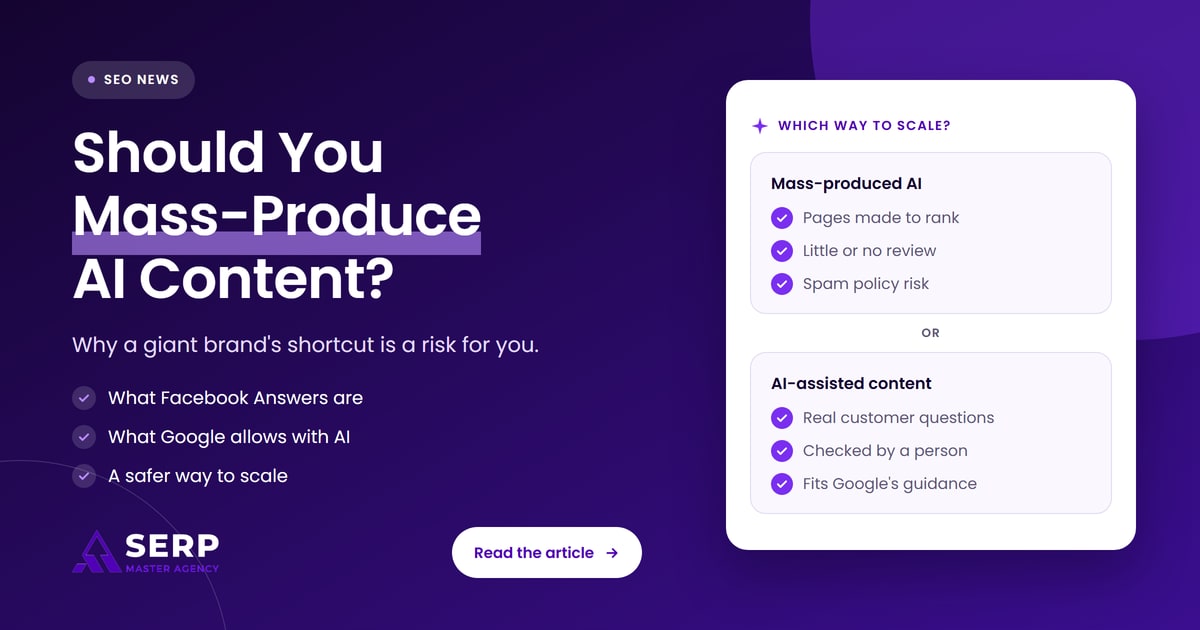
Quick answer: No. Facebook getting millions of AI-written pages into Google does not make bulk AI content safe for your business. Google’s spam policies treat many low-value pages made mainly to rank as scaled content abuse, however they are produced. A small business has far more to lose. Use AI to help write fewer, genuinely useful pages instead.
Key takeaways
- Meta’s “Facebook Answers” are AI-generated topic pages built from public Facebook posts, and Search Engine Roundtable reported on November 5, 2026 that about 6 million of them are indexed in Google.
- Industry experts have called the pages scaled content abuse. The Search Engine Roundtable report included no statement from Google.
- Google does not ban AI content. It judges content on quality and purpose, and it penalizes pages made mainly to manipulate rankings.
- A giant brand ranking for a while is not a safe model. Your website may be your main lead source, and spam actions can remove pages from search.
- The safer way to scale is AI-assisted content that starts from real customer questions and adds your own experience, with a person checking every page.
What changed with Facebook Answers in Google?
Meta has been publishing AI-generated summary pages under facebook.com/fb-answers/, built from public Facebook posts and pages. On November 5, 2026, Search Engine Roundtable reported that Google has indexed about 6 million of them and that they rank in regular results and AI features. Google had not commented publicly in that report.
Here is what has been reported so far:
- The pages: each Facebook Answers page summarizes a topic using public posts from Facebook users and Pages. Pages link to each other through a “More like this” section, according to Peripheral Creative.
- Who found them: Saul Westbrook of Peripheral Creative documented the pages first. He wrote that he noticed them in June 2026 and that they first appeared in search results in May.
- The scale: Barry Schwartz of Search Engine Roundtable put the indexed count at about 6 million pages. Using Semrush estimates, Peripheral Creative reported worldwide monthly traffic rising from about 129,500 visits in May 2026 to about 40.6 million in October 2026.
- Where they show up: Search Engine Roundtable reported that SEO consultant Glenn Gabe found the pages ranking in standard results, AI Overviews and AI Mode, and that he called the directory scaled content abuse.
- Quality concerns: Westbrook found heavy topic overlap, including over 180 English pages about padel tennis, plus outdated details and unverified advice drawn from individual posts.
- Official response: Peripheral Creative said Meta had not spoken publicly about the pages as of November 3, 2026. The Search Engine Roundtable article contained no statement from Google.
What are Facebook Answers?
Facebook Answers are AI-generated pages on facebook.com that answer a topic or question by summarizing what people have said in public Facebook posts. They are open to search engines, which is why they can appear in Google results. Peripheral Creative reported that the pages show little sign of editorial review.
What is scaled content abuse?
Scaled content abuse is Google’s name for publishing many pages mainly to manipulate search rankings rather than to help people. Google’s spam policy says the method does not matter: pages written by AI, by people or by a mix of both can all break the rule if they add little value for readers.
Google’s spam policies list several examples of scaled content abuse. The ones most relevant to business owners are:
- Using generative AI tools to produce many pages without adding value for users.
- Scraping feeds or search results and rewording them, with synonyms or translation, into lots of thin pages.
- Stitching together content from other websites without adding anything of your own.
- Spreading scaled content across several sites to hide how much of it there is.
- Creating pages that contain search keywords but make little sense to a reader.
Google says it detects policy violations with automated systems and with human review. When a person at Google confirms a violation, the affected pages can receive a manual action, and the site owner is told through the Manual actions report in Search Console.
Does Google allow AI-generated content?
Yes. Google allows AI-generated and AI-assisted content when it is helpful, accurate and made for readers. Google’s 2023 guidance says it rewards high-quality content however it is produced, and that not all automation is spam. Using AI mainly to manipulate rankings still breaks Google’s spam policies.
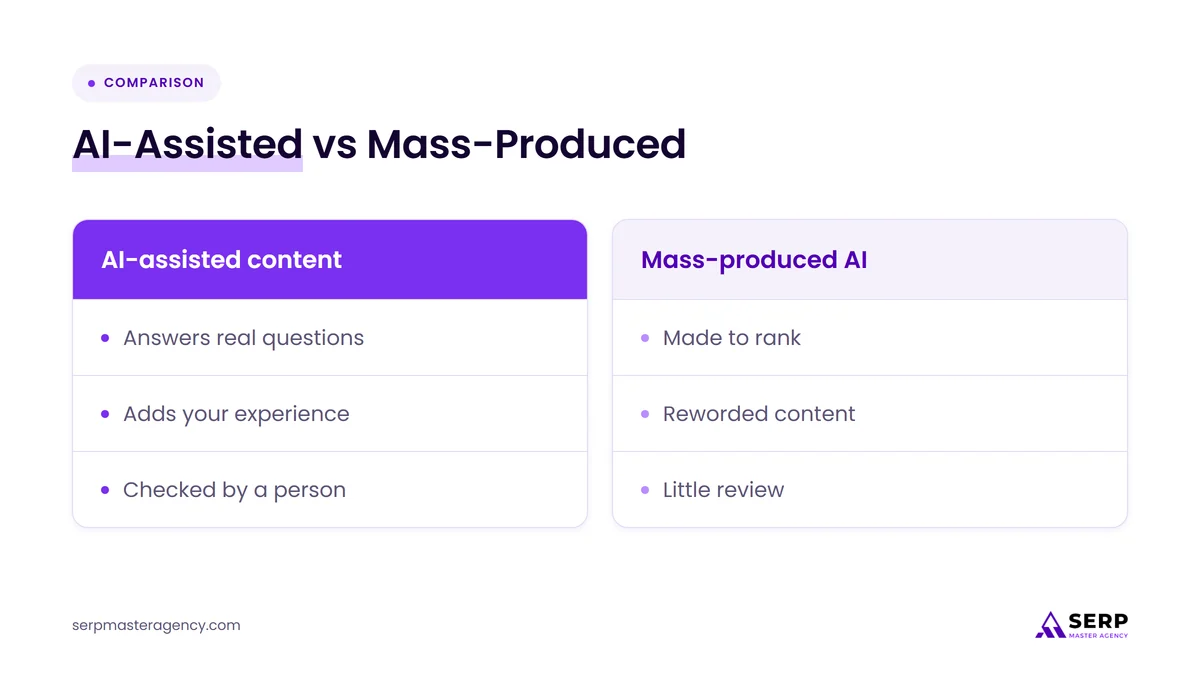
Google’s own documents give a clear picture of what it expects when AI is part of the process:
- Quality over method. Google’s February 2023 post on AI-generated content says its focus is on the quality of content, rather than how content is produced.
- Who, how and why. Google’s helpful content guidance asks site owners to make clear who created a page, how it was made, including any use of AI where readers would expect to know, and why it exists. The “why” should be to help people, not to attract search visits.
- Check everything. Google’s guidance on using generative AI content tells site owners to fact-check and review AI output, including titles, meta descriptions, structured data and image alt text.
- Watch for the warning signs. The helpful content guidance asks whether you are using extensive automation to produce content on many topics. A yes is a sign that content is made for search engines first.
| Factor | AI-assisted helpful content | Mass-produced AI pages |
|---|---|---|
| Why the page exists | To answer a real customer question | To catch search traffic on as many terms as possible |
| Role of AI | Research help, outlines and first drafts | Writes and publishes pages with little or no review |
| Original input | Your experience, prices, process, photos and data | Rewording of what already exists elsewhere |
| Human review | Every page fact-checked and edited | Rare or none |
| Overlap between pages | One strong page per topic | Many near-duplicate pages on the same topic |
| Fit with Google’s policies | In line with Google’s AI and helpful content guidance | Matches Google’s examples of scaled content abuse |
Who is affected by the Facebook Answers story?
Two groups are affected. Businesses and publishers that rank for the same questions now compete with Facebook Answers pages in results and AI answers. Business owners weighing bulk AI content are affected indirectly, because the story makes mass-produced pages look like a working strategy when Google’s own rules say otherwise.
If you run a service business, an online store or a professional firm, the second group is the one to think about. Tools that promise hundreds of pages a day are easy to find, and a headline about Facebook ranking with millions of AI pages can make the risk look smaller than it is.
Why shouldn’t a small business copy Facebook’s approach?
A small business should not copy Facebook because the two situations are not comparable. Facebook has a huge brand, its own audience and many sources of traffic. For many small businesses, the website is a main source of leads, so pages that trigger a spam action can cost real enquiries.
Four differences matter most:
- Nobody knows how long the pages will last. Barry Schwartz wrote that he suspects the Facebook Answers pages will not stay indexed much longer now that they are widely known. Ranking for a few months is not the same as a lasting strategy.
- Google’s rules apply whatever the site’s size. The scaled content abuse policy does not include an exception for big brands. A smaller site copying the tactic has no reason to expect a softer outcome.
- Recovery takes work. If Google applies a manual action, the site owner has to fix the problem, remove or improve the pages and submit a reconsideration request through Search Console before the affected pages can recover.
- Thin pages hurt trust with customers. Peripheral Creative found outdated information and unverified advice in Facebook Answers pages. On your own site, a page with wrong prices, wrong hours or generic advice can lose the customer even if it ranks.
There is also the cost of the clean-up. Many low-value pages can be harder to manage than they were to publish. Our guide to content pruning and consolidation explains how businesses merge or remove weak pages when that happens.
What should you do now?
Start by checking what you have already published with AI, then set rules for what you publish next. Look for pages that overlap, repeat information from elsewhere or have never been checked by a person. Improve the useful ones, merge the duplicates and remove the rest before they become a problem.
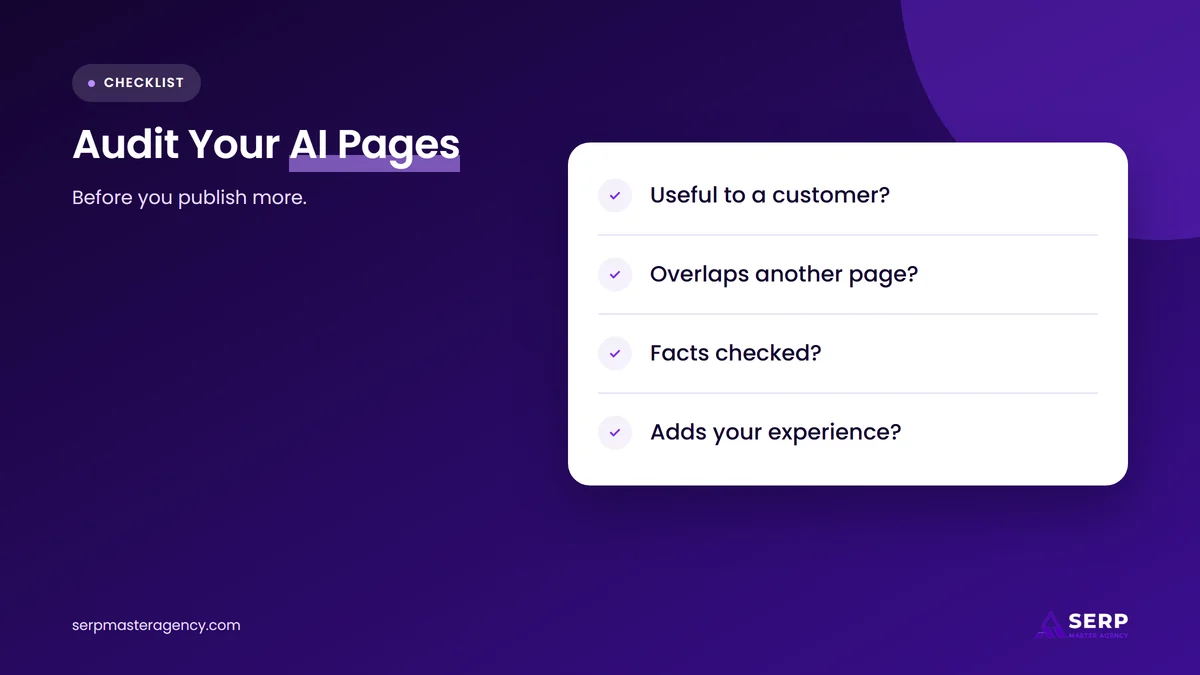
- List your AI-written pages. Include blog posts, location pages, service pages and product descriptions that a tool drafted or wrote.
- Check each page against one question. Would a customer who landed on this page directly find it useful? If the honest answer is no, the page needs work or removal.
- Find overlapping pages. Several pages chasing the same topic with small wording changes are a warning sign. Merge them into one stronger page.
- Fact-check what stays. Check prices, services, opening hours, locations and any claims. Google’s generative AI guidance also asks you to review titles, meta descriptions and image alt text.
- Add what only you know. Your process, your pricing approach, real photos and answers to the questions customers ask your team are what separate your page from a generic summary.
- Check Search Console. Open the Manual actions report. If it shows an issue, fix the pages it names before you publish anything new.
- Set a review rule. No AI-drafted page goes live until a person who knows the business has read, corrected and approved it.
What is a safer way to scale content with AI?
The safer way is to scale the work behind each page, not the number of pages. Use AI to research, outline and draft faster, then have a person add real experience, check facts and approve the page. You publish fewer pages, but each one answers a real question better than what already ranks.
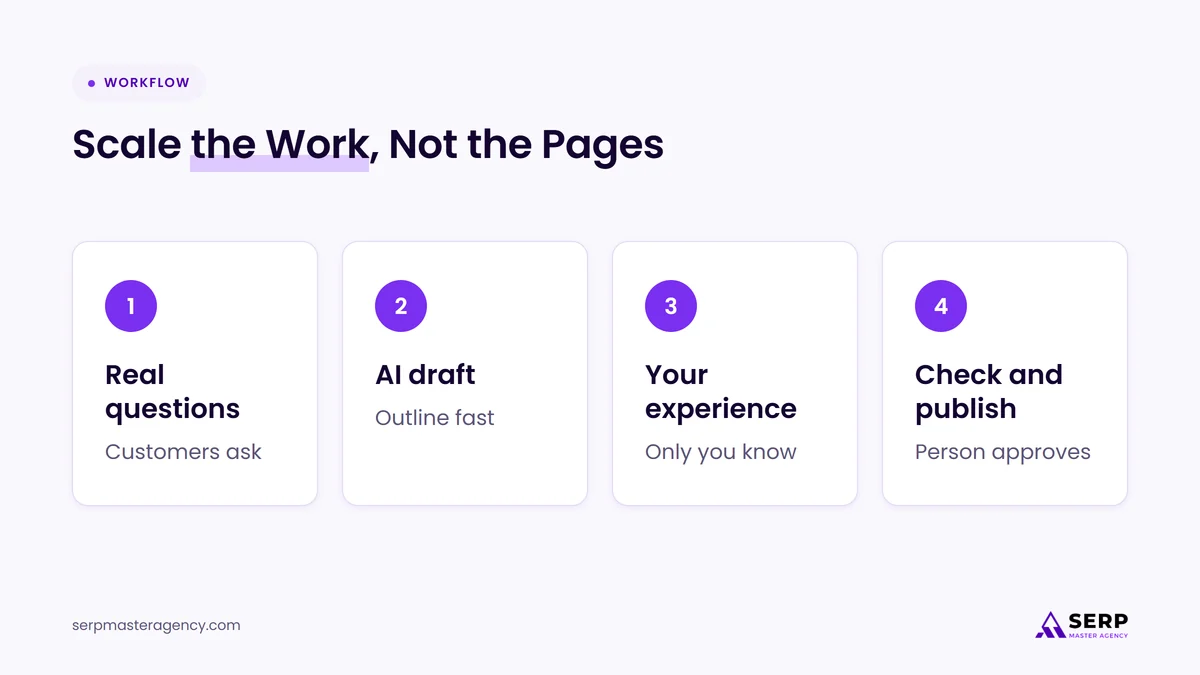
A simple workflow that fits Google’s guidance looks like this:
- Start from real questions. Collect the questions customers ask by phone, email and in person, and the searches that already bring people to your site. Each page should answer one of them.
- Draft with AI. Use an AI tool for research, outlines and a first draft. Treat the draft as raw material, not a finished page.
- Add your experience. Add the details only your business has: how you do the work, what it usually involves, mistakes you see customers make and photos of real jobs or products.
- Check, then publish. A person fact-checks every claim, removes anything generic and approves the page. Add a byline so readers can see who stands behind it.
Publishing pace matters less than most owners expect. Our article on why content depth beats publishing frequency covers this in more detail, and the same pages that answer questions well are the ones AI tools tend to cite, as our guide on getting your business recommended by ChatGPT explains.
What’s likely to happen next?
This section is our opinion, not confirmed news. We expect Google to deal with the Facebook Answers pages in some way, through ranking changes, a spam update or Meta adjusting the pages itself. We do not expect Google to loosen its scaled content rules because a large site found a temporary gap.
Barry Schwartz shares a similar view in his report, saying he suspects the pages will not stay indexed for long. Until Google or Meta says something on the record, treat the Facebook Answers rankings as a live test with an unknown ending, not as proof that bulk AI content works.
Frequently asked questions
Is AI-generated content against Google’s guidelines?
No. Google’s guidance says it rewards high-quality content however it is produced, and that using AI is not spam by itself. What breaks the rules is using AI or any other method to publish many low-value pages mainly to manipulate search rankings, which Google calls scaled content abuse.
How many AI pages can I publish before Google sees it as spam?
Google does not set a page limit. Its spam policy focuses on purpose and value: pages made mainly to rank, that add little for readers, are the problem. Ten thin pages can be a risk, while a large set of genuinely useful, reviewed pages can be fine.
Do I need to label AI-written content on my website?
Google’s helpful content guidance suggests explaining how content was made, including the use of AI, where readers would reasonably expect it. Google also asks online stores to label AI-generated product data. For most business blog posts, a clear byline and a person who checked the facts matter most.
Will Facebook Answers pages be removed from Google?
Nobody outside Google and Meta knows yet. As of the Search Engine Roundtable report on November 5, 2026, Google had not commented. Barry Schwartz said he suspects the pages will not stay indexed for long, but that is his opinion, not a confirmed change.
What should I do if my site already has lots of AI-written pages?
Review them page by page. Keep and improve pages that answer real customer questions, merge pages that overlap and remove pages with nothing useful to say. Check the Manual actions report in Google Search Console, and set a rule that a person approves every new page before it goes live.
Should your business mass-produce AI content?
No. Facebook Answers shows that a huge brand can get millions of AI pages into Google for a while, not that a business website should do the same. Use AI to work faster on fewer, better pages that answer real questions, and keep a person responsible for every one. If you already have a pile of AI pages, our guide on how SEO services reduce the risk of ranking penalties is a useful next read. You can see how we plan content and search work on our SEO services page at SERP Master Agency.
Worried your AI content could be holding your site back?
SERP Master Agency reviews business websites for thin, overlapping and unchecked pages and builds content plans around the questions your customers ask. Tell us about your site and we’ll tell you honestly what to keep, fix or remove.
Sources
- Google Search Central, “Spam policies for Google web search”, accessed November 6, 2026. https://developers.google.com/search/docs/essentials/spam-policies#scaled-content
- Google Search Central Blog, “Google Search’s guidance about AI-generated content”, February 8, 2023. https://developers.google.com/search/blog/2023/02/google-search-and-ai-content
- Google Search Central, “Creating helpful, reliable, people-first content”, accessed November 6, 2026. https://developers.google.com/search/docs/fundamentals/creating-helpful-content
- Google Search Central, “Google Search’s guidance on using generative AI content on your website”, accessed November 6, 2026. https://developers.google.com/search/docs/fundamentals/using-gen-ai-content
- Search Engine Roundtable, “Facebook Answers AI-Generated 6 Million Pages Is Google Scaled Content Abuse”, November 5, 2026. https://www.seroundtable.com/facebook-answers-google-42467.html
- Peripheral Creative, “Facebook made one quiet change, and increased organic traffic by over 40 million visits a month”, November 2026, accessed November 6, 2026. https://www.peripheralcreative.com/news/facebook-answers-ai-generated-pages

Suraj Rana is a highly regarded SEO expert specializing in the dental industry. His expertise lies in crafting strategic SEO marketing plans to help new or expanding businesses increase their online visibility and attract more customers. Suraj Rana’s skills extend to improving website rankings and boosting organic search visibility, thereby enhancing web traffic and return on investment for businesses.