Quick answer: Agents rank for local valuation and selling searches by setting up Google Business Profile correctly as a practitioner or office, publishing a real home valuation page and useful neighborhood pages, collecting steady genuine reviews, and keeping the same name, details and specialties everywhere. That same groundwork is what Google AI Overviews and ChatGPT draw on when they suggest agents.
Key takeaways
- Sellers still rely on agents: NAR’s 2026 Profile of Home Buyers and Sellers found that 92% of sellers used an agent.
- Google treats real estate agents as individual practitioners, so the profile rules for solo agents, teams and brokerages differ.
- “What’s my home worth” searches are won by a valuation page that explains local value, not by a bare form.
- Neighborhood pages help only when each one has real local detail. Near-identical city pages risk Google’s doorway policy.
- AI tools name very few agents. One 2026 study found about 1.3% of licensed Realtors in the markets it tested.
- Reviews matter for both Maps and AI answers, but Google bans incentives and selectively asking happy clients only.
What is SEO for real estate agents?
SEO for real estate agents is the work of making an agent, team or brokerage show up when people in a specific area search for help buying or selling a home. It covers Google Business Profile, the agent’s own website, reviews, local content and consistent listings, so the agent appears in Google Maps, organic results and AI answers.
For most agents, the money is on the listing side. A buyer search often lands on a big portal such as Zillow, Realtor.com, Rightmove or realestate.com.au, because those sites own the inventory. Seller searches are different. Someone asking “how much is my house worth in [suburb]” or “best agent to sell my home in [town]” is looking for a person, and that is where a well-built agent site and profile can compete.
Why should agents focus on local seller searches?
Seller searches lead to listings, and listings are where agents earn most reliably. Portals dominate many buyer searches, but a homeowner looking for a valuation or a listing agent wants local expertise from a named person. Agents can compete there with a strong profile, a genuine valuation page and proof they know the area.
Demand for agents is still high. NAR’s 2026 Profile of Home Buyers and Sellers, which covers transactions from July 2025 to June 2026, reports that 92% of sellers used an agent, and that more buyers and sellers relied on an agent or broker than at any point in decades. The question is not whether sellers hire an agent. It’s which agent they find first.
How sellers search is also changing. BrightLocal’s 2026 survey of 1,002 US consumers found that use of ChatGPT and other AI tools for local business recommendations rose from 6% to 45% in a year. A Realtor.com survey reported by HousingWire found that 82% of 1,000 US adults were using AI for real estate insights in August 2025.
What do home sellers search for when they want an agent?
Sellers search in a few predictable ways: valuation questions, “sell my house” searches with a place name, comparisons of agents in an area, and questions about the local market. Each needs a different page or profile element, so agents who build one page for each intent tend to do better than those with only a homepage.
| What the seller types or asks | What they want | What wins it |
|---|---|---|
| “What’s my home worth in [area]” | A price range and someone to explain it | A valuation page with local context and a clear way to book a valuation |
| “Sell my house [town]” or “listing agent [suburb]” | An agent who sells in their area | Google Business Profile plus a seller services page naming the areas you cover |
| “Best real estate agent in [area]” | A shortlist they can trust | Recent reviews, a detailed bio and mentions on trusted local and portal sites |
| “Is now a good time to sell in [area]” | Local market insight | Market update pages with your own commentary and dated figures |
| “Agent for selling a condo / acreage / probate home in [area]” | A specialist | A specialty page that explains your process for that type of sale |
| A question to ChatGPT or Google AI Mode | A named recommendation | Consistent details, reviews across platforms and specific, quotable pages |
Specialty matters more than many agents expect. In the withNotable study covered by HousingWire, specialty prompts returned specific Realtor names 87% of the time, compared with 73% for generic prompts. If you’re known for a niche, such as downsizers, waterfront homes or estate sales, give it its own page.
How should real estate agents set up Google Business Profile?
Google lists real estate agents as individual practitioners. A solo agent working under a brokerage brand usually shares one profile with that brand, named “[Brand]: [Agent name]”. Where several agents work from one office, the office gets its own profile, and each agent can have a separate profile if they are public-facing and reachable there.
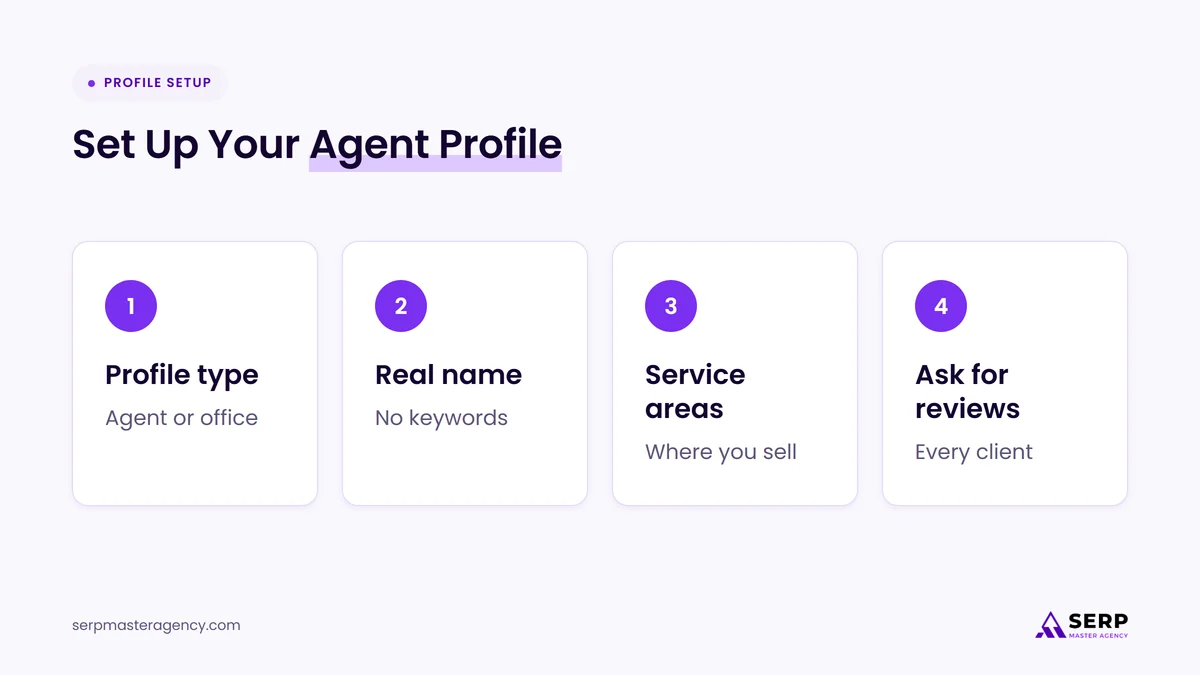
- Pick the right profile type. Decide whether you are a solo practitioner sharing the brokerage profile, an agent with your own practitioner profile, or the office itself. Google’s guidelines say a practitioner should have a profile only if they work in a public-facing role and can be contacted at the verified location during stated hours.
- Use your real name. Google’s guidelines say “unnecessary information” in the business name isn’t permitted. “Jane Smith Realtor Best Homes Springfield” is the kind of name that gets profiles suspended.
- Get the address rules right. If clients visit your office, show the address. If you work from home and meet clients at their properties, you are a service-area business and should hide the address. Google does not allow virtual offices unless they are staffed during business hours.
- Set service areas to where you actually sell. List the towns or suburbs you work in, not every place within an hour’s drive.
- Choose an accurate primary category. Pick the category that matches your role, such as real estate agent, broker or agency, and keep secondary categories to services you really offer.
- Keep hours and phone numbers true. If you answer calls in the evening, say so. A listed number that goes to an unattended desk wastes the click.
Google bases local results mainly on three factors: relevance, distance and prominence. Distance you can’t change. Relevance comes from complete, accurate profile details. Prominence comes from how well known you are, including links, mentions and reviews. Google also states that there’s no way to pay for a better local ranking.
How do you rank for “what’s my home worth” searches?
Build a dedicated home valuation page for each main area you serve that explains how you value homes there, what drives prices locally and what the owner gets from you. A page with only a form gives Google and AI tools nothing to understand or quote, so it rarely ranks against portal estimate tools.
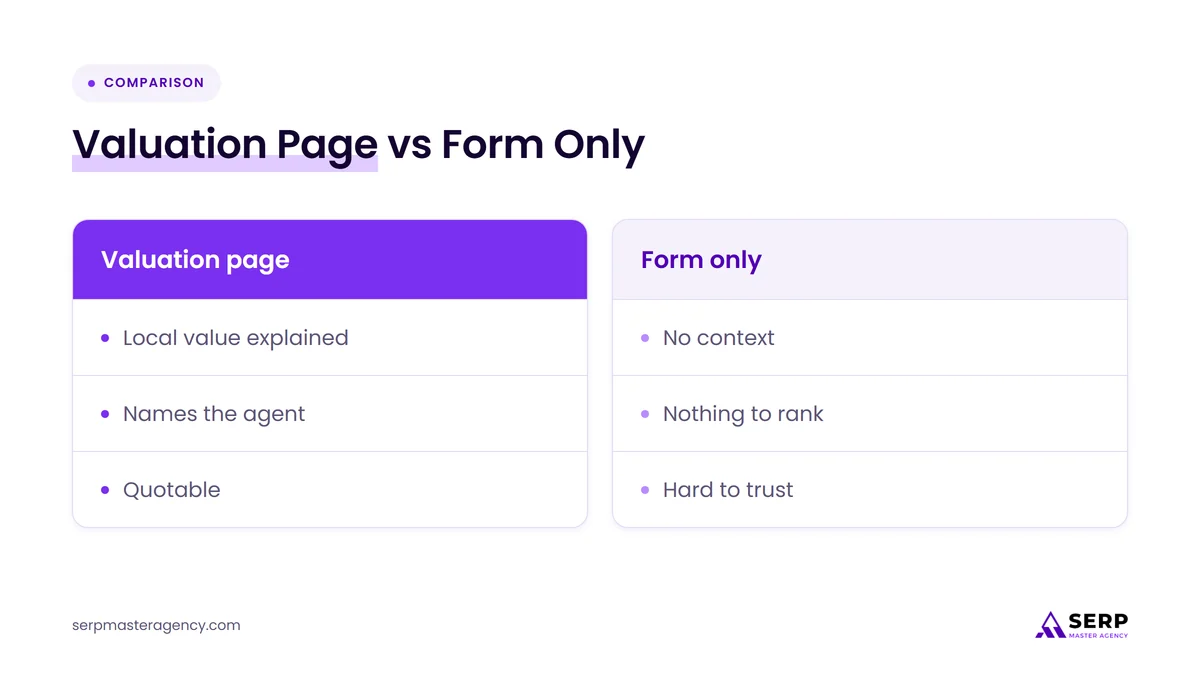
A strong valuation page usually includes:
- A plain explanation of your method. Say how you look at recent comparable sales, condition, lot size and local demand, and how that differs from an automated estimate.
- Local factors. Name the streets, school zones, transit links or building types that change values in that area, in your own words.
- What happens next. Explain whether you visit in person, how long the valuation takes and what the owner receives.
- Who does the valuation. Show your name, photo, license details where your market requires them, and how long you have worked the area.
- A short form and a phone number. Keep the form to what you need to prepare, and offer a call for people who don’t want to type.
- Recent reviews from sellers. Pull in genuine seller reviews, ideally ones that mention the valuation or the sale.
Avoid promising a number you can’t support. Many sellers have already seen a portal estimate. Your page earns the click by explaining why a local agent’s view can differ and what you check that an algorithm can’t see.
How do neighborhood pages help without becoming doorway pages?
Neighborhood pages help when each one offers something a seller in that area can use: local market notes, the types of homes there, what buyers ask about and your own experience selling nearby. They become a problem when an agent creates many near-identical pages with only the place name swapped, which Google’s spam policies call doorway abuse.
Google’s spam policies list “having multiple domain names or pages targeted at specific regions or cities that funnel users to one page” as an example of doorway abuse. They also define scaled content abuse as many pages “generated for the primary purpose of manipulating search rankings and not helping users.”
Use this test for each area page:
- Could you only have written it about this area? If the text works for any suburb after a find-and-replace, it isn’t ready.
- Does it show first-hand knowledge? Mention the housing stock, what sells quickly and what holds homes back, based on your own work.
- Is the data dated and sourced? If you quote median prices or days on market, name the source and the month.
- Does it link naturally? Link each area page to your valuation page and seller services page, and back again.
- Would you still publish it if search didn’t exist? If not, combine thin pages into fewer, better ones.
It is better to have five strong pages for the areas where you actually list homes than fifty thin pages for every town in the county.
How do reviews affect where agents rank?
Reviews affect both local rankings and whether a seller calls you. Google says more reviews and positive ratings can help local ranking, and sellers compare agents on review count, recency and what clients say about the sale. Reviews on third-party sites such as portals also feed the picture AI tools build of an agent.
Two rules keep your reviews safe. Google’s policy prohibits offering incentives such as payment, discounts or free services for a review. It also bans discouraging negative reviews or “selectively” asking only happy clients. Ask every client after closing, sellers and buyers alike, and let them say what they want.
Recency counts too. BrightLocal’s 2026 survey found that 74% of consumers look for reviews written in the last three months. Agents with low transaction volume should ask past clients from earlier years as well, and reply to every review with specifics, not a copied thank-you.
How do agents show up in ChatGPT and Google AI answers?
AI tools recommend agents they can find consistent, specific evidence about: matching details across Google Business Profile, portals and the agent’s site, reviews on several platforms, and pages that answer local questions clearly. There is no separate trick. Google says there are no additional requirements to appear in AI Overviews or AI Mode beyond normal Search eligibility.
The bar is high. In a Spring 2026 study by withNotable, reported by HousingWire in October 2026, 240 queries across ChatGPT, Perplexity and Gemini in 10 US markets surfaced 656 Realtors, about 1.3% of roughly 51,870 licensed professionals in those markets. Only 2.4% of the agents named appeared on all three platforms, and 88.7% appeared on just one. The study linked recommendations to Zillow reviews, Google Business Profiles and community forums.
Google explains that AI Overviews and AI Mode use “query fan-out,” running several related searches across subtopics to build an answer. For an agent, that means a seller’s question about selling in your area may pull from your profile, your valuation page, a market update and a review site at once. The more of those places say the same accurate thing about you, the better.
Practical steps:
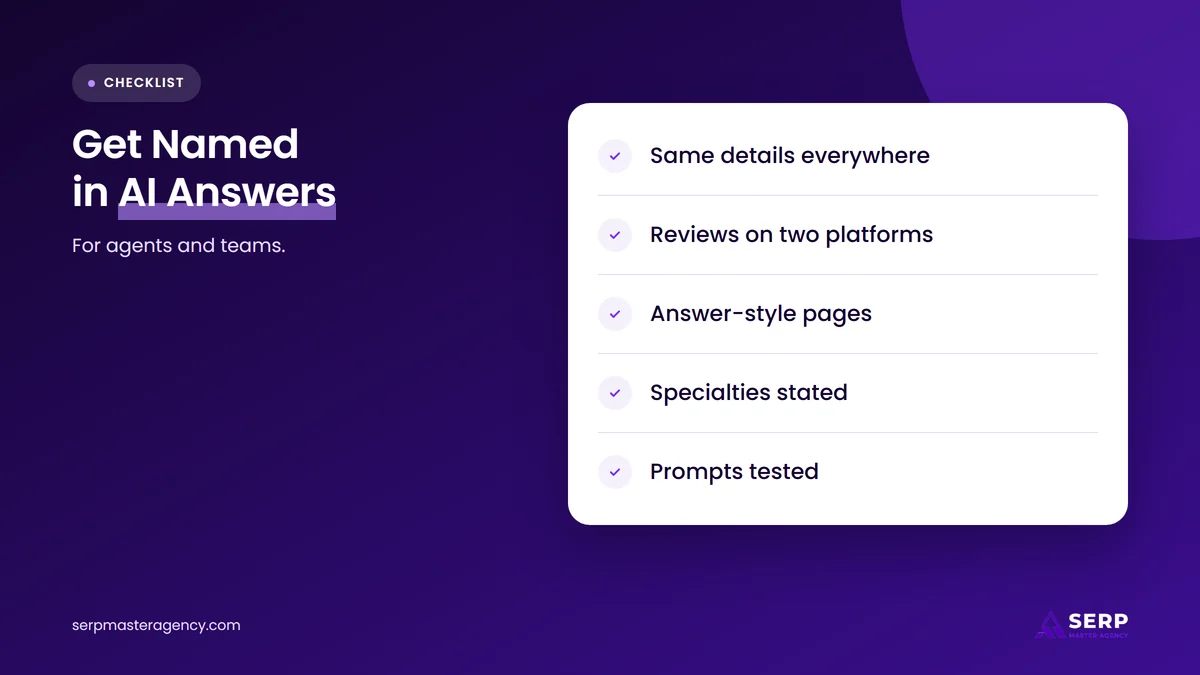
- Keep one identity. Use the same name, brokerage, phone number and areas on your site, Google Business Profile, portal profiles and social accounts.
- Collect reviews in more than one place. Google plus at least one portal or industry site gives AI tools more than a single source.
- Write answer-style pages. Start pages with a direct answer to the question a seller would ask, then add detail.
- State your specialties. Say plainly what kinds of homes and sellers you help, and where.
- Test the prompts sellers use. Ask ChatGPT, Gemini and Google AI Mode who they recommend for selling in your area, and note which sources they cite.
We explain the wider approach in our guide on how to get your business recommended by ChatGPT, and what to do about ChatGPT’s planned business listings in claiming your business in ChatGPT.
What structured data should a real estate agent website use?
Use schema.org’s RealEstateAgent type, a subtype of LocalBusiness, on your homepage or contact page, with your name, address or service area, phone, URL and opening hours. Google’s local business guidance says to use the most specific subtype possible, and its AI features guidance says markup should match what’s visible on the page.
Keep it simple. Mark up the agent or office once, keep the details identical to your Google Business Profile, and don’t add review markup for reviews you’ve copied from other sites. Google also says you don’t need special AI files or extra schema to appear in AI features, so structured data supports your pages rather than replacing them.
What mistakes stop agents ranking for seller searches?
The most common mistakes are relying only on a brokerage or IDX site with no original content, stuffing keywords into the business name, building dozens of copy-paste area pages, and letting reviews go stale. Each one either breaks a Google guideline or gives search engines nothing specific to rank.
- Only listings, no seller content. IDX listing pages are shared with many other sites, so they rarely set you apart for seller searches.
- A keyword-stuffed profile name. It can lead to suspension, which costs far more than it gains.
- A team member’s profile at the wrong address. Each practitioner profile needs to match where that person can be contacted.
- Different details everywhere. Old brokerages, old phone numbers and old headshots on portals confuse both clients and AI tools.
- No way to measure leads. Track calls and valuation form fills from search, not only rankings.
If your details are scattered across old directories, our guide on fixing inconsistent NAP across listings explains the cleanup.
How does SERP Master Agency help real estate agents?
SERP Master Agency works with agents, teams and brokerages on the seller-side work covered here: Google Business Profile setup within Google’s practitioner rules, valuation and area pages, review processes and visibility in AI answers. We start by checking where you show up today for seller searches in your own area.
That usually means reviewing your profile type and categories, testing valuation and “sell my house” searches in your service areas, and comparing your pages and reviews with the agents who appear above you. You can see what our real estate agent SEO service includes, and how it fits with our local SEO services for businesses that rely on map results.
Frequently asked questions
Can a real estate agent have their own Google Business Profile?
Yes, if they meet Google’s practitioner rules. Google lists real estate agents as individual practitioners who can have their own profile when they work in a public-facing role and can be contacted at the verified location during stated hours. A solo agent under a brokerage brand usually shares the brand’s profile instead.
Should agents hide their address on Google Business Profile?
Hide it if you work from home or meet clients only at their properties, because Google treats that as a service-area business. Show it if clients can visit a staffed office during your listed hours. Google does not allow virtual offices that aren’t staffed.
Do home valuation pages still work if portals show instant estimates?
Yes, when the page offers what an automated estimate can’t: local context, your method, who does the valuation and what happens next. A form-only page rarely ranks or converts. A page that explains local value gives sellers a reason to talk to an agent.
How many neighborhood pages should an agent create?
Create pages only for the areas where you actively list and sell, and only when you can write something specific about each one. A handful of detailed pages works better than many thin ones, and near-identical city pages can fall under Google’s doorway abuse policy.
How long does real estate SEO take to work?
Profile fixes such as categories, service areas and hours can affect map visibility fairly quickly. Valuation pages, area pages and a steady flow of reviews take months to build ranking strength, especially in markets where competing agents already publish and collect reviews.
How do agents win local seller searches?
Win local seller searches by getting the basics exactly right and then being more specific than other agents. Set up your Google Business Profile within the practitioner rules, publish a genuine valuation page and a few strong area pages, ask every client for a review, and keep your details identical everywhere. That same groundwork is what Google AI Overviews and ChatGPT read when they suggest an agent. If you want help with any part of it, our SEO services at SERP Master Agency cover the full plan.
Want more sellers to find you first?
Tell us where you sell and who you want to reach. We’ll check how you show up today for valuation and selling searches in your area, on Google and in AI answers, and tell you what to fix first.
Sources
- National Association of REALTORS, “Highlights From the Profile of Home Buyers and Sellers” (2026 Profile, transactions July 2025 to June 2026), accessed November 10, 2026. https://www.nar.realtor/research-and-statistics/research-reports/highlights-from-the-profile-of-home-buyers-and-sellers
- HousingWire, “Your next buyer or seller may ask ChatGPT for an agent. Will your name come up?”, October 7, 2026. https://www.housingwire.com/articles/your-next-client-may-ask-chatgpt-for-an-agent-will-your-name-come-up/
- BrightLocal, “Local Consumer Review Survey 2026”, February 11, 2026. https://www.brightlocal.com/research/local-consumer-review-survey/
- Google Business Profile Help, “Guidelines for representing your business on Google”, accessed November 10, 2026. https://support.google.com/business/answer/3038177?hl=en
- Google Business Profile Help, “Tips to improve your local ranking on Google”, accessed November 10, 2026. https://support.google.com/business/answer/7091?hl=en
- Google Maps User Contributed Content Policy, “Prohibited & restricted content”, accessed November 10, 2026. https://support.google.com/contributionpolicy/answer/7400114?hl=en
- Google Search Central, “AI features and your website”, updated December 10, 2025. https://developers.google.com/search/docs/appearance/ai-features
- Google Search Central, “Spam policies for Google web search”, updated August 28, 2026. https://developers.google.com/search/docs/essentials/spam-policies
- Google Search Central, “Local business (LocalBusiness) structured data”, updated September 8, 2026. https://developers.google.com/search/docs/appearance/structured-data/local-business
- Schema.org, “RealEstateAgent”, accessed November 10, 2026. https://schema.org/RealEstateAgent

Suraj Rana is a highly regarded SEO expert specializing in the dental industry. His expertise lies in crafting strategic SEO marketing plans to help new or expanding businesses increase their online visibility and attract more customers. Suraj Rana’s skills extend to improving website rankings and boosting organic search visibility, thereby enhancing web traffic and return on investment for businesses.