Quick answer: On November 12, 2026, Google upgraded Search to Gemini 4 Hydrogen for all users worldwide. Google says AI Mode and AI Overviews now understand complex questions better, fan out to more subtopics and link to a wider range of sites, with more visual answers. Businesses should cover related questions, state clear facts and keep their details consistent.
Key takeaways
- Google rolled out Gemini 4 Hydrogen in Search on November 12, 2026, globally and for all users, and called it its biggest model upgrade to Search yet.
- According to Google’s Robby Stein, Hydrogen is now the default model in AI Mode and is used for harder questions in AI Overviews.
- Google says the upgraded query fan-out searches more subtopics at once and links to a broader set of sites, including ones searchers may not have found before.
- Answers are becoming more visual, with images, structured layouts, comparison tables and custom tools.
- The upgrade landed during the November 2026 core update, so separate the two before you judge any traffic change.
- Google says no special optimization is needed for AI features. Clear, complete, consistent pages remain the work that pays off.
What did Google announce on November 12, 2026?
Google announced that Google Search now runs on Gemini 4 Hydrogen, available globally to all Search users from November 12, 2026. Robby Stein, Google’s VP of Product for Search, described it as the biggest model upgrade to Search yet. The changes cover intent understanding, query fan-out, visual answers and language understanding.
Here is what Google’s own announcements and the first coverage confirm:
- Scope. The upgrade is available in Google Search globally, for all users. It is not limited to a paid plan.
- Where it runs. Robby Stein said on X that Hydrogen is now the default model in AI Mode and is used for harder questions in AI Overviews, as reported by Search Engine Roundtable.
- Better intent understanding. Google says Search can now handle more complex questions, including multi-part questions, typos that are hard to parse and highly specific requests. It credits better instruction following and tool calling.
- Expanded query fan-out. Google says Search runs simultaneous searches across relevant subtopics and surfaces a broader set of links, including sites people may not have found before.
- More visual answers. Responses now include more images, structured responses, comparison tables and custom tools.
- Better language understanding. Google says answers are more nuanced in any language people ask in, across all languages AI Mode supports.
Hydrogen arrived a few days after Google released Gemini 4 Carbon to paid AI Mode subscribers earlier the same week. Carbon is the paid, deep-reasoning option. Hydrogen is the free upgrade that every searcher now gets.
What is Gemini 4 Hydrogen?
Gemini 4 Hydrogen is a Google AI model built for fast, everyday tasks. Google DeepMind calls it “our daily driver for agentic workflows.” It sits below Google’s frontier models, Gemini 4 Carbon and Gemini 4 Argon, which handle longer, deeper reasoning. In Search, Hydrogen powers the AI answers that appear in AI Mode and AI Overviews.
Google DeepMind’s launch post says Hydrogen is also available in the Gemini app, the Gemini API and Google’s business tools, and Google says it cuts fabricated claims by more than five times. For business owners, the Search side is what matters. A few terms come up often in coverage:
- AI Overviews: the AI summary that appears at the top of some regular Google results pages.
- AI Mode: Google’s conversational search tab, where people ask longer questions and follow-ups and get an AI answer with links.
- Query fan-out: Google’s technique of splitting one question into many related searches across subtopics and data sources, then building an answer from the pages it finds.
- Tool calling: the model’s ability to use other tools, such as live data or calculations, while it builds an answer.
What changes in AI Mode and AI Overviews?
The main change is that AI answers can now break harder questions into more parts and pull from more websites for each part. Google says answers also look different, with more images, tables and tools. For businesses, that means more chances to be cited for a specific subtopic, and more competition from sites that answer it clearly.
| What Google changed | What Google says it does | What it means for your business |
|---|---|---|
| Intent understanding | Handles multi-part questions, typos and highly specific requests | Customers can ask detailed, real-world questions, so vague pages lose out to specific ones |
| Query fan-out | Searches more subtopics at once and links to a broader set of sites | Pages that answer one subtopic well can be cited, even if they don’t rank for the main search |
| Visual answers | More images, structured layouts, comparison tables and custom tools | Clear facts, prices, specs and comparisons are easier for Search to reuse |
| Language understanding | More nuanced answers in every language AI Mode supports | Customers searching in other languages get better answers, which matters if you serve them |
Google’s Search Central guidance already describes fan-out this way: AI Overviews and AI Mode may issue multiple related searches across subtopics, which lets them show a wider and more diverse set of links than classic web search. Hydrogen expands that behavior. If you want the bigger picture on how this fits with traditional SEO, our guide to SEO vs AEO vs GEO explains the differences.
Does the Hydrogen upgrade change your Google rankings?
Google’s announcement describes changes to AI answers, not to the core ranking systems behind the regular blue links. Barry Schwartz of Search Engine Roundtable suggested the upgrade likely affects only AI Overviews and AI Mode, though he framed this as his view. The separate November 2026 core update is what is moving organic rankings this month.
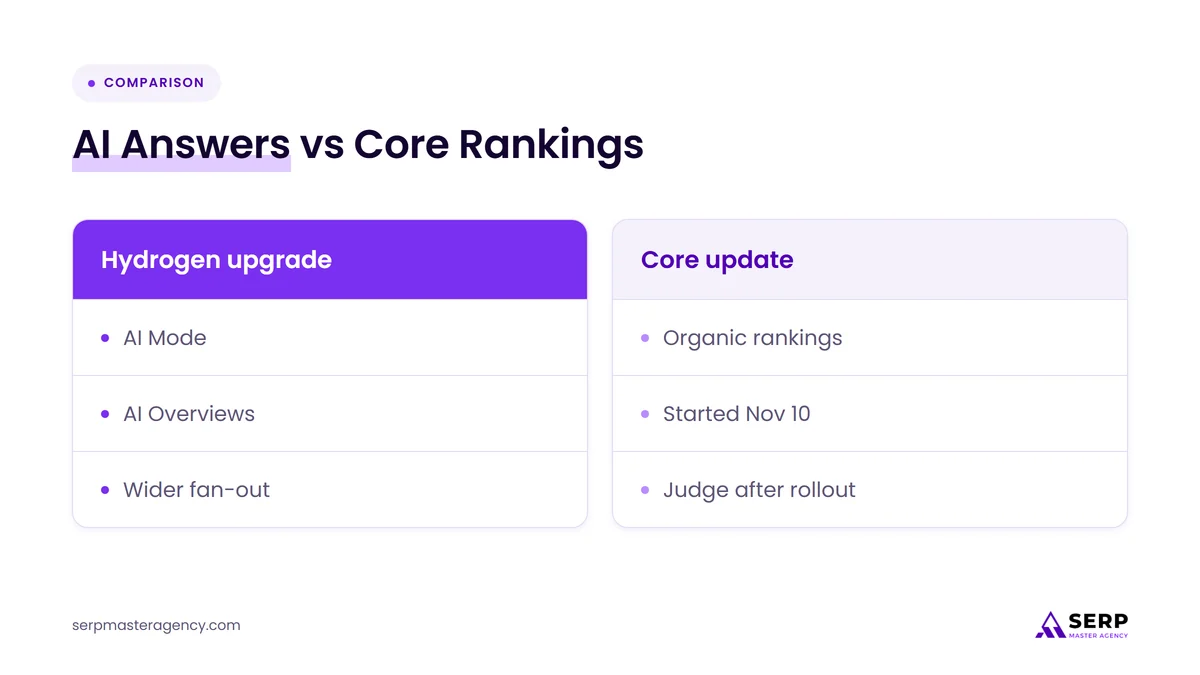
The timing makes this tricky. Google released the November 2026 core update on November 10, 2026, with a rollout that may take up to two weeks. Hydrogen arrived two days later. Our article on what to do during the November 2026 core update covers that rollout and when to check your data.
There is a second complication. Google says traffic from AI features is included in the Search Console Performance report under the “Web” search type, not in a separate AI report. So a change in clicks over the next few weeks could come from the core update, from Hydrogen’s new answers, or from both, and Search Console alone won’t separate them.
Who is affected by the Hydrogen upgrade?
Any business whose customers use Google Search can be affected, because the upgrade is global and applies to all users. Businesses whose customers ask detailed questions before they buy are most exposed: professional services, home services, ecommerce stores comparing products, healthcare and software companies with complex buying decisions.
Some patterns are worth thinking about:
- Local service businesses. A question like “emergency electrician open Sunday who does EV chargers” has several parts. Fan-out can check each part separately, so pages that state hours, services and areas clearly have more to offer.
- Ecommerce stores. More comparison tables in answers mean product specs, sizes and prices written clearly on the page are easier for Search to compare.
- Professional firms. Multi-part questions about cost, process and timelines favor firms that answer each of those questions on their site.
- Businesses serving more than one language. Google says language understanding improved across all AI Mode languages, so translated pages that read naturally matter more.
What should a business do now?
Focus on four things: cover the subtopics your customers ask about, state key facts clearly, keep your business details consistent everywhere, and measure leads rather than guessing. None of these need special AI files. Google says there are no additional requirements or special optimizations needed to appear in AI Overviews or AI Mode.
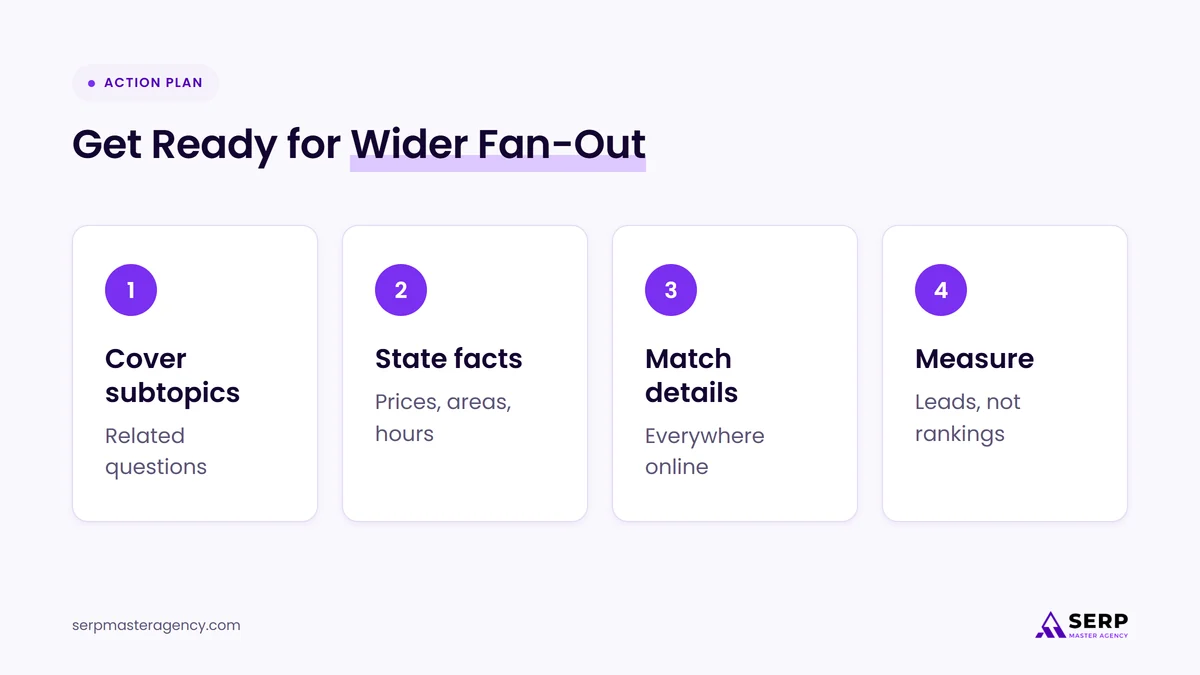
- Cover the subtopics behind your main services. List the questions customers ask before they buy: cost, timing, process, who it suits, what can go wrong and how you compare with alternatives. Make sure each one has a clear answer on your site, either on the service page or a dedicated page. Fan-out looks for answers to those smaller questions.
- State facts plainly, and use tables where they fit. Write prices or price ranges, service areas, opening hours, specs and turnaround times as plain text. Use a simple table when you compare options, packages or products. Google’s guidance says important content should be available in text form, so don’t hide key facts inside images or PDFs.
- Keep your business details consistent. Your name, address, phone number, hours and list of services should match on your website, your Google Business Profile and major directories. In our view, a model that checks many sources at once is more likely to trust details that agree. Our guide on getting your business recommended by AI tools covers how to tidy this up.
- Measure leads, not only rankings. Make sure calls and form fills from organic search are tracked, note November 10 and November 12, 2026 in your reporting, and review the trend once the core update has finished.
How should you write for multi-part questions?
Write each page so a short section can answer one specific question on its own. Use question-style headings, put a direct answer in the first sentence or two under each heading, then add detail. A searcher’s multi-part question can then be matched to the exact section that answers each part.
A simple test: read any section of a service page out of context. If it still makes sense and names your business, service and location where needed, it is easy for an AI answer to use.
How do you make your pages easy for AI Mode to use?
Make sure your pages are indexed and allowed to show a snippet, put the answer near the top, keep key facts in text, and make sure any structured data matches what is visible on the page. These are the basics Google lists for AI features, and they matter more as fan-out reaches deeper into sites.
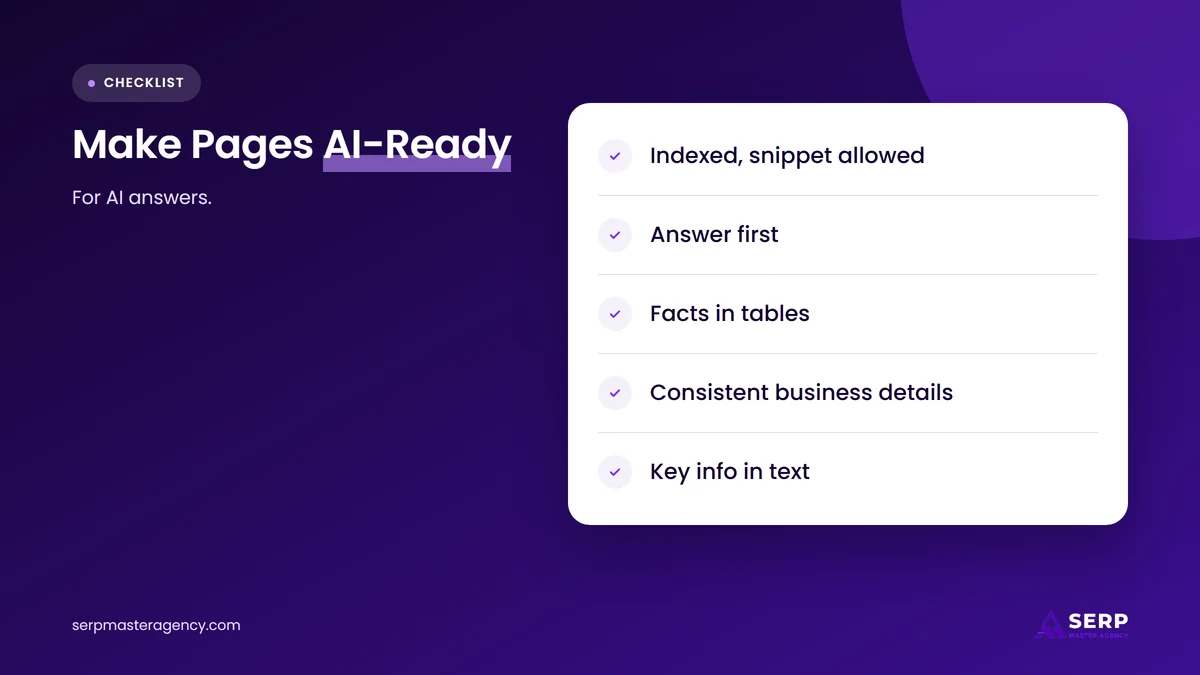
Google’s Search Central page on AI features lists these practices:
- Indexing and snippets. A page must be indexed and eligible to show in Search with a snippet to be used as a supporting link.
- Crawl access. Allow crawling in robots.txt and make sure your hosting or CDN doesn’t block Googlebot.
- Text content. Keep important information in text, supported by images and video where useful.
- Structured data. If you use schema markup, it must match the visible text on the page.
- Preview controls. If you want to limit what appears, Google points to nosnippet, data-nosnippet, max-snippet and noindex. Check these aren’t set by accident on pages you want cited.
What should you avoid after the upgrade?
Avoid buying “AI optimization” shortcuts, rewriting pages in a rush during the core update rollout, and judging the upgrade from a few manual searches. Google says no special files or markup are needed for AI features, and day-to-day AI answers vary, so single screenshots are a poor measure.
- Don’t pay for special AI files. Google’s guidance says you don’t need new machine-readable files, AI text files or special schema markup to appear in AI Overviews or AI Mode.
- Don’t rewrite during the rollout. The core update is still moving rankings. Wait until it finishes before making big changes.
- Don’t judge from one search. AI answers change between searches and users. Track a set of questions over several weeks instead.
- Don’t pad pages. Covering subtopics means answering real customer questions, not adding filler text or near-duplicate pages.
How do you measure the impact on your business?
Use Search Console for clicks and impressions, your analytics or call tracking for leads, and a short list of real customer questions you check in AI Mode each month. Because Google reports AI feature traffic inside the “Web” search type, leads and enquiries are the clearest signal of whether visibility is turning into business.
- Annotate your reports. Mark November 10 (core update start) and November 12, 2026 (Hydrogen) so you can read later trends in context.
- Compare after the core update ends. Wait until Google marks the core update complete, then compare a full week after with the week before November 10.
- Watch query patterns. In the Search Console Queries tab, look for longer, more specific queries and pages getting impressions for questions they answer in a single section.
- Track 10 to 20 customer questions. Ask them in AI Mode once a month and note whether your site is linked. Treat this as a direction check, not an exact score.
- Tie it to leads. Calls, forms and bookings from organic search are what pay the bills. Our guide to measuring SEO by leads and revenue explains how to set this up.
What is likely to happen next?
This section is our opinion. We expect AI answers in Google to keep getting longer, more visual and more specific, and to link out to a wider mix of sites. That favors businesses with genuinely useful, specific pages over businesses relying on a few broad pages that rank for big keywords.
At SERP Master Agency, we think the businesses that gain most from wider fan-out will be the ones that answer the small questions competitors skip: what a job costs, how long it takes, what is included and who it is not right for. Those answers help customers whether they arrive from a blue link, an AI Overview or AI Mode.
Frequently asked questions
Is Gemini 4 Hydrogen available in my country?
Yes, if Google Search and AI Mode are available where you are. Google says the Hydrogen upgrade is available globally for all Search users, and its language improvements apply across all languages AI Mode supports. Businesses in the US, UK, Canada, Australia and New Zealand are all included.
Is Gemini 4 Hydrogen the same as Gemini 4 Carbon?
No. Gemini 4 Carbon is one of Google’s frontier models and was released to paid AI Mode subscribers earlier the same week. Gemini 4 Hydrogen is a faster model and is the free upgrade now used in Search for all users, as the default model in AI Mode.
Do I need special markup or an AI file for AI Mode?
No. Google’s Search Central guidance says there are no additional requirements or special optimizations needed to appear in AI Overviews or AI Mode, and no new AI text files or special schema markup. Standard SEO practices apply: pages must be indexed, crawlable and eligible to show a snippet.
Can I see AI Mode traffic separately in Search Console?
Not as a separate report. Google says traffic from AI features is included in the Search Console Performance report under the “Web” search type. To judge impact, combine Search Console trends with lead tracking and regular manual checks of the questions your customers ask.
Will more of my customers get answers without clicking?
Some may. Google says Hydrogen surfaces a broader set of links, including sites people may not have found before, but it has not published click data for the upgrade. Pages that answer specific questions well give searchers a reason to click for detail, pricing or booking.
What should your business do this week?
Keep it simple. Pick your three most important services, list the questions customers ask about each, and check that your site answers every one in clear text. Make sure your business details match everywhere, and note both November dates in your reports. Our SEO services cover this kind of content and visibility work, and you can learn more about how we work at SERP Master Agency.
Want to know how AI Mode sees your business?
SERP Master Agency helps business owners in the US, UK, Canada, Australia and New Zealand find the customer questions their site doesn’t answer yet. Tell us your main services and market, and we’ll show you where your pages fall short for AI Mode and AI Overviews.
Sources
- Google, Robby Stein, “Google Search gets a major upgrade with Gemini 4 Hydrogen”, November 12, 2026. https://blog.google/products-and-platforms/products/search/gemini-4-hydrogen-search-upgrade/
- Google, Koray Kavukcuoglu, “Introducing Gemini 4 Hydrogen”, November 12, 2026. https://blog.google/innovation-and-ai/models-and-research/gemini-models/introducing-gemini-4-hydrogen/
- Google Search Central, “AI features and your website”, accessed November 13, 2026. https://developers.google.com/search/docs/appearance/ai-features
- Search Engine Roundtable, Barry Schwartz, “Google Search Gets Massive Upgrade With Gemini 4 Hydrogen”, November 12, 2026. https://www.seroundtable.com/google-search-gemini-4-hydrogen-42526.html

Suraj Rana is a highly regarded SEO expert specializing in the dental industry. His expertise lies in crafting strategic SEO marketing plans to help new or expanding businesses increase their online visibility and attract more customers. Suraj Rana’s skills extend to improving website rankings and boosting organic search visibility, thereby enhancing web traffic and return on investment for businesses.