Quick answer: Seer Interactive watched 161 real AI search sessions from March to September 2026. ChatGPT ads became far more common, reaching 12 of 19 users by July to September, yet 7 of 12 people served an ad said there were none. Branded prompts often showed a rival’s ad. Check your branded prompts first, build organic visibility, and test ads only as awareness.
Key takeaways
- Seer Interactive’s study covers nine usability studies and 161 recorded AI search sessions, run between March and September 2026, and was published on November 12, 2026.
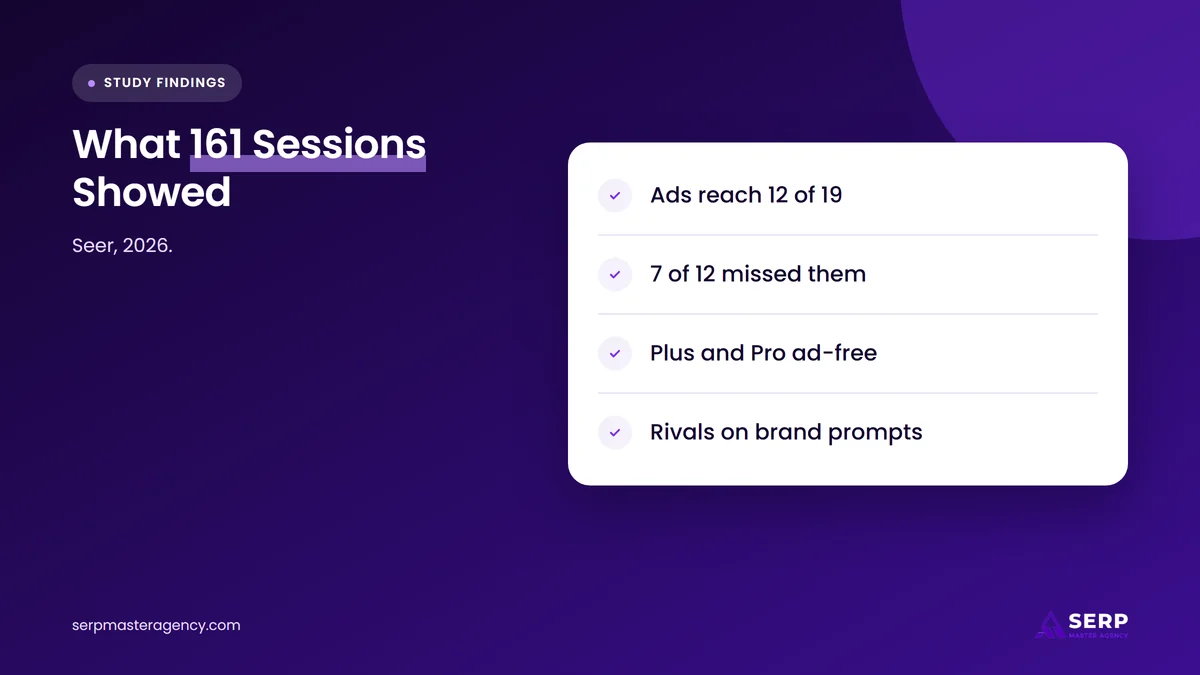
- ChatGPT users who saw an in-answer ad rose from 2 of 22 in March to 17 of 46 in May and June, then 12 of 19 from July to September.
- 7 of the 12 participants who were served an ad told the researchers there were none. Only one pointed out an ad without being asked.
- Every Plus and Pro session was ad-free. Ads appeared on free and logged-out accounts.
- In 5 of 6 verticals with a branded task, the ad belonged to a different brand from the one named in the prompt.
- The samples are small and not representative, so treat the findings as early signals, not market-wide rates.
What did Seer Interactive’s ChatGPT ads study find?
Seer Interactive found that ads inside ChatGPT answers became much more common during 2026, that most people who were shown an ad did not register it as an ad, and that branded prompts often showed a competitor’s ad. The study recorded 161 real AI search sessions across nine studies from March to September 2026.
The research comes from Seer Interactive’s UX team, Denise Baginski and Andrea Haley. Participants used their own AI tools and thought aloud while they searched, so the researchers could hear what people noticed as well as see what was on screen. Each ad unit was checked by eye against what the participant said.
Here are the headline figures, all from the Seer report:
| Finding | What Seer observed | Why it matters to you |
|---|---|---|
| Ad exposure, March 2026 | 2 of 22 ChatGPT users saw an in-answer ad | Ads started as a rare sight |
| Ad exposure, May to June 2026 | 17 of 46 users | Exposure grew quickly |
| Ad exposure, July to September 2026 | 12 of 19 users, nearly 2 out of 3 | Ads are now a normal part of free ChatGPT |
| Noticing ads | 7 of 12 people served an ad said there were none | An ad can work without being seen as an ad |
| Account type | All Plus and Pro sessions were ad-free | Paying users don’t see ads at all |
| Branded prompts | A different brand’s ad in 5 of 6 verticals | Rivals can appear when people ask about you |
What counts as an in-answer ad in ChatGPT?
An in-answer ad in ChatGPT is a sponsored card or product carousel shown inside or directly below ChatGPT’s response, marked with a small “Ad” label. Unlike a search result page, there is no separate row of ads: the sponsored placement sits within the conversation, close to the answer the user asked for.
Seer tracked how the format changed over the study. From March to June, the ad was a single card below the Sources row, often below the fold. In July, cards responded to what the user typed, such as a geo-targeted car insurance card for Georgia. By September, the ad opened with a sentence restating the user’s need, followed by a priced product carousel. Seer notes that the placements use context from the conversation and look more like the answer around them.
How was the study run, and how reliable is it?
The study used unmoderated, recorded sessions in which real people searched with their own AI tools while thinking aloud. Recordings were sampled every two seconds with on-device text recognition, and ads were checked by eye. The samples are small, the participants were not representative, and findings on perception come from only two of the nine studies.
Seer is open about these limits. Some vertical groups were tiny, such as 4 auto users and 5 utilities users. Gemini, Claude and Grok were only scanned in some of the studies, and none of those sessions showed an in-answer ad. Treat the figures as what one research team observed in real sessions, not as rates you can apply to every market.
Why don’t most ChatGPT users notice the ads?
Most ChatGPT users in the study did not notice ads because the ads read like part of the answer. The placements use context from the conversation, sit next to relevant recommendations and carry only a small label. Seer found that most participants ignored the ads, and 7 of the 12 who were served one said there were none.
Several observations from the study show how this plays out:
- Only one person spotted an ad unprompted. Everyone else either ignored it or didn’t register it.
- An insurance shopper clicked only after being asked. The click came after the interviewer raised the topic of clicking.
- A shopper credited ChatGPT for an ad. An ecommerce participant picked shoes from an ad carousel but described the choice as ChatGPT’s recommendation.
- Delayed effect. A home and DIY shopper started searching for a furniture retailer’s products about seven minutes after seeing its card.
- No visible reaction in insurance. In the insurance study, Seer counted 34 ad impressions across 16 sessions and observed no reactions to them.
For an advertiser, that cuts both ways. Low recognition means people may not treat your ad with the suspicion they bring to search ads. It also means fewer deliberate clicks, so the value of an ad may show up later as branded searches or direct visits rather than as a clean click and conversion. Seer’s authors suggest that users may credit an advertiser’s recommendation to ChatGPT itself.
Who sees ads in ChatGPT, and who doesn’t?
In Seer’s sessions, ads appeared only for people on free and logged-out ChatGPT accounts, though not every logged-out session showed one. Every Plus and Pro session was ad-free. Exposure also varied by industry, with insurance shoppers seeing ads most often in the study.
Exposure by vertical, from the Seer report, shows how uneven ad coverage was across topics:
| Vertical | Users who saw an ad | Note |
|---|---|---|
| Insurance | 8 of 11 | Some participants saw 6 or 7 ads in one conversation |
| Ecommerce | 4 of 8 | One shopper picked shoes from an ad carousel |
| Travel | 4 of 10 | Fewer than half of users |
| Home and DIY | 13 of 37 | Largest group in the study |
| Auto | 1 of 4 | Very small sample |
| Utilities | 1 of 5 | Very small sample |
What this means for your audience: if your customers are mostly on paid ChatGPT plans, ads won’t reach them at all. If they use the free version, there is a real chance an ad sits next to the answer they read.
Can a competitor’s ad show up when someone asks ChatGPT about your brand?
Yes. In Seer’s study, branded prompts still drew ads, and in 5 of 6 verticals with a branded task the sponsored card belonged to a different brand from the one named in the prompt. A customer who asks ChatGPT about your business by name can see a rival’s offer right beside the answer.
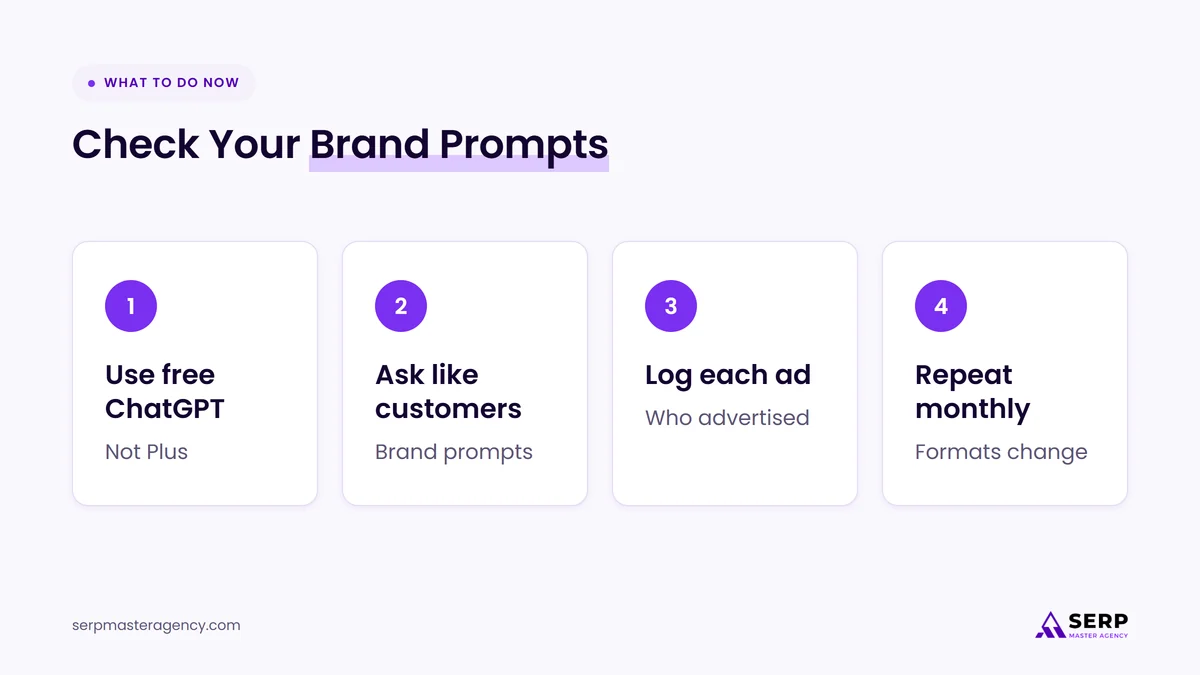
Seer’s first recommendation is simple: ask ChatGPT about your brand on a free account and look at the card underneath. Here is a practical way to do that check:
- Use a free or logged-out account. Plus and Pro accounts showed no ads in the study, so checking on a paid plan will tell you nothing.
- Ask the questions customers ask. Try your business name, your name plus your main service, and comparisons such as your brand against a known rival.
- Note every sponsored card. Record who advertised, what they offered and whether the ad matched or contradicted ChatGPT’s answer.
- Repeat monthly. Seer saw the ad format change between March, July and September, so one check is a snapshot, not a verdict.
Seer also warns that aggregators can be your biggest competitors here. In the insurance study, comparison sites accounted for 24 of the 34 ad impressions and insurance carriers for 10. If you sell through a crowded category, lead-generation and comparison sites may be buying the space next to your brand.
Should business owners advertise in ChatGPT?
Test ChatGPT ads only if your customers use free ChatGPT for buying research and you can treat the spend as awareness. Seer advises against expecting high conversion rates. If rivals already appear on your branded prompts, a small branded test may be worth it. For most businesses, organic visibility in ChatGPT’s answers is the first priority.
Use this table to decide where you stand:
| Your situation | Sensible next step |
|---|---|
| A competitor’s ad shows on your branded prompts | Fix your organic presence first, then consider a small branded test |
| Busy category with comparison sites buying ads | Test non-branded prompts as an awareness play, with a fixed budget |
| ChatGPT doesn’t mention you in its answers yet | Work on organic visibility before paying for placement |
| Your buyers mostly use paid ChatGPT plans | Skip ads for now: Plus and Pro sessions showed none |
| You can’t track branded searches or direct visits | Set up measurement before testing, or results will be hard to judge |
If you do test, set it up the way the platform now works. As we covered in our post on ChatGPT Ads bidding before Max CPC retires, bidding now runs on cost targets, so set them from real costs. For the wider question of whether the platform suits your business, see ChatGPT Ads Are Expanding: Should Your Business Advertise in ChatGPT?
How should you measure a ChatGPT ads test?
Measure a ChatGPT ads test by more than clicks. Seer saw a shopper act on an ad minutes later and another credit an ad to ChatGPT, so track branded searches, direct visits and how new customers say they found you during the test period, alongside clicks and conversions reported in Ads Manager.
Ask new customers where they heard of you and add “ChatGPT” as an option on your forms. Compare branded search volume in Google Search Console for the weeks before and during the test. If you also run Google or Microsoft ads, our PPC advertising services page explains how we judge paid channels side by side.
How do you get recommended in ChatGPT’s answers without paying?
You earn a place in ChatGPT’s answers with clear, consistent and trusted information about your business across your website and the wider web. Seer found the strongest position belonged to the brand whose ad reinforced ChatGPT’s own recommendation, which means organic visibility makes any paid test work harder too.
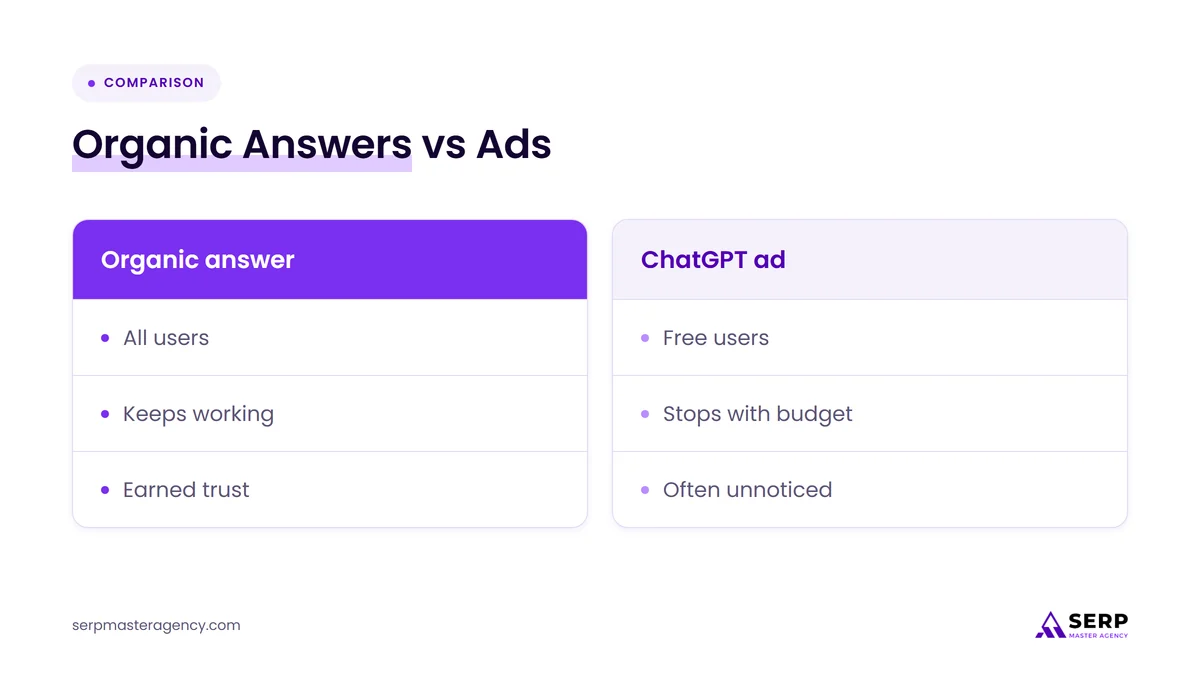
Seer’s last recommendation is to align the paid ad with the answer. In practice, the answer has to mention you first. That depends on work you control:
- Clear service pages. State what you do, where you do it and for whom, in plain sentences an AI system can lift and repeat.
- Consistent business details. Keep your name, address, phone number and services the same on your site, Google Business Profile and directories.
- Reviews and mentions. Earn recent reviews and coverage on the sites people in your industry trust.
- Comparison and pricing content. Answer the questions buyers ask before they choose, so ChatGPT has something accurate to cite.
Our guide on how to get your business recommended by ChatGPT walks through each step in detail.
What is likely to happen next with ChatGPT ads?
This section is our view, not something Seer or OpenAI has stated. The trend in Seer’s data is clear: more ads, shown to more free users, in formats that blend further into the answer. We expect branded prompts to become contested space, much like branded keywords in Google Ads.
If that happens, businesses with a strong organic presence will be in the best position. Their name already appears in the answer, so any ad they choose to run reinforces it. Businesses that are missing from the answer will face a harder choice: pay to appear next to someone else’s recommendation, or let rivals and comparison sites fill the space.
Frequently asked questions
How many sessions did Seer Interactive’s ChatGPT ads study cover?
Seer Interactive’s study covered 161 recorded AI search sessions across nine usability studies run from March to September 2026. Participants used their own AI tools and thought aloud while searching. The report was published on November 12, 2026 by Denise Baginski and Andrea Haley of Seer’s UX team.
Do ChatGPT Plus and Pro users see ads?
No Plus or Pro session in Seer Interactive’s study showed an ad. Ads appeared on free and logged-out accounts, although not every logged-out session showed one. If your customers mostly pay for ChatGPT, ads will not reach them, and organic visibility in answers is the only way to appear.
Do people click on ChatGPT ads?
In Seer’s study, deliberate clicks were rare. Most participants ignored ads, one insurance shopper clicked only after the interviewer asked about clicking, and no reactions were observed to the 34 insurance ad impressions. Some effects were delayed, such as a shopper searching for a retailer’s products about seven minutes after seeing its card.
Why did a competitor’s ad appear when someone searched for a brand?
Branded prompts still drew ads in Seer’s study, and in 5 of 6 verticals with a branded task the ad belonged to another brand. ChatGPT ads respond to the conversation’s topic, so a rival or comparison site can appear when a customer asks about your business by name.
Are Seer’s findings true for every business?
No. Seer notes that the samples were small, the participants were not representative and the findings describe what was observed, not market-wide rates. Some industries had only four or five users. Use the study as an early signal and check your own branded prompts on a free ChatGPT account.
Should you advertise or optimize for ChatGPT?
Start by checking which ads appear on your branded prompts in free ChatGPT. Then put your main effort into being named in ChatGPT’s answers, because that visibility reaches every user, including paid subscribers who never see ads. Test ads later, with a fixed budget, as an awareness channel measured by more than clicks. At SERP Master Agency, our SEO services help businesses earn that visibility in Google and AI search, so paid placements support your presence rather than replace it.
Want to know what ChatGPT says about your business?
SERP Master Agency helps businesses in the US, UK, Canada, Australia and New Zealand get named in Google and AI answers. Tell us your brand and your main services, and we’ll show you where you appear today and what to fix first.
Sources
- Seer Interactive (Denise Baginski and Andrea Haley), “ChatGPT Ads UX Study: Findings from Real AI Search Sessions”, November 12, 2026. https://www.seerinteractive.com/insights/chatgpt-ads-inside-answers-what-161-ai-search-sessions-show

Suraj Rana is a highly regarded SEO expert specializing in the dental industry. His expertise lies in crafting strategic SEO marketing plans to help new or expanding businesses increase their online visibility and attract more customers. Suraj Rana’s skills extend to improving website rankings and boosting organic search visibility, thereby enhancing web traffic and return on investment for businesses.