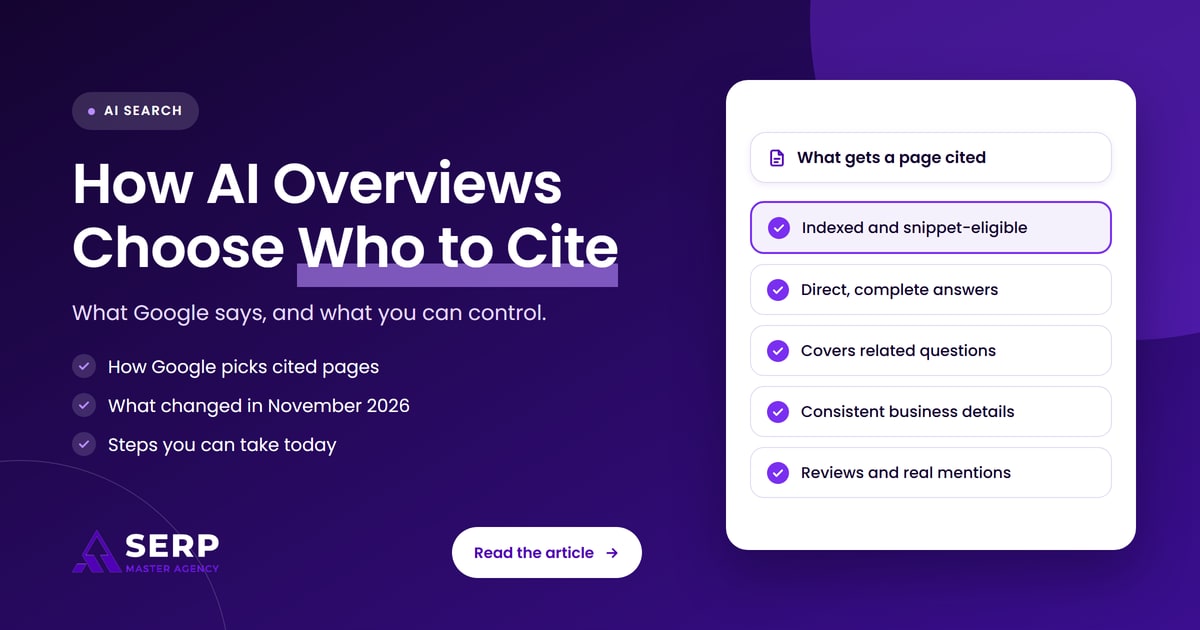
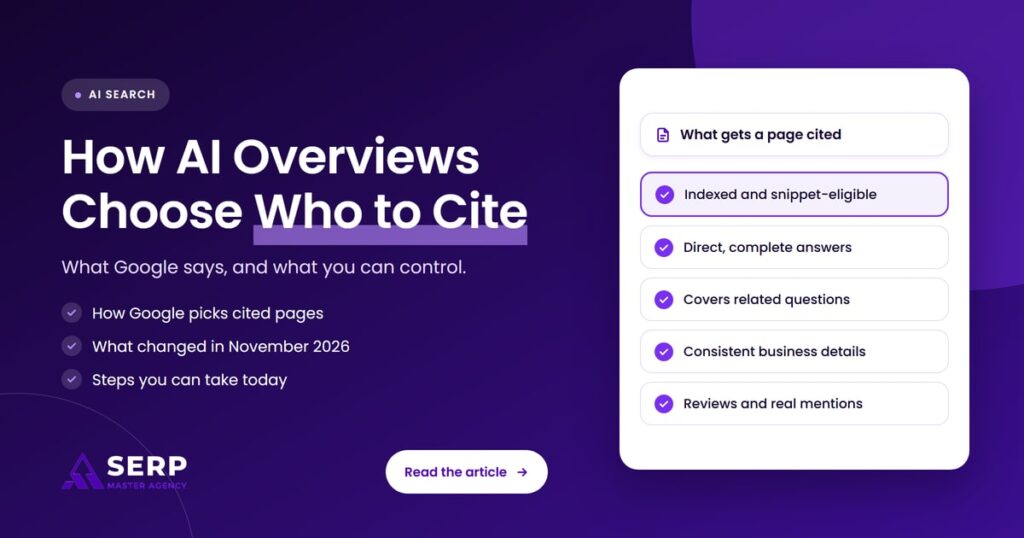
Quick answer: Google’s AI Overviews cite pages that are indexed, eligible for a snippet and judged relevant and reliable by Google’s normal ranking and quality systems. A business gets cited over a rival when its page answers the exact question clearly, matches related sub-questions, and is backed by consistent business details, reviews and mentions across the web.
Key takeaways
- Google says there are no extra requirements to appear in AI Overviews or AI Mode: a page must be indexed and eligible to show with a snippet.
- AI Overviews work with Google’s existing quality and ranking systems and the Knowledge Graph, so normal SEO is the foundation.
- Ranking top 10 helps but is not the whole story: in Ahrefs’ March 2026 study, 37.9% of cited URLs also appeared in the first 10 results.
- Query fan-out means Google searches related subtopics too, so pages that answer the follow-up questions get more chances to be cited.
- You can control indexing, clear answers, consistent business details, reviews, mentions and accurate structured data. You can’t control which model runs or which links appear on a given day.
What does it mean when an AI Overview cites a business?
An AI Overview citation is a link to a web page that Google shows alongside its AI-generated summary, as a source that supports the answer. When your page is cited, your business name and link appear inside the overview, which can send visitors and builds trust before anyone reaches the classic blue links.
AI Overviews are the AI summaries at the top of some Google results. AI Mode is the separate, chat-style tab in Google Search where people can ask longer questions and follow-ups. Both show supporting links, but Google notes they may use different models, so the links in each can differ for the same question.
Being cited is not the same as being recommended by name. Sometimes the overview names your business in its text. More often it links your page as a source for one fact or step. Both count, and both start from the same place: Google has to find your page useful for that question.
How does Google choose which pages to cite in AI Overviews?
Google says AI Overviews use a customized Gemini model that works with its existing quality and ranking systems and the Knowledge Graph. The overview is built to show information backed up by top web results, so Google first finds relevant, high-quality pages from its index, then links the ones that support each part of the answer.
In its May 2025 explainer on AI Overviews and AI Mode, Google describes the overview as doing traditional search tasks, like “identifying relevant, high-quality results from our index.” It also says Google has integrated its core web ranking systems into the experience. In plain terms, AI Overviews do not run on a secret, separate list of favorite websites. They draw on the same index and ranking signals that decide normal search results.
Google’s Search Central page on AI features adds the technical floor. To be eligible as a supporting link, a page must be indexed and eligible to be shown in Google Search with a snippet. Google states there are “no additional requirements to appear in AI Overviews or AI Mode,” and no special markup or AI-specific files are needed.
Does a page need to rank in the top 10 to be cited?
No, but ranking well still helps. Ahrefs’ March 2026 study of 863,000 keyword results found that 37.9% of URLs cited in AI Overviews also appeared in the first 10 results for the same search. Another 31.2% ranked from 11 to 100, and 31.0% ranked beyond the top 100.
That figure was about 76% in Ahrefs’ July 2025 study. Ahrefs notes the two studies are not strictly like-for-like, because its data collection improved and AI Overviews moved to a newer Gemini model in between. It suggests query fan-out may explain part of the shift, but says this could not be verified because Google does not show its fan-out searches.
The practical lesson is simple. Ranking for your main keyword is useful, but it is not enough on its own. A page can also be cited because it ranks for a narrower, related question that Google searched while building the answer.
What is query fan-out, and why does it matter for citations?
Query fan-out is a technique where Google splits one question into several related searches across subtopics and data sources, then combines the results into one answer. It matters because each of those related searches is another chance for a page to be found and cited, even if it doesn’t rank for the original wording.
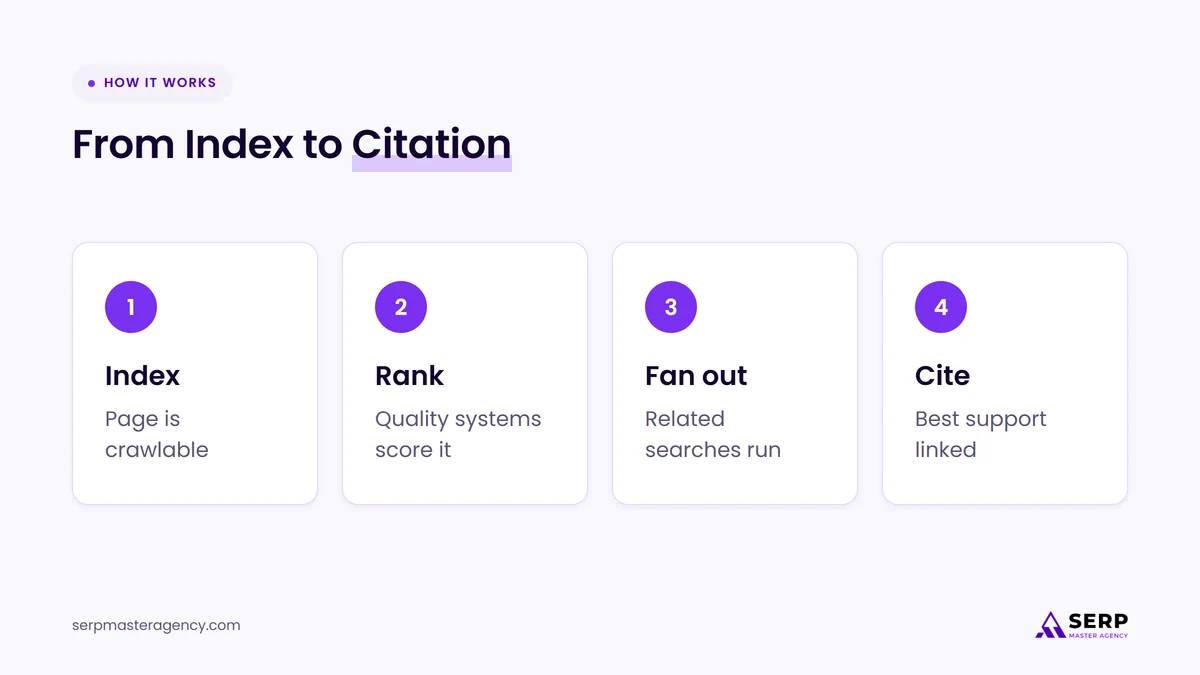
Google’s Search Central documentation says both AI Overviews and AI Mode may use query fan-out, issuing multiple related searches across subtopics and data sources. Google’s explainer adds that, while responses are generated, its models can find more supporting pages than before, which is why AI answers often show a wider set of links than classic results.
Imagine someone asks how much it costs to replace a commercial roof. Google might also look up what affects the price, how long the job takes, which materials last longest and when repair is cheaper than replacement. A roofing company whose site answers those questions clearly on well-organized pages has more ways to be picked than one with a single thin services page.
What changed for AI Overviews in November 2026?
Two changes landed close together. On November 12, 2026, Google moved Search to its Gemini 4 Hydrogen model, which became the default model in AI Mode and is used for the hardest questions in AI Overviews. Separately, the November 2026 core update began rolling out on November 10, 2026.
In its announcement, Google said Hydrogen “supercharges our query fan-out technique” and that Search now connects people to a broader range of helpful links than before. Google’s VP of Product for Search, Robby Stein, said on X that it is “now the new default model in AI Mode,” as reported by Search Engine Roundtable. Google did not say how sources are selected or ranked under the new model.
The core update matters because AI Overviews draw on the same ranking systems. Google’s Search Status Dashboard says the rollout may take up to two weeks. If your citations or rankings move this month, wait for the rollout to finish before you change anything. Our guides to what Gemini 4 Hydrogen means for your business and what to do during the November 2026 core update cover both changes in detail.
What makes Google cite one business over another?
Google cites the page that best supports a specific part of its answer. Between two similar businesses, the one with an indexable page that answers the question directly, covers the related questions, shows consistent business details and has stronger signals of reputation across the web has the edge. No single trick decides it.
Here is how the main factors line up, based on what Google has published and what recent studies have measured.
| Factor | What Google or studies say | What you can do |
|---|---|---|
| Indexing and snippet eligibility | Google requires pages to be indexed and eligible to show with a snippet (Google Search Central) | Check pages in Search Console’s URL Inspection tool and avoid blocking snippets |
| Normal ranking and quality systems | AI Overviews integrate Google’s core web ranking systems (Google, 2025) | Keep doing sound SEO: helpful pages, good site structure, earned links |
| Direct, complete answers | Cited pages opened with a direct answer more often: 23% vs 14% for retrieved pages that weren’t cited (TJ Digital, 2026) | Answer the question in the first lines of each section |
| Coverage of related questions | Google uses query fan-out across subtopics (Google Search Central) | Answer pricing, timing, process and comparison questions on your pages |
| Unique, non-commodity content | Google recommends unique, valuable content for AI search (Google Search Central Blog, 2025) | Add your own process, examples, local detail and experience |
| Reviews and web presence | More reviews, positive ratings and links can help local ranking (Google Business Profile Help) | Ask every happy customer for a review and earn mentions locally |
| Structured data | Markup should match visible page text; no special schema is required (Google Search Central) | Use accurate LocalBusiness and FAQ markup that mirrors the page |
One recent study is worth a closer look. TJ Digital analyzed 193,507 AI answers from ChatGPT, Google AI Mode and Google AI Overviews, collected from August to October 2026, as reported by Search Engine Journal. Cited pages opened with a direct answer 23% of the time, compared with 14% for pages the AI retrieved but didn’t cite. The author describes these as associations, not proof of cause, and the company sells AI search services, so treat the numbers as a useful signal rather than a rule.
What can a business owner control?
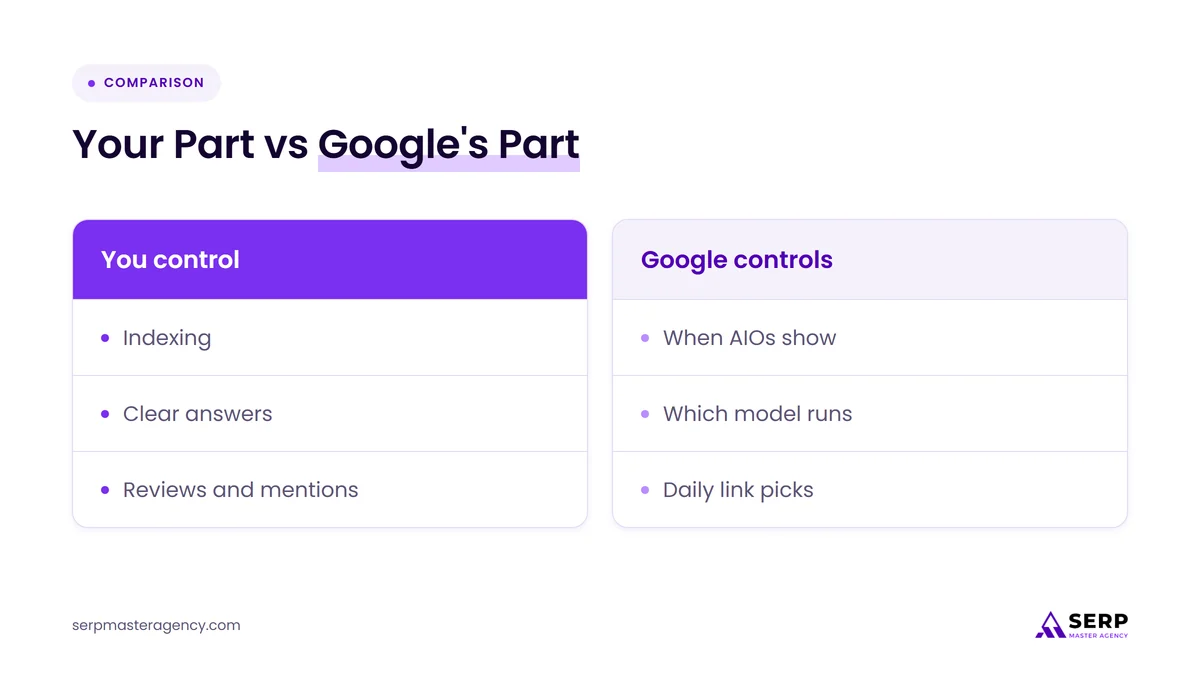
You can control whether Google can read and index your pages, how clearly they answer real customer questions, how consistent your business details are, how many genuine reviews and mentions you earn, and whether your structured data matches what visitors see. These are the same foundations Google recommends for all of Search.
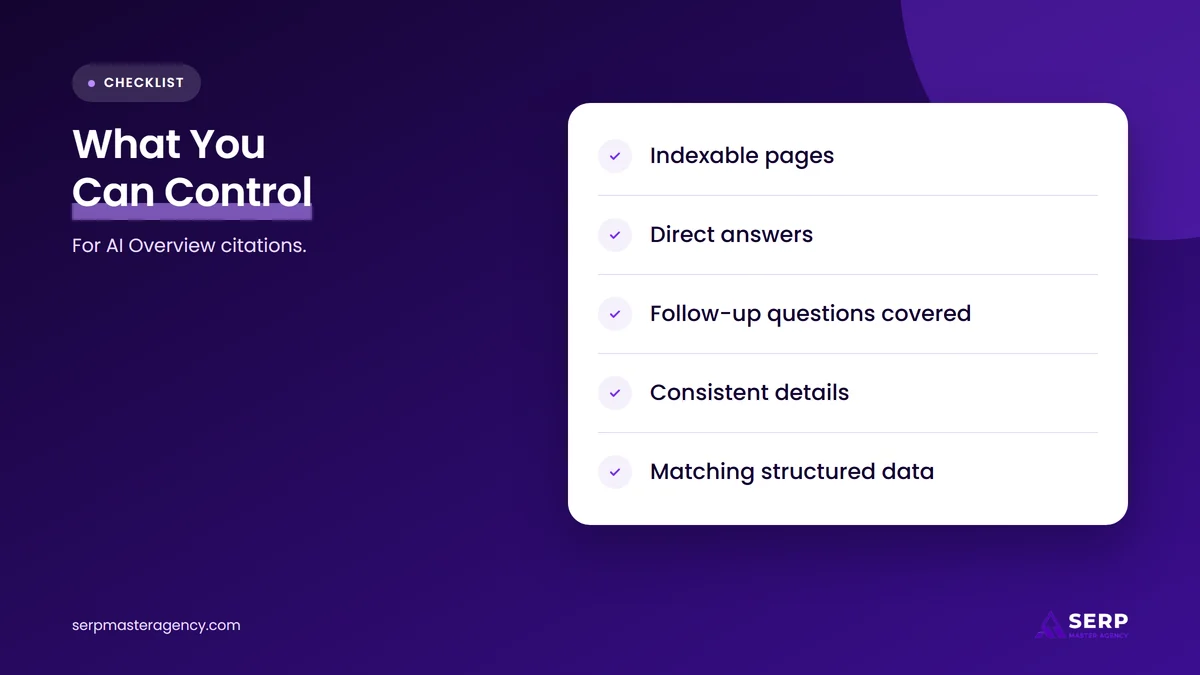
- Make every key page indexable. Googlebot must be able to reach the page, it must return a successful status code and the content must be indexable. Avoid nosnippet or very low max-snippet settings on pages you want cited, because Google says more restrictive preview controls limit how your content appears in AI experiences.
- Answer one question per section, early. Use headings that match how customers ask, then give a short, complete answer before the detail. This makes it easy for Google to lift a passage that supports one part of its summary.
- Cover the follow-up questions. List the questions customers ask on calls and in emails: price ranges, timelines, what’s included, how you compare with other options. Answer them on the relevant service pages or in focused articles.
- Keep your business details consistent. Your name, address, phone number, hours and services should match on your website, your Google Business Profile and major directories. Google recommends keeping Business Profile and Merchant Center information up to date for AI search.
- Earn reviews and real mentions. Google’s local ranking help says more reviews and positive ratings can help, and that prominence also reflects how many websites link to your business. Local press, industry associations and partner sites all count.
- Use structured data that matches the page. Google says markup should match the visible text. Mark up your business details, services and FAQs only where that information is actually shown, and validate it.
- Add original detail. Explain your own process, show real photos and include specifics competitors can’t copy. Google’s guidance asks for unique, non-commodity content, and that is also what makes a page worth citing.
If you want the bigger picture on how this differs from classic SEO, our guide to SEO vs AEO vs GEO explains where each fits. For local businesses, local SEO services cover the Business Profile, listings and review work that feeds these signals.
What can’t a business owner control?
You can’t control whether an AI Overview appears for a search, which model Google uses, which sub-questions it searches, or which links it shows on a given day. Google also states there is no way to pay for a better local ranking. Anyone selling a secret AI Overview ranking factor is selling a guess.
A few points help set expectations:
- AI Overviews don’t always show. Google says they appear only when its systems judge them helpful beyond classic results, so many searches have none.
- Answers change. Ahrefs notes that AI Overview citations and fan-out searches vary each time, so any single check is a snapshot.
- Models change. Google moved AI Mode to Gemini 4 Hydrogen in November 2026, and each model change can shift which links appear.
- Meeting the requirements isn’t a promise. Google says meeting its technical requirements does not mean a page will be crawled, indexed or served.
How can you tell if AI Overviews cite your business?
Search Console doesn’t show AI Overview citations separately. Google counts traffic from AI features in the Performance report under the “Web” search type, together with normal results. To see citations, search your key customer questions yourself, note which pages are linked, and track leads and calls rather than clicks alone.
A simple monthly routine works for most businesses:
- Write down 10 to 20 questions your customers actually ask before they buy.
- Search each one in Google, signed out, and check the AI Overview and AI Mode links.
- Record which businesses and pages are cited, including yours and your competitors’.
- Compare Search Console clicks and impressions for the matching pages over the same period.
- Track enquiries, calls and bookings, since Google itself suggests looking at conversions, not only click counts.
The same habits help beyond Google. Our guide on how to get your business recommended by ChatGPT covers how other AI assistants find and name businesses.
Frequently asked questions
Do I need special schema markup to appear in AI Overviews?
No. Google says no special schema.org markup or AI-specific files are needed to appear in AI Overviews or AI Mode. Structured data can still help Google understand your business, but it must match the visible text on the page and should be validated.
Can I pay Google to be cited in AI Overviews?
No. Citations in AI Overviews are not sold. Google also states there is no way to request or pay for a better local ranking.
Does ranking number one mean AI Overviews will cite my page?
No. Ranking well helps, but it doesn’t decide citations on its own. In Ahrefs’ March 2026 study, 37.9% of URLs cited in AI Overviews also appeared in the first 10 results, so many cited pages ranked lower for the original search.
How long does it take for changes to show up in AI Overviews?
There is no set timeline. Google first has to recrawl and reindex the page, and its documentation says recrawling for preview control changes can take from several days to several months. During a core update, wait for the rollout to finish before judging results.
Can I stop Google using my content in AI Overviews?
Yes, with limits. Google says the nosnippet, data-nosnippet, max-snippet and noindex controls affect how content appears in AI features. Blocking snippets also limits how your pages show in normal results, so most businesses that want visibility should leave them open.
How should you approach AI Overview citations?
Google picks citations with the same index and ranking systems it uses for normal search, then widens the net with query fan-out. That makes the plan clear: get your pages indexed, answer real customer questions directly, cover the follow-ups, and back it all with consistent details, reviews and mentions. Ignore anyone claiming secret factors. At SERP Master Agency, our SEO services focus on exactly these foundations for both classic results and AI answers.
Want to know if AI Overviews can find your business?
Tell us which questions your customers ask before they buy. We’ll check how your pages show up in Google and its AI answers, and tell you plainly what to fix first.
Sources
- Google Search Central, “AI features and your website”, accessed November 16, 2026. https://developers.google.com/search/docs/appearance/ai-features
- Google Search Central Blog, “Top ways to ensure your content performs well in Google’s AI experiences on Search”, May 21, 2025. https://developers.google.com/search/blog/2025/05/succeeding-in-ai-search
- Google, “AI Overviews and AI Mode in Search”, May 2025. https://search.google/pdf/google-about-AI-overviews-AI-Mode.pdf
- Google, “Google Search gets a major upgrade with Gemini 4 Hydrogen”, November 12, 2026. https://blog.google/products-and-platforms/products/search/gemini-4-hydrogen-search-upgrade/
- Search Engine Roundtable, “Google Search Gets Massive Upgrade With Gemini 4 Hydrogen”, November 12, 2026. https://www.seroundtable.com/google-search-gemini-4-hydrogen-42526.html
- Google Search Status Dashboard, “November 2026 core update”, November 10, 2026. https://status.search.google.com/incidents/WLxcJyC6jMWMfryxsKMc
- Google Business Profile Help, “Tips to improve your local ranking on Google”, accessed November 16, 2026. https://support.google.com/business/answer/7091
- Ahrefs, “Update: 38% of AI Overview Citations Pull From The Top 10”, March 2, 2026. https://ahrefs.com/blog/ai-overview-citations-top-10/
- Search Engine Journal, “Pages AI Cited Got Straight To The Answer More Often”, October 28, 2026. https://www.searchenginejournal.com/ai-cited-pages-more-often-got-straight-to-the-answer/594781/

Suraj Rana is a highly regarded SEO expert specializing in the dental industry. His expertise lies in crafting strategic SEO marketing plans to help new or expanding businesses increase their online visibility and attract more customers. Suraj Rana’s skills extend to improving website rankings and boosting organic search visibility, thereby enhancing web traffic and return on investment for businesses.