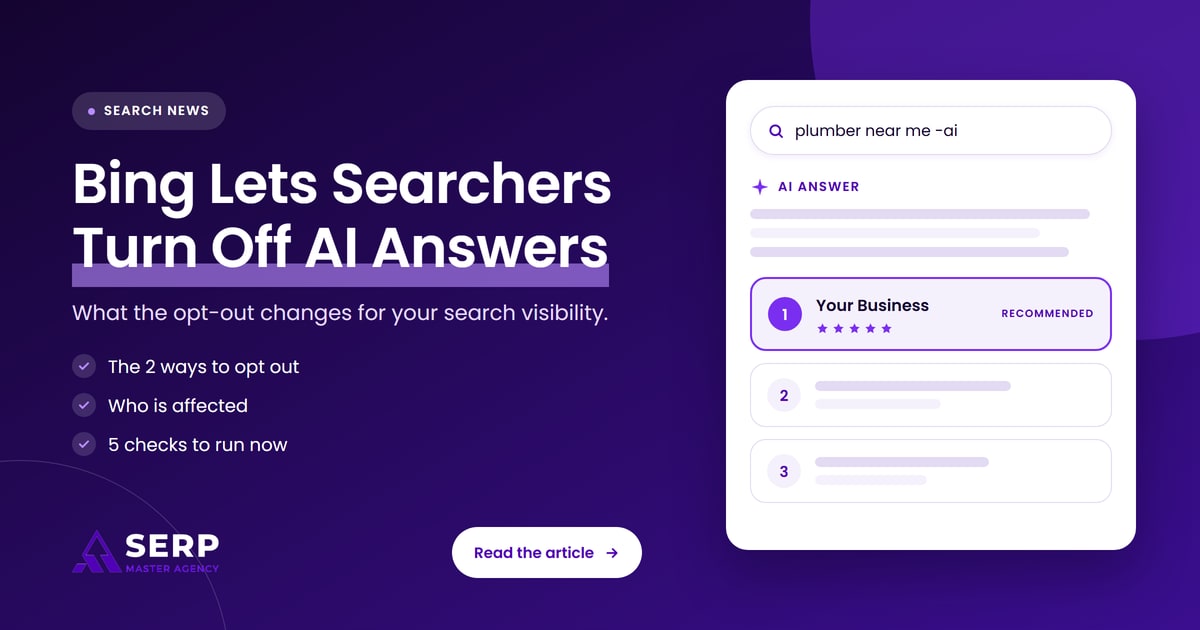

Quick answer: Microsoft confirmed on November 11, 2026 that Bing searchers can turn off AI answers in 2 ways: the Microsoft Bing AI Search Choice browser extension, or by adding “-ai” to a query. Searchers who opt out see traditional search results and links, so classic rankings, titles and snippets matter more for them, while AI citations still matter for everyone else.
Key takeaways
- Microsoft’s Bing Search Blog documented 2 ways to turn off AI answers on November 11, 2026: a browser extension for Google Chrome and Microsoft Edge, and the “-ai” operator.
- Both methods were first shown in June 2026, and Bing is now also testing a Web Mode tab that shows only web page results.
- Bing held 4.8% of worldwide search and 18.8% of US desktop search in October 2026, according to StatCounter. Microsoft has not said how many people switch AI answers off.
- AI summaries reduce clicks: Pew Research Center found people clicked a traditional result in 8% of visits with an AI summary and 15% without one.
- Bing-heavy audiences, Microsoft Advertising buyers and local businesses are the groups most likely to notice a difference.
- Owners should check Bing Webmaster Tools, test their main queries with and without “-ai”, and keep both classic rankings and AI citations in their SEO plan.
What did Microsoft announce about AI answers in Bing?
Microsoft announced that Bing users can turn off AI answers in their searches, in a Bing Search Blog post titled “Your choice: Turn AI answers on or off in Bing” on November 11, 2026. The post names 2 methods: the Microsoft Bing AI Search Choice browser extension, which is still in preview, and the “-ai” operator added to any Bing query.
The methods themselves are not brand new. Search Engine Roundtable first reported the “-ai” operator and the extension on June 8, 2026, and PPC Land dates the first announcement to a LinkedIn post by Microsoft’s Jordi Ribas in June 2026. The November post is Microsoft’s official documentation of both, and it arrived after Bing had removed a 2024 search setting that switched off Copilot answers on the results page, as Search Engine Roundtable noted on November 12, 2026.
Microsoft’s Jordi Ribas explained the reasoning when he shared the 2 methods on X.
“we believe everyone deserves a search experience that works for them”
Jordi Ribas (@JordiRib1) on X, November 11, 2026 (source)
A third change is in testing. Search Engine Roundtable reported on November 16, 2026 that Bing is testing a Web Mode tab that shows only web page results and removes Copilot answers, much like the Web filter Google launched in May 2024.
How do the 2 ways to turn off AI answers in Bing work?
The 2 ways to turn off AI answers in Bing work at different levels: the extension switches AI-generated answers off for every Bing search in the browser, while the “-ai” operator removes them from one query at a time. Both leave searchers with traditional search results and links.
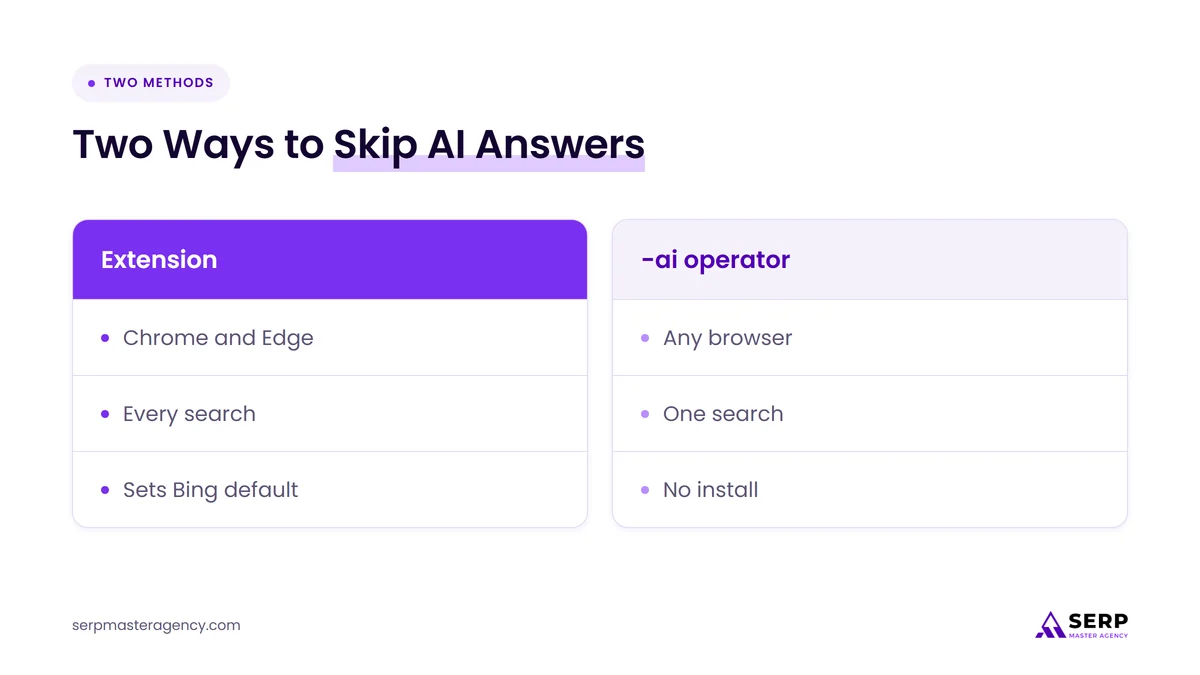
The 2 opt-out methods and what each one changes are listed below.
- Microsoft Bing AI Search Choice extension: a preview browser extension for Google Chrome and Microsoft Edge with a simple toggle for AI answers across all Bing searches. Installing it also sets Bing as the default search engine, which PPC Land flagged on November 12, 2026 as a catch for Chrome users.
- The -ai operator: a searcher types “-ai” after any Bing query, such as Microsoft’s example “why is the sky blue -ai”, and gets results without AI-generated answers. It needs no install and no account.
Neither method is a permanent account setting, and both take a deliberate step by the searcher. That is why this news changes search visibility for a slice of Bing users rather than for every Bing user, and why Bing work belongs in a complete plan for SEO services rather than in a panic fix.
How many searchers can turn off AI answers in Bing?
Every Bing searcher can turn off AI answers, and Bing handled 4.8% of worldwide searches in October 2026, against 91.05% for Google, according to StatCounter. Microsoft has not published how many people use the extension or the “-ai” operator.
Bing’s reach is larger on desktop computers in the United States, where StatCounter measured an 18.8% share of search in October 2026. A business that sells to office workers, other businesses or older desktop users can get a meaningful share of its search traffic from Bing, and those are the searchers who now have a documented way to skip Copilot answers.
Early adoption looks small. PPC Land reported that the Chrome version of the extension showed 6 users when it was first listed in June 2026. The “-ai” operator leaves no public count at all, so the honest answer is that the opt-out audience is unknown, and owners should judge the change by their own Bing data rather than by headlines.
How do AI answers change clicks to business websites?
AI answers reduce clicks to business websites: people clicked a traditional search result in 8% of visits when an AI summary appeared, compared with 15% of visits without one, in a Pew Research Center study published on July 22, 2025. Turning off AI answers removes that summary layer for the searchers who opt out.
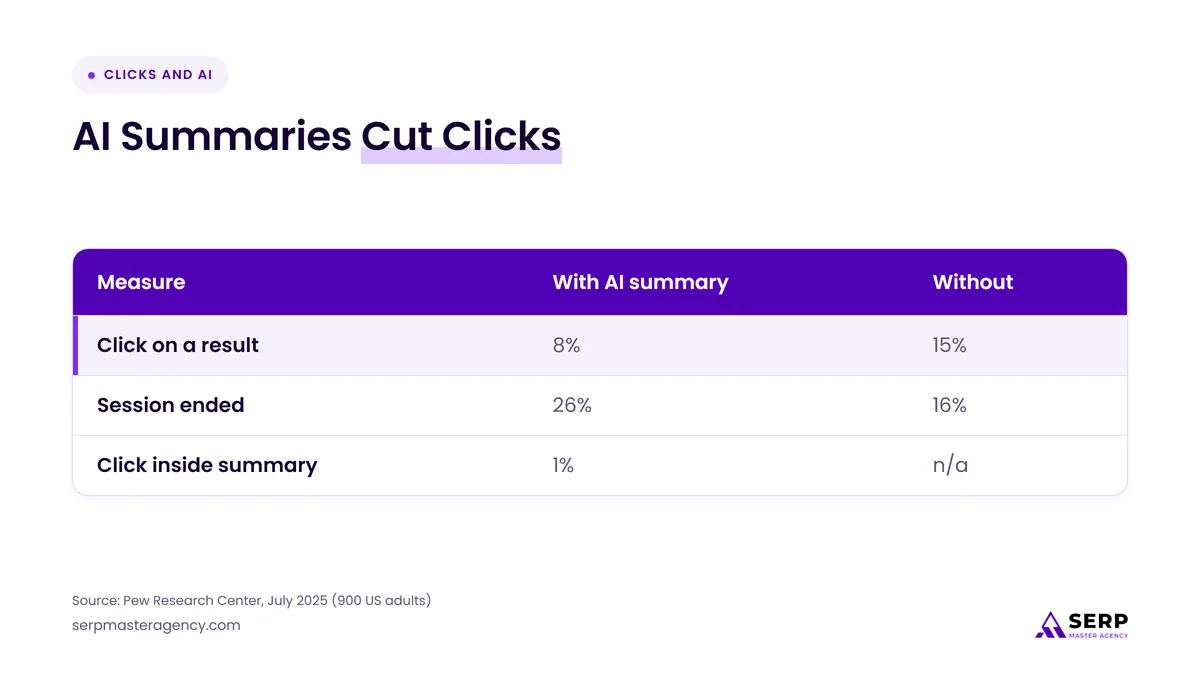
The Pew study tracked the browsing of 900 US adults in March 2025 across 68,879 Google searches, and 18% of those searches produced an AI summary. The figures below combine Pew’s click data with StatCounter’s October 2026 search share data.
| Measure | Number | Source and date |
|---|---|---|
| Visits with a click on a traditional result, AI summary shown | 8% | Pew Research Center, July 2025 |
| Visits with a click on a traditional result, no AI summary | 15% | Pew Research Center, July 2025 |
| Visits with a click on a link inside the AI summary | 1% | Pew Research Center, July 2025 |
| Search pages where the browsing session ended, AI summary shown | 26% | Pew Research Center, July 2025 |
| Search pages where the browsing session ended, no AI summary | 16% | Pew Research Center, July 2025 |
| Bing share of worldwide search | 4.8% | StatCounter, October 2026 |
| Bing share of US desktop search | 18.8% | StatCounter, October 2026 |
The table shows that an AI summary roughly halves organic clicks to traditional results, and that very few people click the sources inside the summary. Pew measured Google, not Bing, so the figures are a guide to how AI answers behave in general, not a forecast for Bing. Being cited still matters, which is why our guide on how AI Overviews choose which businesses to cite applies to Copilot answers too.
Which businesses are affected when searchers turn off AI answers?
Businesses with a large Bing audience, Microsoft Advertising buyers and local businesses are the most affected when searchers turn off AI answers, because their customers are the ones who will see classic Bing results instead of Copilot answers. For most other businesses, Bing is a small share of search and the effect is modest.
The 4 groups that should pay attention are listed below.
- Businesses with a desktop or B2B audience: Bing’s 18.8% share of US desktop search in October 2026 means these businesses get more Bing visitors, and more of them can opt out of AI answers.
- Microsoft Advertising buyers: Microsoft has not said whether ads change when AI answers are off. PPC Land reported that earlier Microsoft research found ads in Copilot had a 73% higher click-through rate than traditional search ads, so advertisers should watch for shifts in placement.
- Local service businesses: a searcher who opts out sees the classic Bing results page, so a complete Bing Places for Business listing and a strong local ranking carry more weight for that searcher.
- Content-led businesses: sites that earn leads from guides and articles get the traditional search results back for opted-out searchers, where a good title and snippet win the click.
Advertisers also face the separate change we covered when Bing AI Mode started showing ads above its answers. The two updates pull in different directions: one adds ads inside AI answers, and the other lets searchers skip AI answers altogether.
What should business owners do now about AI answers in Bing?
Business owners should check how they appear in Bing both with and without AI answers, and keep working on classic rankings and AI citations at the same time. The checks take about an hour and use free Microsoft tools.
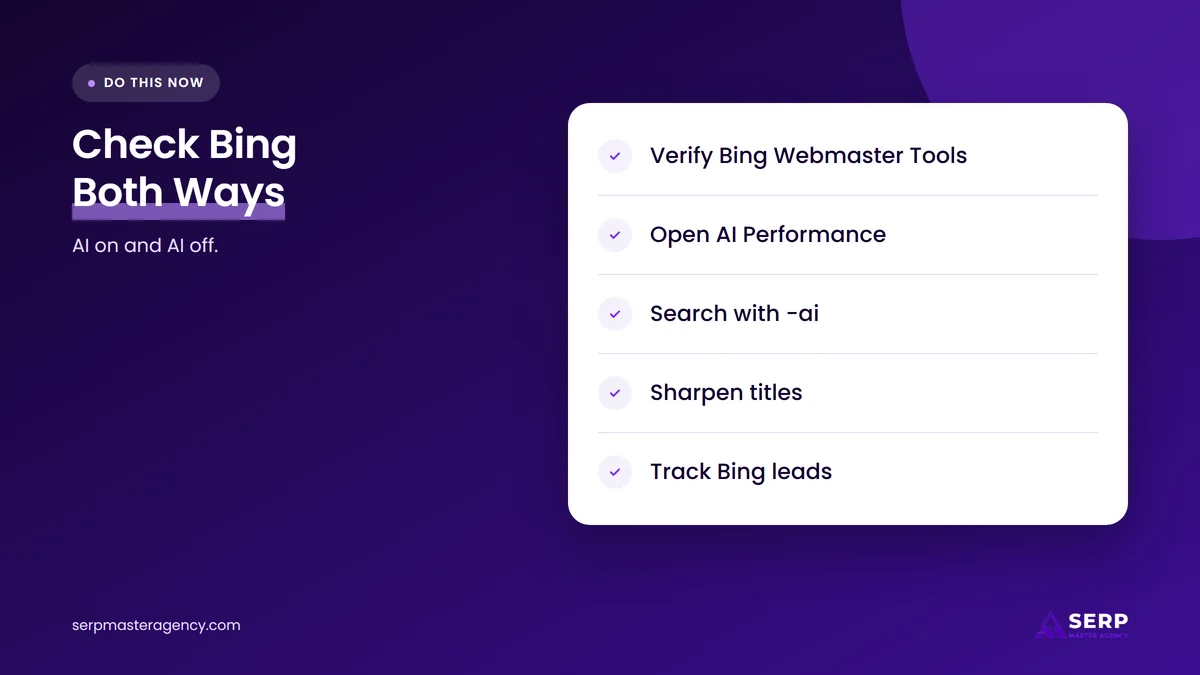
The 5 steps to protect your search visibility in Bing are listed below in order.
- Verify your site in Bing Webmaster Tools. Bing Webmaster Tools is free and shows the queries, impressions and clicks your site gets from Bing search.
- Open the AI Performance report. Microsoft launched the AI Performance report in public preview on February 10, 2026. It shows total citations, average cited pages and grounding queries in Copilot and Bing AI summaries, but it does not show clicks.
- Search your top 10 queries twice. Run each query normally and again with “-ai”, then note where your business appears in Copilot answers and where it ranks in the traditional search results.
- Improve titles and snippets for the classic results. Rewrite page titles and meta descriptions that don’t name the service, the place and the reason to click, because opted-out searchers choose from links alone.
- Track leads from Bing separately. Set up Bing as its own source in Google Analytics 4 and your call tracking, and compare leads month by month rather than raw visits.
Businesses that sell overseas or depend on more than one search engine can follow our guide to optimising for Bing, Naver, Baidu and Yandex for the wider Bing checklist.
Does turning off AI answers make AI search optimization less important?
No, turning off AI answers does not make AI search optimization less important, because the opt-out takes a deliberate step and most searchers keep AI answers on by default. Copilot answers, Google AI Overviews and ChatGPT still shape which businesses people shortlist.
The change does mean a business needs both layers to work. Classic SEO wins the searcher who types “-ai” or uses Web Mode, and AI search optimization wins the searcher who reads Copilot answers. Our comparison of SEO vs AEO vs GEO explains how to split effort between the two.
Frequently asked questions
Is the -ai operator in Bing new?
No, the -ai operator in Bing is not new: Search Engine Roundtable first reported it on June 8, 2026. Microsoft’s November 11, 2026 blog post documented it officially for the first time, alongside the extension, so more searchers now know they can turn off AI answers.
Does Google have a way to skip AI Overviews?
Yes, Google has a way to skip AI Overviews: its Web filter, launched in May 2024, shows only web page links. Bing’s Web Mode test, reported by Search Engine Roundtable on November 16, 2026, works in a similar way and also removes AI answers from the results.
Does the Bing AI Search Choice extension work in Firefox?
No, the Microsoft Bing AI Search Choice extension is listed for Google Chrome and Microsoft Edge only. Microsoft has not said whether it will release a version for Firefox or other browsers, so Firefox users can use the “-ai” operator to skip AI answers instead.
Does the extension change my default search engine?
Yes, installing the Microsoft Bing AI Search Choice extension sets Bing as your default search engine. Microsoft states this in its November 11, 2026 post, and PPC Land reported in June 2026 that the toggle for AI answers and the default change could not be separated.
Will Bing ads still show when AI answers are off?
Microsoft has not said whether Bing ads change when AI answers are off. Its November 11, 2026 post does not mention ads, so Microsoft Advertising buyers should compare their impression and click data for the weeks before and after the announcement.
What does Bing’s AI answers opt-out mean for your business?
Bing’s AI answers opt-out means a business has to be visible in 2 versions of Bing: the Copilot version most people see, and the classic results page that opted-out searchers get. With Bing at 4.8% of worldwide search and 18.8% of US desktop search in October 2026, the change is worth an hour of checks, not a new strategy.
If you want both classic rankings and AI citations handled for you, our SEO services for small businesses cover Bing, Google and AI search together, and you can see how SERP Master Agency works with business owners in the US, UK, Canada, Australia and New Zealand.
Want your business found with AI answers on or off?
SERP Master Agency checks how your business shows up in Bing, Google and AI answers, then fixes the pages, listings and tracking that cost you leads. Tell us about your business and the areas you serve, and we’ll show you where the quickest gains are.
Sources
- Bing Search Blog (Microsoft), “Your choice: Turn AI answers on or off in Bing”, November 11, 2026. https://blogs.bing.com/search/2026/11/your-choice-turn-ai-answers-on-or-off-in-bing/
- Search Engine Roundtable, “Bing Touts Two Methods To Turn Off AI In Search But It’s Not A Search Setting”, November 12, 2026. https://www.seroundtable.com/bing-turn-off-ai-search-setting-42520.html
- Search Engine Roundtable, “Bing Tests Web Mode Tab To Show Only Web Page Results”, November 16, 2026. https://www.seroundtable.com/bing-web-mode-42535.html
- Search Engine Roundtable, “Bing Gives Searchers A Way To Disable AI Copilot Answers”, June 8, 2026. https://www.seroundtable.com/bing-minus-ai-41459.html
- PPC Land, “Bing’s AI-off switch for Chrome also makes Bing the default search engine”, November 12, 2026. https://ppc.land/bings-ai-off-switch-for-chrome-also-makes-bing-the-default-search-engine/
- StatCounter Global Stats, “Search Engine Market Share Worldwide”, October 2026. https://gs.statcounter.com/search-engine-market-share
- StatCounter Global Stats, “Desktop Search Engine Market Share United States Of America”, October 2026. https://gs.statcounter.com/search-engine-market-share/desktop/united-states-of-america
- Pew Research Center, “Google users are less likely to click on links when an AI summary appears in the results”, July 22, 2025. https://www.pewresearch.org/short-reads/2025/07/22/google-users-are-less-likely-to-click-on-links-when-an-ai-summary-appears-in-the-results/
- Bing Webmaster Blog, “Introducing AI Performance in Bing Webmaster Tools Public Preview”, February 10, 2026. https://blogs.bing.com/webmaster/February-2026/Introducing-AI-Performance-in-Bing-Webmaster-Tools-Public-Preview
- Jordi Ribas (@JordiRib1), post on X, November 11, 2026. https://x.com/JordiRib1/status/2120638041882517867

Suraj Rana is a highly regarded SEO expert specializing in the dental industry. His expertise lies in crafting strategic SEO marketing plans to help new or expanding businesses increase their online visibility and attract more customers. Suraj Rana’s skills extend to improving website rankings and boosting organic search visibility, thereby enhancing web traffic and return on investment for businesses.