Quick answer: A restaurant gets found in Google Maps by matching Google’s three local ranking factors, relevance, distance and prominence: the right primary category, accurate opening hours, a complete menu and a steady flow of reviews in its Google Business Profile. It gets found in AI recommendations by keeping those facts consistent and readable as text across its website and listings.
Key takeaways
- Restaurant SEO covers three places diners look: Google Maps and the local pack, organic results and AI recommendations.
- Google ranks local results on relevance, distance and prominence. In Whitespark’s 2026 survey of 47 local SEO experts, the primary Google Business Profile category scored 227, the top score among the 187 factors listed.
- A restaurant should pick the most specific primary category that fits and the fewest categories that describe its core business.
- A complete Google Business Profile needs the real business name, a correct map pin, real opening hours and a full menu.
- Reviews decide who gets the booking: 97% of US consumers read reviews and 47% won’t use a business with fewer than 20 (BrightLocal, 2026).
- For AI recommendations, 45% of US consumers used AI tools for local recommendations in 2026, up from 6% a year earlier, and Google says no special optimization is needed beyond good, readable pages.
What is SEO for restaurants?
SEO for restaurants is the work of making a restaurant appear when nearby diners search Google, Google Maps or an AI tool for somewhere to eat. It covers the Google Business Profile, the menu, reviews, the restaurant’s website and its business listings, all aimed at turning searches into calls, direction requests and table bookings.
A restaurant has three places to win, and each one draws on the same public facts about the business. Our restaurant SEO services are built around the 3 search surfaces listed below.
- Google Maps and the local pack: the map with 3 restaurants that appears for “restaurants near me”, “Italian restaurant near me” and “brunch near me”. Most last-minute dining decisions start here.
- Organic results: the regular blue links, where a restaurant’s own online menu, private dining page or catering page can rank.
- AI recommendations: answers in AI Overviews and AI Mode in Google, and in tools such as ChatGPT, that name a few restaurants for a question like “where should we eat for a birthday dinner”.
Restaurant searches also differ by timing. A diner searching “restaurants near me” at 6 p.m. wants one open now. A diner planning an anniversary compares reviews, menus and photos days ahead. Good restaurant SEO plans for both.
How does Google rank restaurants in Google Maps searches?
Google ranks restaurants in Google Maps searches using three factors: relevance, distance and prominence. Google Business Profile Help defines relevance as how well a Business Profile matches what someone is searching for, distance as how far each business is from the searcher, and prominence as how well known a business is.
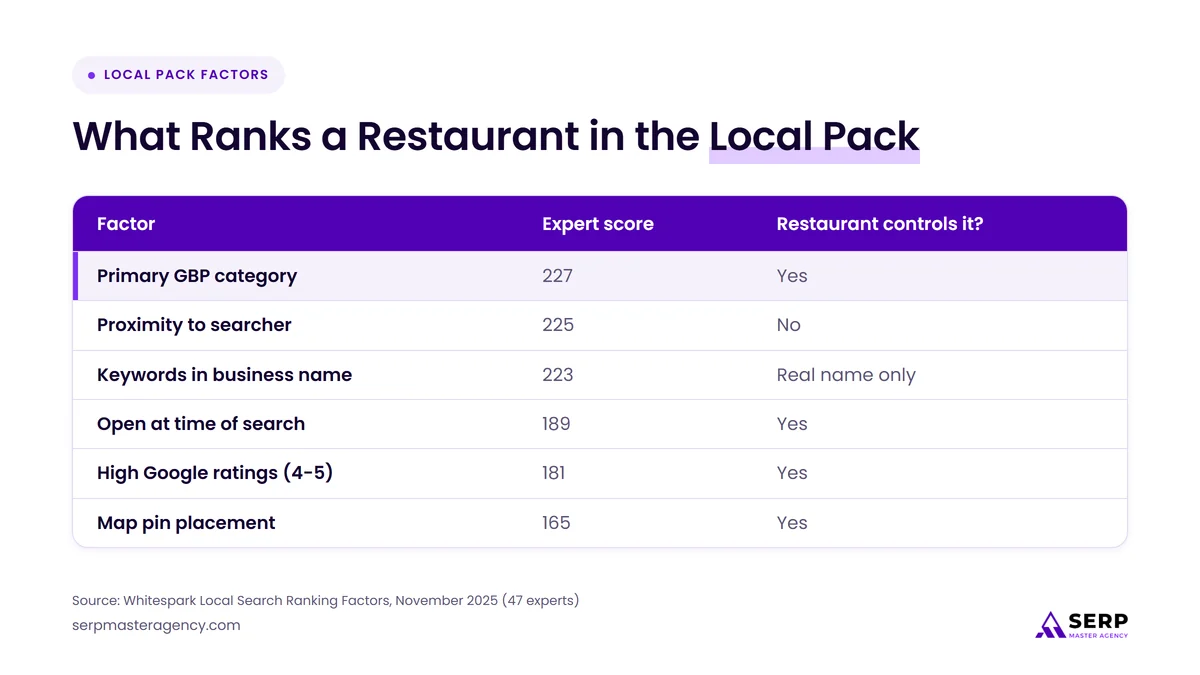
Whitespark’s Local Search Ranking Factors report, published on November 6, 2025, asked 47 local SEO experts to score 187 factors. The report covers local businesses in general, not restaurants only. The highest-scoring local pack factors, and what a restaurant controls for each one, are shown in the table below.
| Local pack factor | Whitespark 2026 score | What a restaurant controls |
|---|---|---|
| Primary Google Business Profile category | 227 | Choose the most specific cuisine or venue category that fits |
| Proximity of address to the searcher | 225 | Nothing directly. The diner’s location is fixed, so the other factors decide who wins. |
| Keywords in the business name | 223 | Only the real-world name. Google does not permit added keywords or taglines. |
| Open at the time of search | 189 | Enter real opening hours and holiday hours |
| High Google ratings (4 to 5 stars) | 181 | Ask every diner for a review and reply to each one |
| Additional Google Business Profile categories | 173 | Add a second category only for a real line of business |
| Quantity of native Google reviews with text | 170 | Build a steady monthly flow of written reviews |
| Proper placement of the map pin | 165 | Place the pin on the restaurant entrance |
The table shows that 6 of the top 8 local pack factors sit inside the Google Business Profile. The scores are expert opinions, not figures Google publishes, but they agree with Google’s own advice. Google also states that there is no way to request or pay for a better local ranking.
Which Google Business Profile category should a restaurant choose?
A restaurant should choose the most specific primary category that fits its core business, such as a cuisine-specific restaurant category, and use the fewest categories that describe it. Google’s guidelines say to choose the fewest number of categories it takes to describe the overall core business, and to pick categories that complete “This business IS a”.
Google’s own restaurant examples show how the rule works. A pizza place with no dine-in should use Pizza Delivery and Pizza Takeout, not Delivery Restaurant or Takeout Restaurant. A burger chain that also sells desserts should use Fast Food Restaurant and Hamburger Restaurant, not Dessert Restaurant. The category rules for a restaurant are listed below.
- Pick the most specific primary category that fits: Google says to use the most specific category available, and a more general one only when no specific one fits.
- Add a secondary category only for a real line of business: a restaurant that runs a full bar every night can add it, but a dessert on the menu is not a category.
- Leave out categories for things the restaurant has: a patio, live music or a kids menu are attributes, not categories.
- Give a restaurant inside a hotel its own profile: Google says a restaurant or bar in a hotel should not share the hotel’s profile.
How should a restaurant set up its Google Business Profile?
A restaurant should set up its Google Business Profile with the real business name, the correct address and map pin, real opening hours, a complete menu and photos of the food and the room. These details feed relevance and prominence, and they are what diners check before they walk in or book.
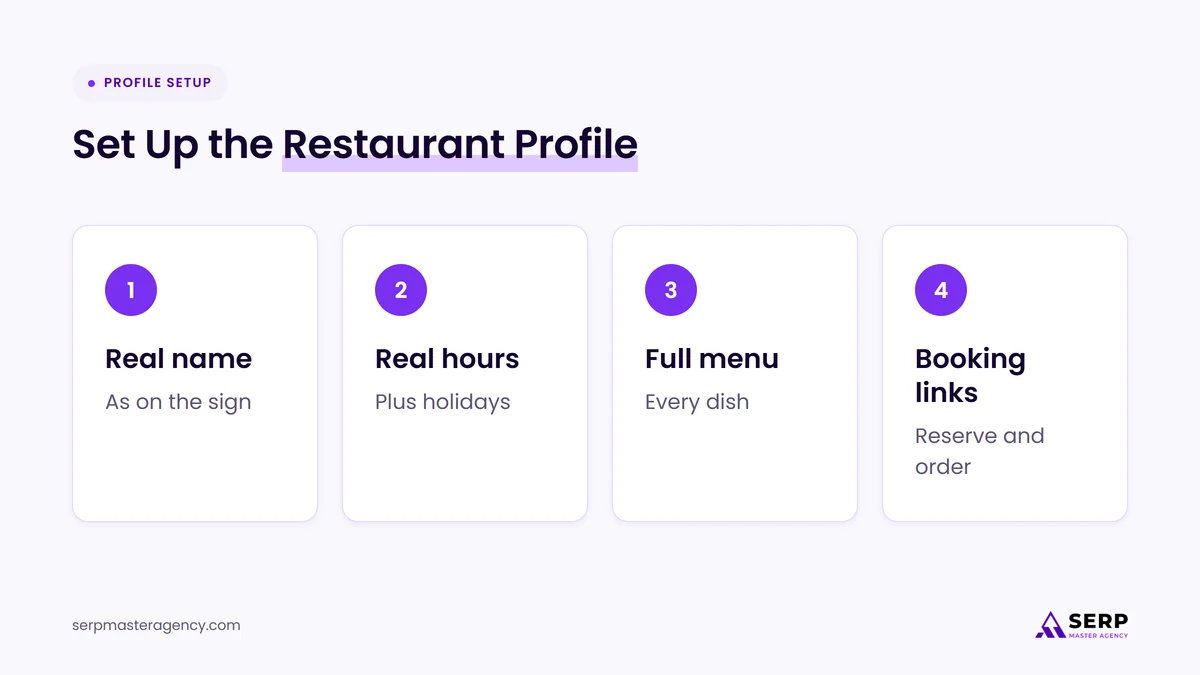
The setup steps for a restaurant’s Google Business Profile are listed below in order.
- Use the real business name. Google says the name should reflect the real-world name on the storefront, without taglines, hours, phone numbers or descriptions. Leave out extras such as “Best Pizza” or the city.
- Check the address and the map pin. Place the pin on the restaurant entrance so Google Maps directions lead diners to the right door.
- Enter real opening hours. Google says restaurants should use dine-in hours if diners can sit down, and takeout hours if they can’t. Add special hours for holidays and events.
- Add the full menu. Google says a menu must list the complete set of food and drink items, and a list of only popular items isn’t allowed. A restaurant can build meal-specific menus for breakfast, lunch and dinner.
- Connect reservation and ordering links. Google lists Reserve with Google for booking a table or joining a waitlist, and online ordering for takeout and delivery in Australia, Canada, Germany, Japan, the UK and the US. Check which options your Business Profile dashboard shows for your country.
- Upload real photos. Add pictures of the best dishes, the menu, the dining room and the entrance, and respond to reviews and questions during opening hours.
Google also says menu URLs can’t link directly to third-party ordering or delivery services, so point the menu link at the restaurant’s own online menu. Our guide on the Google Business Profile optimization checklist explains each profile field in more depth.
How do reviews affect a restaurant’s map ranking?
Reviews affect a restaurant’s map ranking through prominence: Google says prominence also considers how many reviews a business has, and that more reviews and positive ratings can help its local ranking. Reviews also decide which restaurant gets the booking, because diners compare ratings in the local pack before they choose.
BrightLocal’s Local Consumer Review Survey 2026, published on February 11, 2026, surveyed 1,002 US adults. It found that 97% of consumers read reviews for local businesses, 74% look for reviews written in the last 3 months, 68% will only use a business with 4 or more stars, up from 55% in 2025, and 47% won’t use a business with fewer than 20 reviews. The survey has no restaurant-only figures, so treat these as a guide for local businesses in general. The review habits that help a restaurant most are listed below.
- Ask every diner for a review after the meal: send a text or email with the review link the same evening, while the visit is fresh.
- Reply to every review: thank the diner, mention the dish if it fits, and answer complaints calmly with a way to follow up offline.
- Keep reviews coming every month: 74% of consumers look for reviews from the last 3 months, so a steady flow matters more than an old batch.
- Aim past the 20-review line first: a restaurant with fewer than 20 reviews loses the 47% of consumers who won’t consider it.
Our article on local SEO covers review strategy in more detail.
Which website pages does a restaurant need?
A restaurant needs a home page, an online menu as text on the page, a contact page with the address, map and opening hours, and a page for each extra service such as private dining or catering. Pages that state the same facts as the Google Business Profile give both Google and AI tools one consistent answer.
The page types that support a restaurant’s rankings are listed below.
- Online menu page: the full menu as HTML text, not only a PDF or a photo, so Google and AI tools can read each dish and price.
- Contact and location page: the name, address and phone, opening hours, parking and directions from main roads.
- Private dining and catering pages: one page for each service the restaurant really offers, with capacity, menu options and a booking or enquiry form. Whitespark’s experts scored a dedicated page for each service at 170 for AI search visibility.
- Reservation link: a clear booking button on every page, matching the link on the Business Profile.
Add Restaurant structured data to the home and contact pages. Google’s LocalBusiness documentation recommends the properties servesCuisine, menu, openingHoursSpecification and priceRange, and says to use the most specific subtype, with Restaurant as its example. Keep the markup identical to the visible text. Our technical SEO audit checklist shows how to add it.
How do restaurants show up in AI recommendations?
Restaurants show up in AI recommendations the same way they show up in regular search: with indexed pages, an accurate Google Business Profile, strong reviews and mentions on trusted sites. Google Search Central states that there are no additional requirements to appear in AI Overviews or AI Mode, nor other special optimizations necessary.
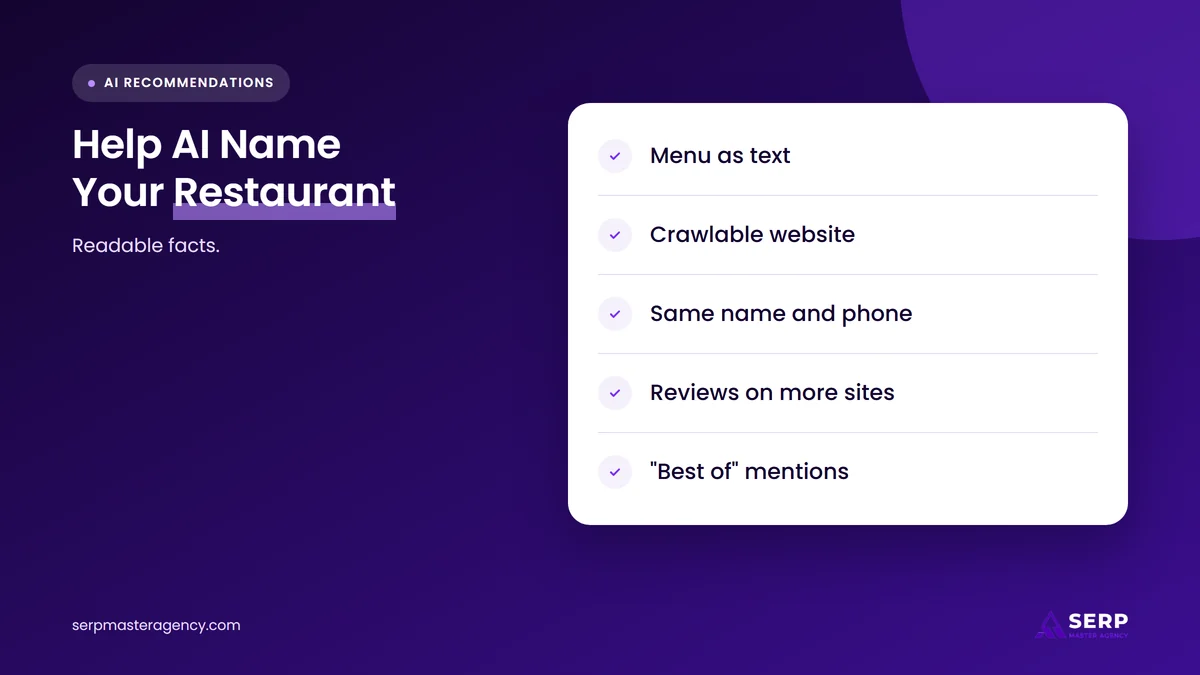
AI recommendations matter for restaurants because diners now use them. BrightLocal’s 2026 survey found that 45% of US consumers used ChatGPT and other AI tools for local recommendations, up from 6% a year earlier. Whitespark’s 2026 experts scored presence on expert-curated “best of” lists at 179 for AI search visibility and the authority of third-party sites that carry reviews at 156. The AI recommendations checklist for a restaurant is listed below.
- Make the menu readable as text: Google says important content should be available in textual form.
- Allow crawling: Google says pages must be indexed and eligible to appear in Search with a snippet, so check robots.txt does not block the site.
- Keep name, address and phone identical: use the same details on the website, Google Business Profile, Apple Maps and Yelp.
- Collect reviews on more than one site: Google reviews matter most for the local pack, and third-party review sites feed AI tools.
- Earn “best of” mentions: local food writers, city guides and event listings that name the restaurant.
Our guide on how to get your business recommended by ChatGPT covers the AI side in more depth.
How should a restaurant measure SEO results?
A restaurant should measure SEO results by calls, direction requests, website clicks and bookings, not by map rankings alone. The Google Business Profile performance report shows calls, direction requests and website clicks each month, and Google Search Console shows which searches bring visitors to the website.
The numbers worth reviewing every month are listed below.
- Calls and direction requests from the profile: the clearest sign that “restaurants near me” visibility turns into diners.
- Reservation clicks: how many diners tap the booking link from the profile and the website.
- Search queries in Google Search Console: which menu, private dining or catering page ranks, and for which searches.
- Bookings by source: ask “How did you find us?” at booking and record the answer.
Google’s Ask Maps feature is changing how diners ask for places and appointments. We cover it in Google’s Ask Maps now calls businesses to find appointments.
Frequently asked questions
Can a restaurant pay Google to rank higher on the map?
No, a restaurant can’t pay Google to rank higher in the free local results. Google Business Profile Help states there is no way to request or pay for a better local ranking. Paid ads can appear above the map, but they are separate from the organic local pack.
Can I add “pizza” or my city to my restaurant name on Google?
No, you can’t add “pizza” or your city to your business name on Google unless it is part of your real-world name. Google says the name should reflect the real-world name on the storefront, without taglines or descriptions. Put the cuisine in the category and the city in the address.
Does a restaurant need a website if it has a Google Business Profile?
Yes, a restaurant benefits from a website even with a Google Business Profile, because the website gives Google and AI tools a text menu, hours and location to match against the profile. Google’s structured data guidance says markup should match the visible text on the page.
Should a restaurant menu be a PDF?
No, a restaurant menu should not be only a PDF. Google recommends making sure that important content is available in textual form, so publish the full menu as text on a page and offer the PDF as an extra download.
Can a restaurant link its menu to a delivery app?
No, a restaurant can’t point its Business Profile menu URL straight at a third-party ordering or delivery service. Google’s guidelines say menu URLs can’t link directly to those services. Link to the restaurant’s own online menu and set ordering partners separately where Google offers it.
What should a restaurant do first?
A restaurant should first fix its Google Business Profile: the right primary category, the real business name, a correct map pin, real opening hours and a full menu. Next, build a steady review routine and a text menu page. Then keep name, address and phone consistent everywhere and track calls and direction requests monthly.
Our restaurant SEO work sits within the wider SEO services offered by SERP Master Agency.
Want more diners from restaurants near me searches?
SERP Master Agency helps restaurants fix their Google Business Profile, publish a readable online menu and track the calls and direction requests that come from search. Tell us about your restaurant and the area you serve, and we’ll show you where the quickest gains are.
Sources
- Google Business Profile Help, “Tips to improve your local ranking on Google”, accessed November 19, 2026. https://support.google.com/business/answer/7091
- Google Business Profile Help, “Guidelines for representing your business on Google”, accessed November 19, 2026. https://support.google.com/business/answer/3038177
- Google Business Profile, “Business Profile for restaurants”, accessed November 19, 2026. https://business.google.com/us/business-profile/restaurants/
- Google Search Central, “Local business structured data”, accessed November 19, 2026. https://developers.google.com/search/docs/appearance/structured-data/local-business
- Google Search Central, “AI features and your website”, accessed November 19, 2026. https://developers.google.com/search/docs/appearance/ai-features
- Whitespark, “Local Search Ranking Factors”, November 6, 2025. https://whitespark.ca/local-search-ranking-factors/
- BrightLocal, “Local Consumer Review Survey 2026: Star Ratings Keep Rising, Old Reviews Don’t Cut It”, February 11, 2026. https://www.brightlocal.com/research/local-consumer-review-survey/

Suraj Rana is the founder of SERP Master Agency and Dental Master Media, based in Chandigarh, India. He has worked in SEO for over 9 years, helping local businesses, clinics, ecommerce stores and marketing agencies win more calls, leads and sales from Google and AI search. His team delivers SEO services, Google Business Profile optimisation, paid ads and white-label SEO for agencies. Every SERP Master guide is written to give business owners a plain-English answer: what to fix first, what it costs and what results to expect.