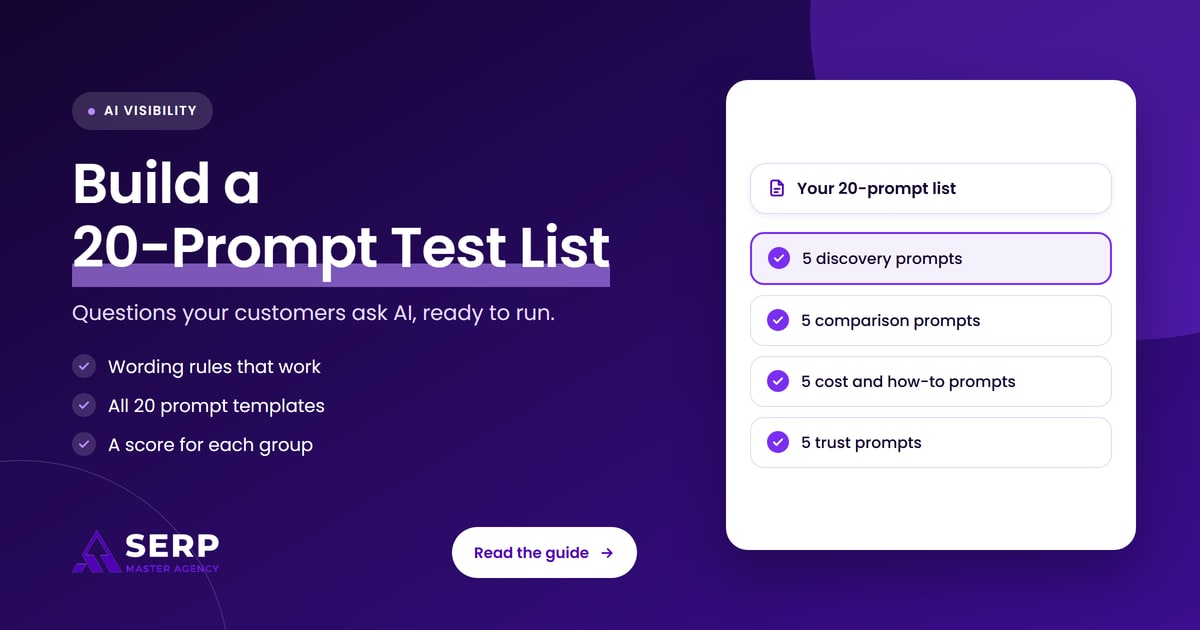
Quick answer: A 20-prompt test list is a fixed set of 20 customer questions, written in your buyers’ own words, that you ask ChatGPT, Google AI Mode and Perplexity to see whether they name your business. Build it from 4 groups of 5 prompts: discovery, comparison, cost and how-to, and trust. Keep the wording fixed and repeat it every month.
Key takeaways
- A test list is 20 customer-style prompts in 4 groups of 5, and it never changes in wording between tests.
- SparkToro found that 142 people asking for the same thing wrote prompts with a similarity score of 0.081, so one phrasing cannot represent your customers.
- Semrush measured AI Mode queries at 7.22 words against 4.0 for classic Google Search, so write prompts as full questions.
- Build the list from real customer language: sales calls, emails, reviews and Google Search Console queries.
- The 4 groups are discovery, comparison, cost and how-to, and trust, with 5 prompts each.
- Score each group separately, then change the list only once a quarter.
What is a 20-prompt test list?
A 20-prompt test list is a fixed set of 20 questions that a customer of your business could ask an AI tool, kept in a spreadsheet and asked in the same words every time. The test list lets you compare AI answers from month to month instead of relying on a few ad hoc searches.
The list works for any service business, from plumbers to accountants, and it sits on top of the same foundation as your SEO services: pages that answer customer questions clearly. The list does not contain your business name in most prompts, because customers who do not know you yet cannot ask for you by name.
Why should your test list hold 20 prompts?
Your test list should hold 20 prompts because customers phrase the same need in very different ways, and 4 groups of 5 prompts cover the 4 kinds of question a buyer asks before choosing a provider. The number 20 is our working choice, not a figure from a study, and the data below explains why a short list of 3 or 4 prompts is too thin.
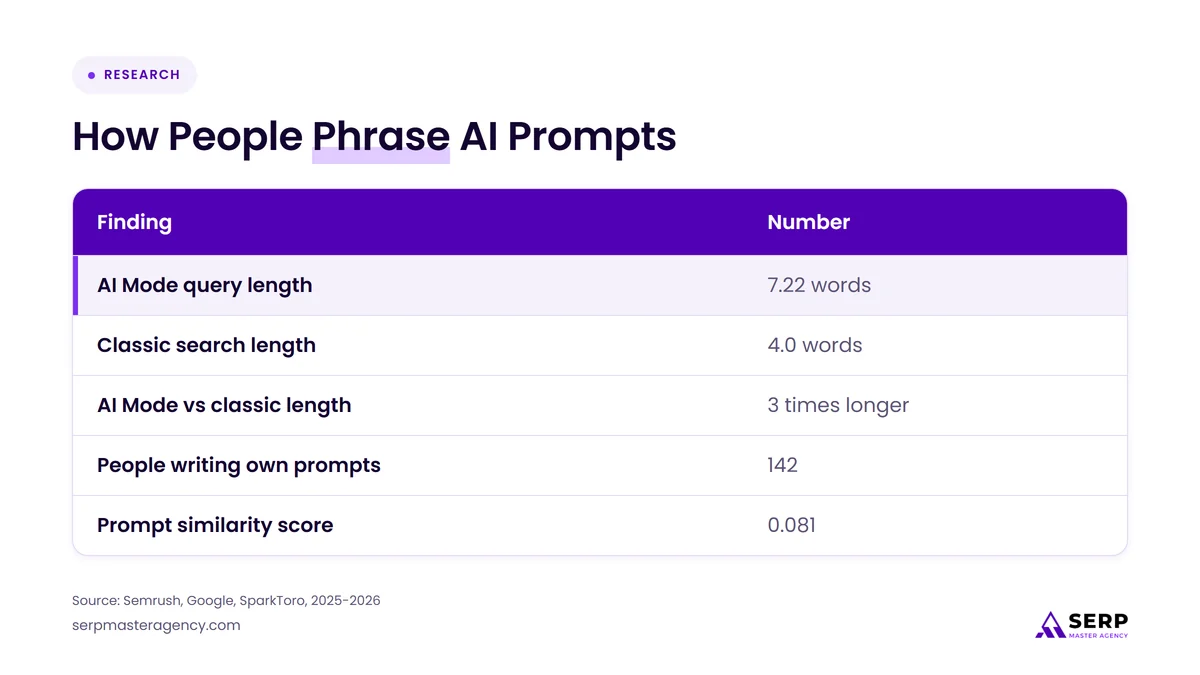
| Finding | Number | Source |
|---|---|---|
| AI Mode query length | 7.22 words | Semrush, Jul 2025 |
| Classic search length | 4.0 words | Semrush, Jul 2025 |
| AI Mode vs classic length | 3 times longer | Google, May 2026 |
| People writing own prompts | 142 | SparkToro, Jan 2026 |
| Prompt similarity score | 0.081 | SparkToro, Jan 2026 |
The table shows that AI prompts are longer than classic searches and that people rarely phrase the same intent alike. Semrush’s figures come from nearly 69 million US desktop sessions between May 1 and July 5, 2025, and SparkToro’s from an experiment reported by Search Engine Journal on January 30, 2026.
Google adds that follow-up queries in AI Mode grew by more than 40% month over month in the US, according to its May 20, 2026 report covered by Search Engine Journal. Buyers do not stop at one question, so a test list needs more than one prompt per need.
How should the prompts in your test list sound?
The prompts in your test list should sound like a full question from a customer, with a service, a place and a reason, and not like a keyword or your own marketing copy. Semrush found AI Mode queries average 7.22 words, so a prompt of 8 to 15 words is realistic.
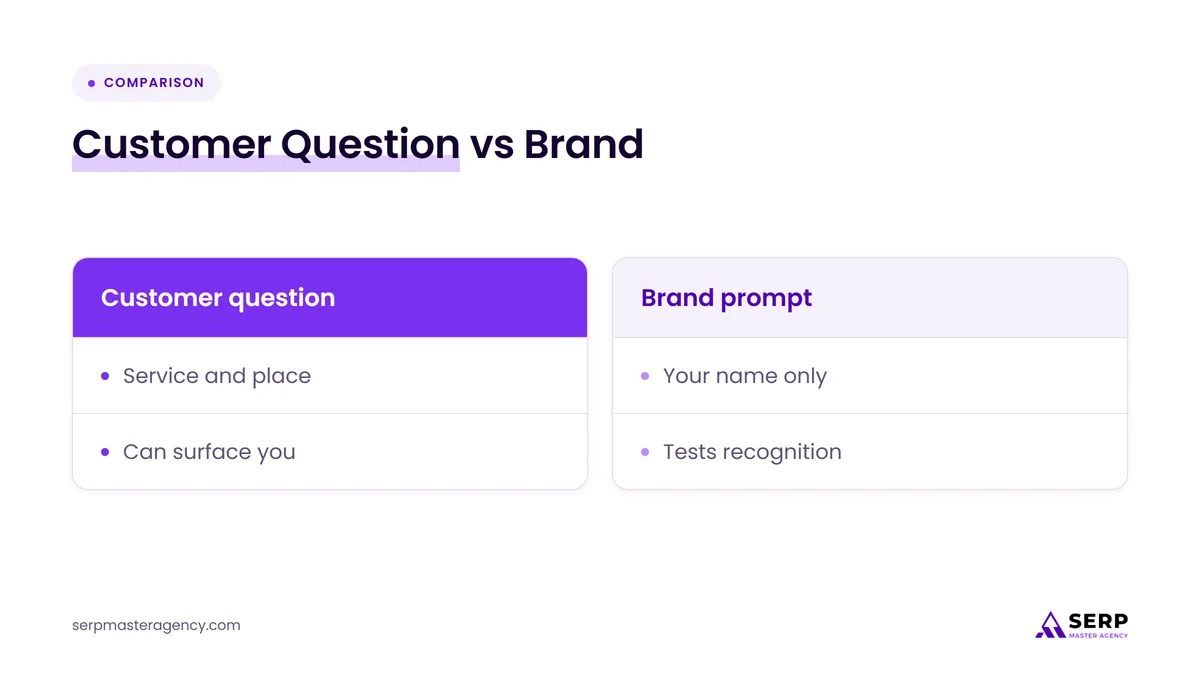
The 5 wording rules below keep each prompt close to real customer questions.
- Write each prompt as a full question a customer would type or say, not a keyword string.
- Name the service and the place in plain words, the way customers say them locally.
- Leave your business name out of 19 of the 20 prompts, so the test shows whether AI tools name you unprompted.
- Add one real detail, such as a customer type, a deadline or a budget range, to about half the prompts.
- Freeze the wording once the test list is final, so each month’s AI answers stay comparable.
Google Search Central says AI Mode is particularly helpful for queries that need further exploration, reasoning or complex comparisons, and that it uses query fan-out, which runs multiple related searches across subtopics. A detailed prompt therefore triggers more searches behind the scenes than a short one.
How do you build your test list in 4 steps?
You build your test list in 4 steps: collect real customer questions, group them by intent, rewrite them as prompts and freeze the final 20. The work takes about 2 hours the first time and gives you a list you reuse every month.
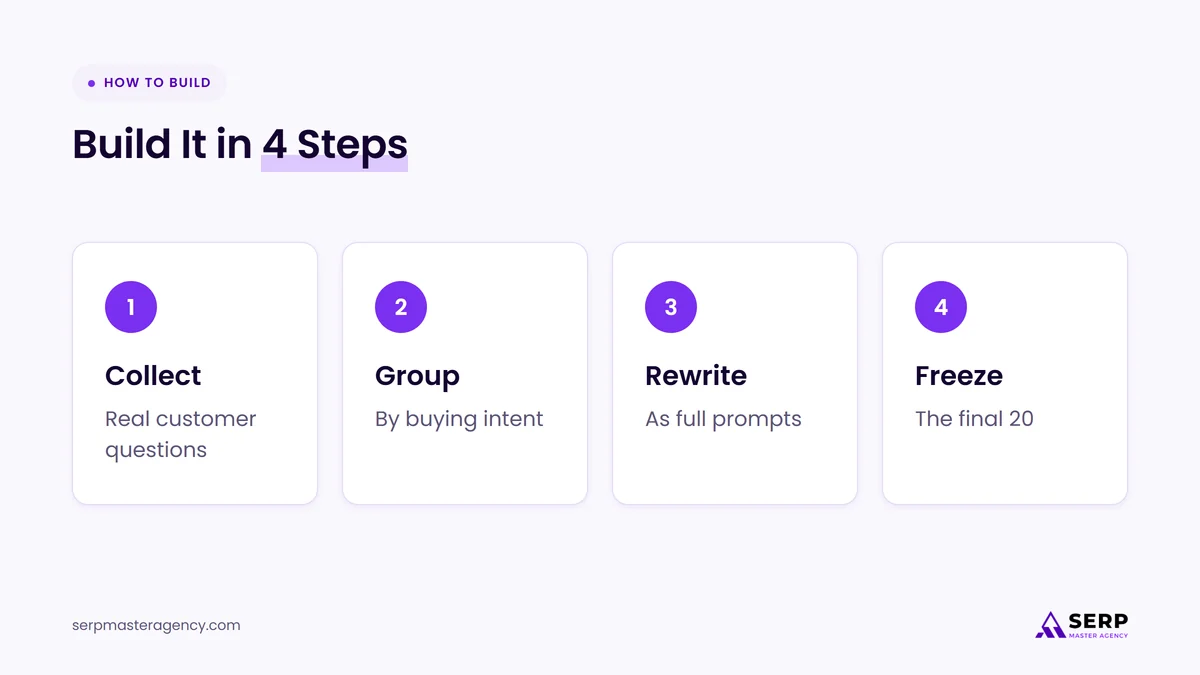
The 4 steps below turn raw customer language into a finished list.
- Collect 30 to 40 real customer questions from sales calls, emails, reviews, chat logs and the queries report in Google Search Console.
- Sort the questions into the 4 groups: discovery, comparison, cost and how-to, and trust.
- Rewrite the 5 strongest questions in each group as full prompts with your service and place.
- Freeze the 20 prompts in one spreadsheet column, with the group name beside each one.
If you have fewer than 30 real questions, fill the gap with the People Also Ask boxes and related searches Google shows for your service, and label those prompts as borrowed so you can replace them when real questions arrive.
Which 20 prompts belong in your test list?
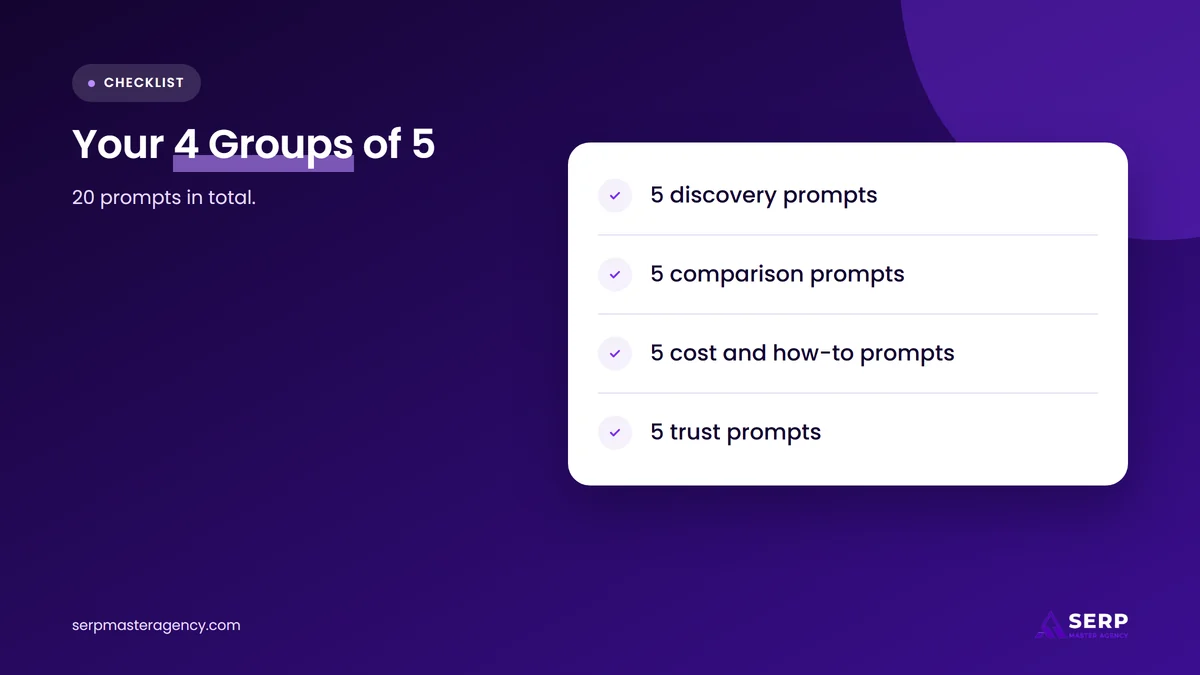
The 20 prompts in your test list are 5 discovery prompts, 5 comparison prompts, 5 cost and how-to prompts and 5 trust prompts, with the brackets replaced by your service, city and customer type. Each group tests a different moment in the buying journey.
5 discovery prompts for your test list
The 5 discovery prompts below test whether AI answers name your business when a buyer starts looking for a [service].
- Ask “Can you recommend a [service] provider in [city]?” to test a plain recommendation request.
- Ask “Who are the top-rated [service] companies near [city]?” to test review-led answers.
- Ask “I need [service] in [city] this week, who should I call?” to test urgent intent.
- Ask “Which [service] business in [city] works with [customer type]?” to test your niche.
- Ask “What are the best [service] options for a [size or budget] business in [region]?” to test a wider area.
5 comparison prompts for your test list
The 5 comparison prompts below test whether AI answers include your business when a buyer weighs options for a [service].
- Ask “Should I hire a [service] company or a freelancer for [customer type]?” to test choice guides.
- Ask “What is the difference between [option A] and [option B] for [service]?” to test your explainer pages.
- Ask “Which is better for [need]: [service type 1] or [service type 2]?” to test comparison pages.
- Ask “What are alternatives to [leading competitor] in [city]?” to test whether you appear beside your competitors.
- Ask “Is [premium service] worth it, or is [basic service] enough?” to test value questions.
5 cost and how-to prompts for your test list
The 5 cost and how-to prompts below test whether AI answers cite your pages when a buyer needs practical detail about a [service].
- Ask “How much does [service] cost in [city]?” to test your pricing information.
- Ask “What affects the price of [service]?” to test cost explainers.
- Ask “How long does [service] take from start to finish?” to test your process page.
- Ask “What should I prepare before I book [service]?” to test your preparation guide.
- Ask “How do I choose a [service] provider?” to test your buyer guide.
5 trust prompts for your test list
The 5 trust prompts below test what AI answers say about risk, quality and problems when a buyer is close to deciding on a [service].
- Ask “What are the warning signs of a bad [service] provider?” to test whether you are framed as the safe choice.
- Ask “What questions should I ask a [service] company before hiring?” to test your checklist content.
- Ask “Does a [service] provider in [city] need a license?” to test your credential and compliance pages.
- Ask “What do customers complain about with [service] providers?” to test how your reviews and policies read.
- Ask “What should I do if [common problem] happens with [service]?” to test your help content.
How do you score your test list by group?
You score your test list by counting, for each of the 4 groups, how many of the 5 prompts named your business in at least 2 of 3 runs. A group score of 0 to 5 shows which stage of the buying journey needs work first.
Group scores are easier to act on than one overall number, because each group points to different pages. A low discovery score points to local and service pages, a low comparison score points to explainer pages, and a low trust score points to review and policy pages. SparkToro’s data shows why you should count appearances across runs: the same brands appeared in 55% to 77% of 994 responses to prompts that looked very different, so repeat appearance is the signal. Also record which competitors appear most often in each group, because they show who AI answers treat as the default choice.
How often should you update your test list?
You should update your test list once a quarter and change at most 4 of the 20 prompts each time. Frozen wording keeps month-to-month AI answers comparable, and a small quarterly refresh lets new customer questions in without breaking your history.
Replace a prompt only when a real customer question beats it, when a service changes or when a prompt never returns a useful answer from any tool. Log the date of every change in the spreadsheet, and keep the retired prompt in a second tab so you can still compare older results.
How do you run your test list on ChatGPT, Google AI Mode and Perplexity?
You run your test list by asking each of the 20 prompts in ChatGPT, Google AI Mode and Perplexity, 3 times each, and logging every answer. That is 180 runs, so most owners split it into one group of 5 prompts per week, which is 45 runs.
The per-tool steps and the results log have their own guide: how to check whether ChatGPT, Google AI Mode and Perplexity mention your business. If your scores come back low, read how AI Overviews choose which businesses to cite and how to get your business recommended by ChatGPT. To decide which kind of optimization to start with, use SEO vs AEO vs GEO: which does your business need.
Frequently asked questions
How many prompts should I test to see if AI recommends my business?
Test 20 prompts, split into 4 groups of 5: discovery, comparison, cost and how-to, and trust. Twenty prompts cover the main customer questions without turning the monthly check into a full-time job, and SparkToro’s own study used 12 prompts to see how AI answers vary.
Should I put my business name in the prompts?
No, leave your business name out of 19 of the 20 prompts. Customers who do not know you cannot ask for you by name, so unbranded prompts show whether AI tools name your business unprompted. Use 1 branded prompt to check what the tools say about you directly.
Can ChatGPT write my test prompts for me?
Yes, ChatGPT can suggest wording, but the questions should come from real customers. Use ChatGPT to rephrase your collected questions into full prompts, then check each one against sales calls, emails and reviews, so the list matches how your buyers actually talk.
Do longer prompts change the answers I get?
Yes, longer prompts can change the answers, because AI Mode and similar tools search for each part of a detailed question. Google says AI Mode uses query fan-out, and Semrush measured 7.22 words per AI Mode query. Keep prompts to 8 to 15 words and keep them identical each month.
Does a good test list score mean customers will find my business?
No, a test list measures what AI answers show today, and it does not change them. A strong score is a good sign, but answers vary between runs, and no one can promise that an AI tool will name your business. Use the scores to decide which pages to improve.
Build the test list once, then let the results guide your SEO
To build a 20-prompt test list, collect real customer questions, sort them into discovery, comparison, cost and how-to, and trust groups, write 5 full prompts for each group and freeze the wording. Run it every month and score each group. The scores show which pages to fix first, which is the starting point of any SEO plan.
That is the work we do at SERP Master Agency, through our SEO services and local SEO services for businesses in the US, UK, Canada, Australia and New Zealand.
Turn your test list into a plan
Book a free consultation. We look at how your business appears in Google and in AI answers today, which of your pages answer customer questions and which do not, and what to fix first. You leave with a clear next step and no obligation.
Sources
- Semrush, “Google AI Mode SEO impact” (nearly 69 million US desktop sessions, May 1 to July 5, 2025), July 30, 2025. https://www.semrush.com/blog/google-ai-mode-seo-impact/
- Search Engine Journal, “Google reveals first AI Mode usage numbers after one year” (Google’s report), May 20, 2026. https://www.searchenginejournal.com/google-reveals-first-ai-mode-usage-numbers-after-one-year/575443/
- Search Engine Journal, “AI Recommendations Change With Nearly Every Query: Sparktoro” (research by Rand Fishkin and Patrick O’Donnell), January 30, 2026. https://www.searchenginejournal.com/ai-recommendations-change-with-nearly-every-query-sparktoro/566242
- Google Search Central, “AI features and your website”, accessed November 21, 2026. https://developers.google.com/search/docs/appearance/ai-features
- Perplexity Help Center, “How does Perplexity work?”, accessed November 21, 2026. https://www.perplexity.ai/help-center/en/articles/10352895-how-does-perplexity-work

Suraj Rana is the founder of SERP Master Agency and Dental Master Media, based in Chandigarh, India. He has worked in SEO for over 9 years, helping local businesses, clinics, ecommerce stores and marketing agencies win more calls, leads and sales from Google and AI search. His team delivers SEO services, Google Business Profile optimisation, paid ads and white-label SEO for agencies. Every SERP Master guide is written to give business owners a plain-English answer: what to fix first, what it costs and what results to expect.