Quick answer: Schema markup is structured data code that labels facts on your page, such as your business name and address, in a format search engines read. Google says you need no special schema markup to appear in AI Overviews or AI Mode. Schema markup still supports rich results, so add it for accuracy, not as an AI shortcut.
Key takeaways
- Schema markup is structured data, usually written in JSON-LD, that describes the content already visible on your page.
- Google Search Central says there is no special schema.org structured data you need to add to appear in AI Overviews or AI Mode.
- Ahrefs tracked 1,885 pages that added JSON-LD and found no meaningful citation lift in AI Mode (+2.4%) or ChatGPT (+2.2%), and a 4.6% decline in AI Overviews.
- Schema markup still helps Google understand your business and can make pages eligible for rich results, which Google does not guarantee.
- A LocalBusiness markup needs 2 required properties, name and address, and the markup must match your visible text.
- If AI Overviews skip your business, fix crawl access, page content and business details before adding more markup.
What is schema markup?
Schema markup is a block of structured data code on a web page that labels facts, such as a business name, address, opening hours or article author, using the Schema.org vocabulary. Google describes structured data as “a standardized format for providing information about a page and classifying the page content.” Schema markup does not change what visitors see.
Google recommends JSON-LD for structured data when your site setup allows it, and also supports Microdata and RDFa. Search engines read the labels to understand the page. A SEO services team usually adds schema markup as one small part of a larger technical and content plan, not as a standalone fix.
The labelled example below shows what JSON-LD for a local business looks like. The name, address and phone number are placeholders, not a real business.
<script type="application/ld+json">
{
  "@context": "https://schema.org",
  "@type": "LocalBusiness",
  "name": "Example Plumbing Co.",
  "address": {
    "@type": "PostalAddress",
    "streetAddress": "100 Example Street",
    "addressLocality": "Austin",
    "addressRegion": "TX",
    "postalCode": "78701",
    "addressCountry": "US"
  },
  "telephone": "+1-555-0100"
}
</script>
Example only: every value in this snippet must match the text visitors can read on your own page before you publish it.
Does schema markup help your business appear in AI Overviews?
No, schema markup is not a requirement for appearing in Google AI Overviews, and the best controlled test found no meaningful citation lift from adding it. Google Search Central says there are no additional requirements to appear in AI Overviews or AI Mode, and no special optimizations are necessary.
The table below lists what Google has said in 3 official sources, with the date or access date of each.
| Google source | Date | What it says |
|---|---|---|
| AI features and your website | Nov 21, 2026 | No special schema needed |
| Search Central blog (John Mueller) | May 21, 2025 | Markup must match visible content |
| Intro to structured data | Nov 21, 2026 | JSON-LD recommended |
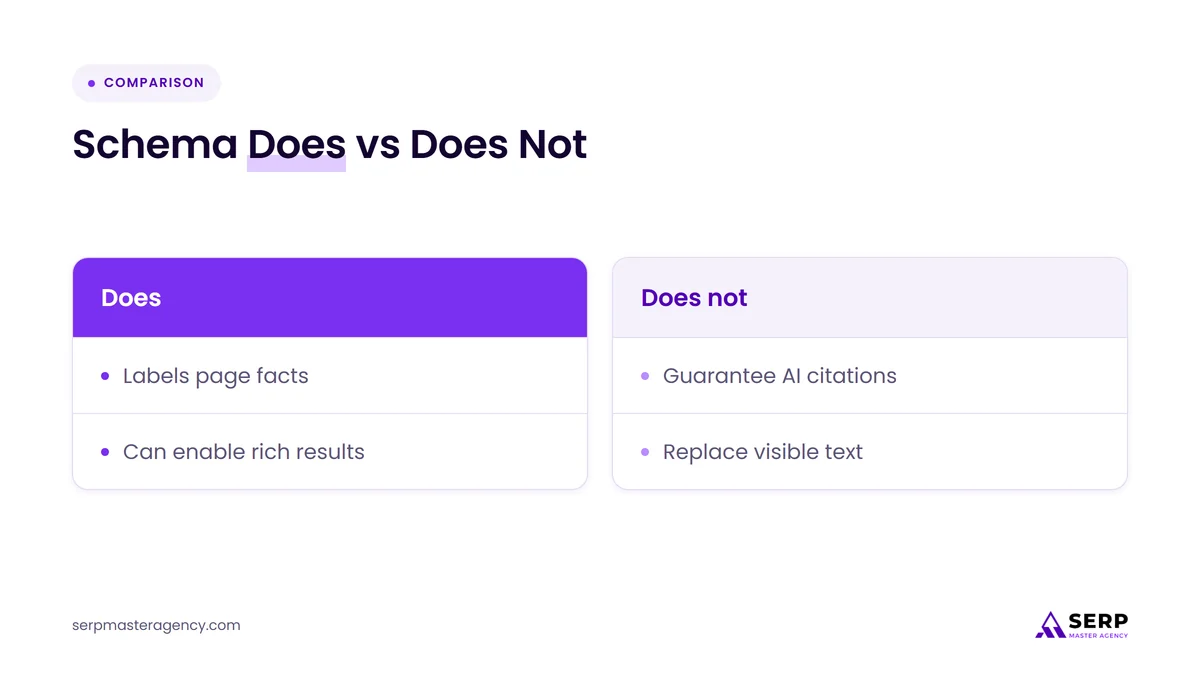
This table shows Google gives the same answer in every source: structured data is useful, but it is not a condition for AI features. The AI features page lists a page that is indexed and eligible to show a snippet as the only technical requirement, and it adds that meeting requirements does not guarantee Google will crawl, index or serve your content.
What do tests show about schema markup and AI citations?
Tests show no reliable citation lift from schema markup. Ahrefs, in a study published May 11, 2026, tracked 1,885 pages that added JSON-LD between August 2025 and March 2026 and compared them with matched control pages over 30 days, across Google AI Overviews, Google AI Mode and ChatGPT.
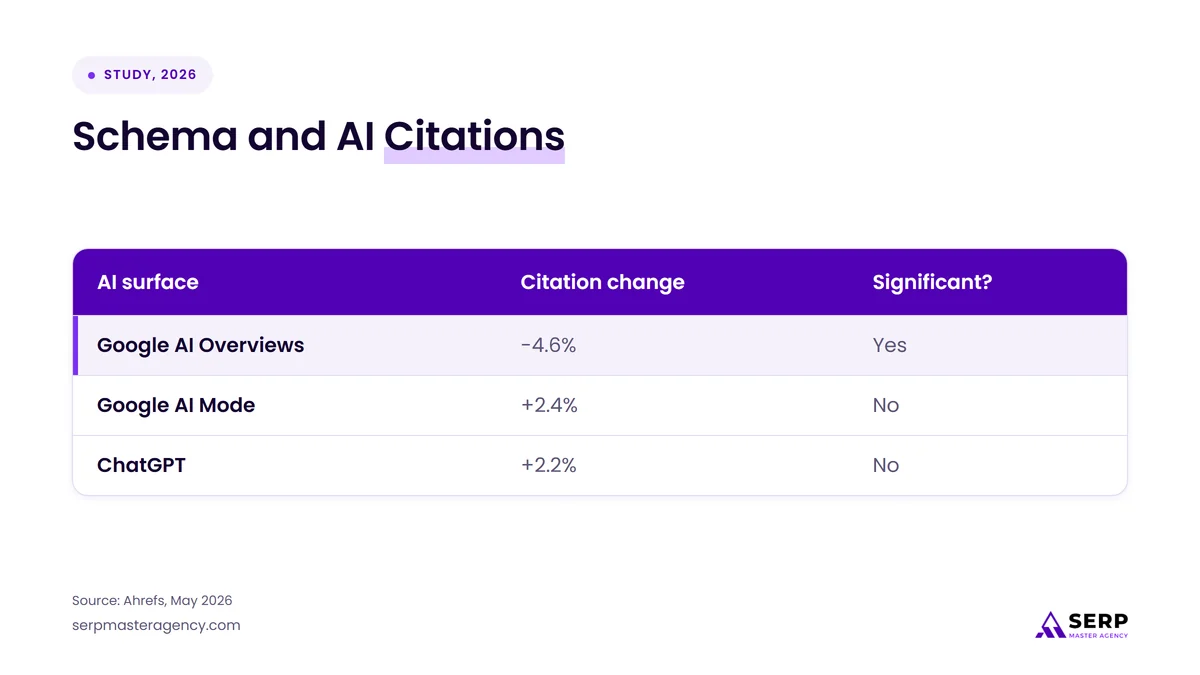
| AI surface | Citation change | Significant? |
|---|---|---|
| Google AI Overviews | -4.6% | Yes |
| Google AI Mode | +2.4% | No |
| ChatGPT | +2.2% | No |
The table shows that adding schema markup did not raise AI citations on any of the 3 surfaces. Search Engine Journal reported the same figures on May 16, 2026. Ahrefs said it could not confidently attribute the AI Overviews decline to schema, which averaged about 12 fewer daily citations per page.
The study has limits. Every page already had 100 or more AI Overviews citations in February 2025, so it cannot show whether schema helps pages that AI tools do not yet cite. Ahrefs also found that 53% of AI-cited pages had JSON-LD and that cited pages were almost 3 times more likely to have it, which it reads as a sign of overall site quality, not proof that schema causes citations.
Search Engine Roundtable reported on September 15, 2025 on 2 separate tests shared on LinkedIn by Mark Williams-Cook and Julio C. Guevara. In Guevara’s test, only the page with visible text returned the correct price, colors and SKU numbers when Gemini and ChatGPT were asked hundreds of times, while the page with only structured data did not.
What does schema markup still do for your business?
Schema markup still helps Google understand your pages and can make them eligible for rich results, which are enhanced listings in Google Search. Google Search Central says structured data helps it understand page content and gather information about companies and other entities, but it does not guarantee that any feature will show.
For a service business, the most relevant type is LocalBusiness. Google’s LocalBusiness documentation lists 2 required properties, name and address, and 10 recommended properties, including telephone, url, geo and openingHoursSpecification. It says results may show a knowledge panel with business details, and that features using structured data are not guaranteed to appear. Keep the markup consistent with your Google Business Profile, because Google lists up-to-date Business Profile information among its best practices for AI features. Our local SEO services cover that profile work.
How do you add schema markup without breaking Google’s rules?
You add schema markup safely by describing only content that visitors can see, using JSON-LD, filling every required property and testing the page before you publish. Google’s structured data policies say not to mark up content that is not visible to readers, and violations can lead to a manual action that removes rich result eligibility.
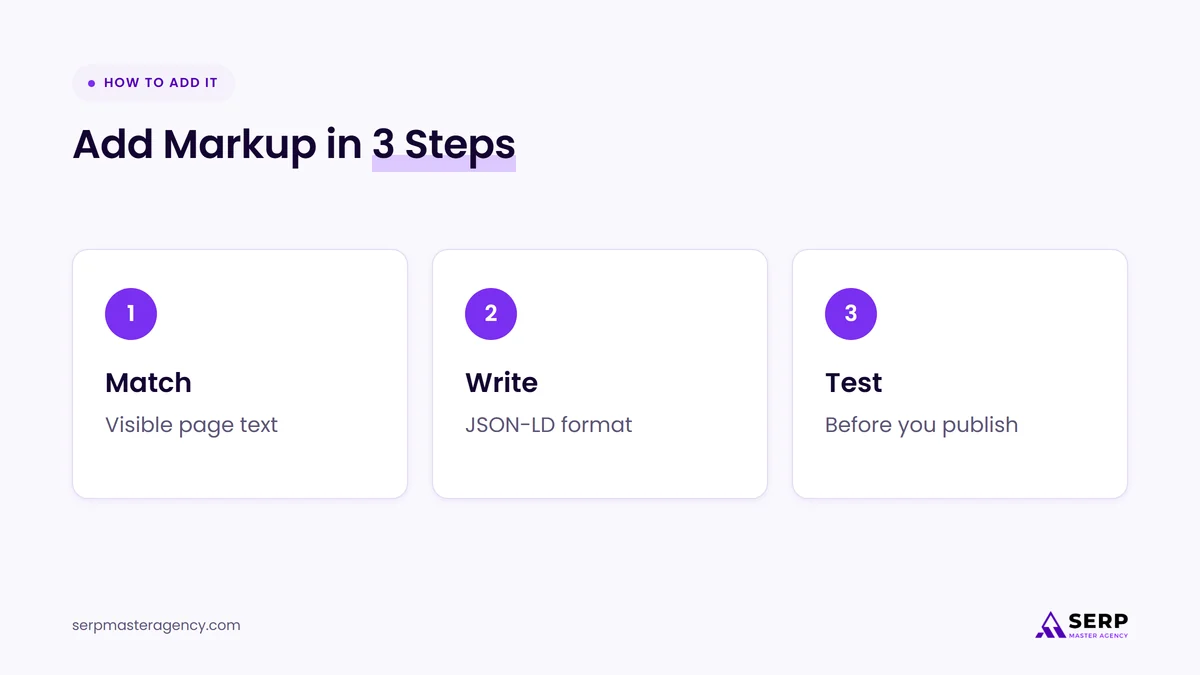
The 5 steps to add schema markup are listed below, in the order to follow.
- Choose the schema markup type that matches the page, such as LocalBusiness for your business details or Article for a blog post.
- Write the structured data in JSON-LD, which is the format Google recommends.
- Fill every required property and use the same name, address, phone and hours that visitors read on the page.
- Keep the page open to Googlebot, with no robots.txt block or noindex tag on it.
- Test the markup with Google’s Rich Results Test, then check the page in Google Search Console after it is live.
If you would rather hand this to a specialist, our schema markup setup service covers the types above for your key pages.
What should you fix before schema markup if AI Overviews skip your business?
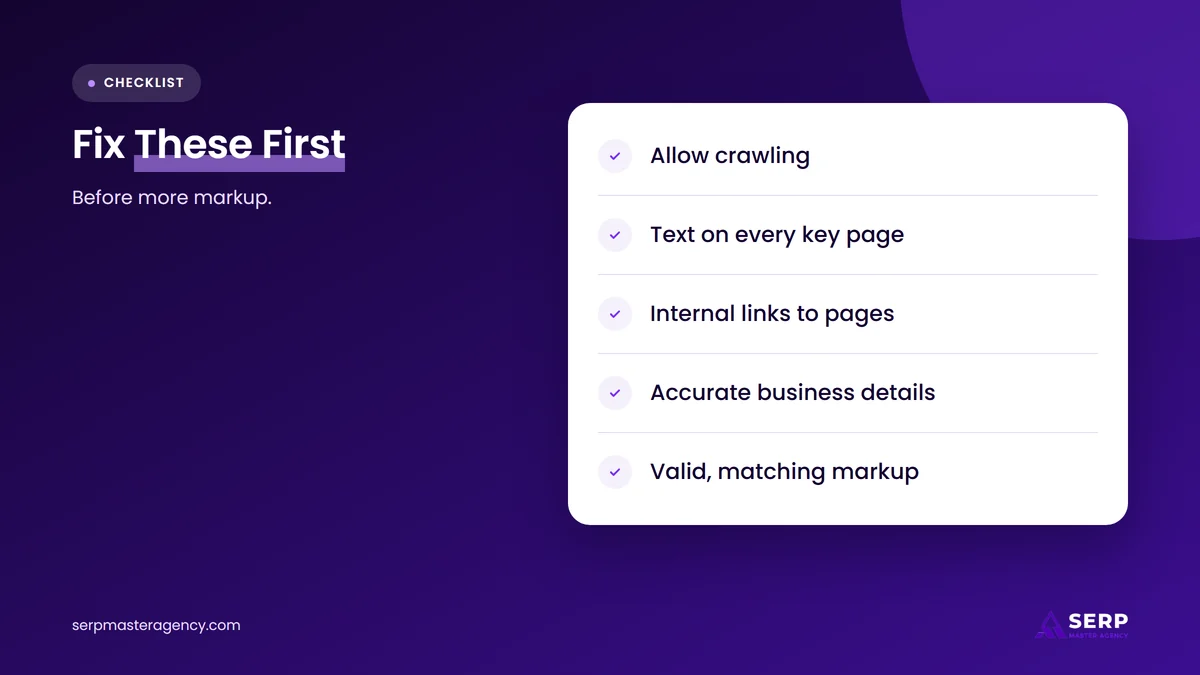
If AI Overviews skip your business, fix the basics Google lists for AI features first: allow crawling, make important content available as text, link to pages internally and keep your business details accurate. Google’s page treats these as ordinary SEO fundamentals, and they apply before any markup does.
Start with crawl access. Our guide on which AI crawlers to allow in robots.txt covers the blocking mistakes that keep pages out of AI answers. Then look at the page itself: how AI Overviews choose which businesses to cite explains what Google looks for in the pages it links. For the bigger picture, read SEO vs AEO vs GEO: which does your business need.
Frequently asked questions
Do I need schema markup for AI Overviews?
No, you do not need schema markup for AI Overviews. Google Search Central says there is no special schema.org structured data you need to add to appear in AI Overviews or AI Mode. Your page must be indexed and eligible to show a snippet. Add schema markup if it describes your visible content accurately.
Does schema markup hurt my chances in AI Overviews?
No, correct schema markup is not known to hurt your chances in AI Overviews. Ahrefs found a 4.6% citation decline for pages that added schema, but it said it could not confidently attribute that to schema, and both page groups were already declining. Wrong or hidden markup can break Google’s policies, so keep it accurate.
Which schema markup type should a local service business add?
A local service business should add LocalBusiness schema markup to its main business pages. Google documents 2 required properties, name and address, and recommends telephone, url, geo and opening hours among 10 others. Every value must match the text on the page and your Google Business Profile.
Can schema markup get my business into ChatGPT or Perplexity answers?
No evidence shows that schema markup gets a business into ChatGPT or Perplexity answers. Ahrefs measured a +2.2% change in ChatGPT citations that was not statistically significant. Other factors, such as clear page content and crawl access, are the better first step for your business.
Can anyone guarantee that schema markup will improve my AI visibility?
No, no one can guarantee that schema markup will improve your AI visibility. Google says valid markup does not guarantee a rich result, and its AI features page says meeting every requirement does not guarantee your content is crawled, indexed or served. You can make your markup accurate, not promise an outcome.
Add schema markup for accuracy, then fix what AI Overviews actually need
Schema markup does not decide whether your business appears in AI Overviews. Google says no special markup is needed, and the Ahrefs test of 1,885 pages found no meaningful citation lift. Add accurate JSON-LD for your business details and articles, keep it matched to your visible text, and spend the rest of your effort on crawl access, clear answers and consistent business details.
That is the order we work in at SERP Master Agency, through our SEO services for businesses in the US, UK, Canada, Australia and New Zealand.
Find out what is holding your business back in AI answers
Book a free consultation. We review how your business appears in Google and in AI answers today, whether your markup and pages are in good shape, and what to fix first. You leave with a clear next step and no obligation.
Sources
- Google Search Central, “AI features and your website”, accessed November 21, 2026. https://developers.google.com/search/docs/appearance/ai-features
- Google Search Central Blog, “Top ways to ensure your content performs well in Google’s AI experiences on Search” (John Mueller), May 21, 2025. https://developers.google.com/search/blog/2025/05/succeeding-in-ai-search
- Google Search Central, “Intro to how structured data markup works”, accessed November 21, 2026. https://developers.google.com/search/docs/appearance/structured-data/intro-structured-data
- Google Search Central, “Local business structured data”, accessed November 21, 2026. https://developers.google.com/search/docs/appearance/structured-data/local-business
- Google Search Central, “General structured data guidelines”, accessed November 21, 2026. https://developers.google.com/search/docs/appearance/structured-data/sd-policies
- Ahrefs, “Does schema markup help AI citations?” (Louise Linehan), May 11, 2026. https://ahrefs.com/blog/schema-ai-citations/
- Search Engine Journal, “Schema Markup Didn’t Move AI Citations In Ahrefs Test” (Matt G. Southern), May 16, 2026. https://www.searchenginejournal.com/schema-markup-didnt-move-ai-citations-ahrefs-test/574568/
- Search Engine Roundtable, “Structured Data Does Not Help With Visibility In AI Search” (Barry Schwartz), September 15, 2025. https://www.seroundtable.com/structured-data-schema-ai-search-visibility-40099.html

Suraj Rana is the founder of SERP Master Agency and Dental Master Media, based in Chandigarh, India. He has worked in SEO for over 9 years, helping local businesses, clinics, ecommerce stores and marketing agencies win more calls, leads and sales from Google and AI search. His team delivers SEO services, Google Business Profile optimisation, paid ads and white-label SEO for agencies. Every SERP Master guide is written to give business owners a plain-English answer: what to fix first, what it costs and what results to expect.